
Introduction The cause of civil rights, established with the signing of the Declaration of Independence and through the Industrial Revolution, moved at a slow pace. As the issue of slavery and whether the U.S. government would allow it in the border states heated up, the progression of civil rights for all its citizens began to take center stage in the American theater. Civil War era The issue of slavery created a deeper division between north and south in the mid-1800s. From that division, the next wave of civil rights for minorities sprang. Slavery. The vast majority of Southerners could not afford a slave prior to the Civil War. Poor Southerners ran into direct competition with cheaper slave labor for jobs. Many small farmers moved west in an attempt to create better opportunities for themselves. Wealthy property owners knew that the large plantation system would wither and die without slavery and therefore were more inclined to support its continued existence. According to plantation owners, slavery was justified since the economy of the North and South were dependent on it, with 60 percent of the nation’s exports arising from cotton grown in the South. Another justification was that slaves were better off than Northern factory workers in terms of working and living conditions. Slavery was also vitally important to the maintenance of the genteel and gracious Southern lifestyle. Rare were the Southern voices expressing a negative view of the impact of slavery upon local workers. The situation was not without a parallel in the North. There, the largest portion of the population was composed of farmers and trades people, few of whom had any direct exposure to slavery. Their root concern was economic, not moral. They did not want to compete against slave labor and were against the new western lands being committed to giant plantations. The Northern workers were willing to tolerate slavery as it existed in the Southern states, but opposed its spread into the territories. The Northern abolitionists, however, opposed the spread of slavery into the territories and also wanted to abolish its existence in the Southern states. If the destruction of slavery meant the end of the plantation system and resulting economic turmoil, then so be it. Although the abolitionists were in the minority of Northern opinion, they were nevertheless persistent and vocal, fired up by their certainty that slavery was immoral. Those views were expressed by such prominent figures as William Lloyd Garrison, Henry Ward Beecher and the zealot John Brown. Political support came from the likes of Charles Sumner and Salmon P. Chase. Therefore by the 1850s, two separate cultures had developed, which fueled the fire of secession. Emancipation Proclamation. President Abraham Lincoln’s Emancipation Proclamation on January 1, 1863 freed slaves in states still fighting the Civil War but it was not until the 13th Amendment to the Constitution that slavery was abolished throughout the United States. It was not until the 14th Amendment was ratified that formerly enslaved citizens were granted “equal protection” under Federal law. When the 15th Amendment was ratified, U.S. citizens could no longer be deprived of the right to vote based on race or gender, but it was not until 1920, when the 19th Amendment was ratified by the states, that women were allowed to vote. Even though the Emancipation Proclamation had signaled freedom for the American black population during the war, blacks were not allowed to play in the newly formed National Association of Base Ball Players. It was not until 1920, when the Negro National League was born in Kansas City, Missouri, that blacks began to receive public attention. Such great American baseball players as Willie Mays, Jackie Robinson, Hank Aaron and Leroy "Satchell" Page got their start in the Negro Leagues. It was not until Jackie Robinson broke the color barrier of the Major Leagues in 1947 that black baseball players begin to be recognized for their talents. Even though Robinson, and the many others who followed him, made it onto Major League rosters in 1947, segregation persisted for many years with black players lodged in different hotels and receiving lower rates of pay. Black players endured such hostility as hate mail, bomb threats, and murder attempts. In 1863, future leaders of the suffragist movement gathered 300,000 signatures on a petition that demanded the end of slavery by constitutional amendment. The Women’s Loyal National League, under the direction of Elizabeth Cady Stanton and Susan B. Anthony, submitted the petition to the U.S. Senate. They would return to the Senate years later demanding the right to vote for women. Turn of the last century The periods of Reconstruction and the turning of the 19th century, brought with them the issues of women’s rights and integration of blacks into mainstream society.
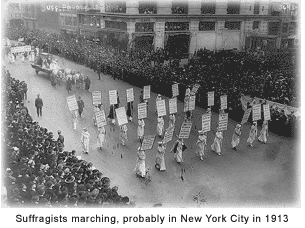 Women’s suffrage. As more and more women began to graduate from college, the issue of a woman’s role in society began to surface in the mid-1800s. When female delegates to the World’s Anti-Slavery Convention in London were not allowed to participate in 1840, Lucretia Mott and Elizabeth Cady Stanton vowed to have a women’s rights convention when they returned home, but it was not until 1848 that the first women’s rights convention took place at the Wesleyan Chapel in Seneca Falls, New York. During that same year, the New York State legislature passed a law giving women the right to retain property they owned prior to their marriage.
When the 14th Amendment was ratified in 1868 granting suffrage to former male black slaves, Anthony and Stanton were outraged because it explicitly restricted voting rights to “males.” Until the U.S. Supreme Court’s decision on the Minor v. Happersett case ruled that a woman’s right to vote and other political rights came under the jurisdiction of each individual state, only the Wyoming and Utah territories had granted suffrage to women. Then by 1900, Utah, Colorado, and Idaho had granted women full suffrage. After another 20 years, American women received full suffrage in each of the states when the Nineteenth Amendment was ratified.
Jim Crow codes. Beginning in the 1880s, Jim Crow codes saw wide usage that sanctioned the physical separation of black people from whites. Jim Crow laws in various states required the segregation of races in such common areas as restaurants and theaters. "Jim Crow" originally referred to a black character in an old song, and was the name of a popular dance in the 1820s. The "separate but equal" standard established by the Supreme Court in Plessy v. Ferguson (1896) lent high judicial support for segregation.
Even though blacks were given the right to vote in 1870 when the 15th Amendment was ratified, by the 1890s, blacks were restricted from voting due to such stumbling blocks as poll taxes, which would-be black voters had to pay prior to their cast, and by tests given by voting registrars with the power to pass or fail those based on their race. When these methods were not sufficient, white mob rule, such as the Wilmington riot of 1898, made it clear to blacks that they were not full citizens in the South.
Chinese immigration. From the Gold Rush through the 1870s, a large migration of mostly single male laborers came to San Francisco and the American West due to hardships brought on by flooding in China. In response to complaints from Californians who resented the competition from a cheap labor pool or who were purely racist, the Chinese Exclusion Act of 1882 was passed by Congress. A sharp departure from America`s traditional open immigration policy, the act was the nation`s first racially restrictive immigration measure. As a result, the Chinese American population fell from 26,000 in 1881 to 11,000 in 1920. Chinese Americans were mostly segregated into such areas as San Francisco`s Chinatown until the late 1940s. It was not until China became an ally of the U.S., during World War II, that the Chinese Exclusion Act was repealed. Immigration continued at a snail`s pace for many years. During the Cold War years, tensions between the two countries often reached a fever pitch. Containing the world`s largest population, China has only recently received "most favored nation" status from the United States.
NAACP. First organized by a group of bi-racial activists in 1909, the National Association for the Advancement of Colored People (NAACP) is America’s oldest civil rights organization. In direct opposition to Booker T. Washington’s belief that blacks ought to accept segregation, it initially sought to educate whites of the need for racial equality. To that aim, it launched the Crisis, a magazine edited for 25 years by the black intellectual and leader, W.E.B. DuBois. After the U.S. Supreme Court handed down its “separate but equal ruling,” the NAACP worked to show that separate facilities, provided to black students, were not equal to those for whites. One study in 1937 revealed that school spending on pupils in the South was $37.87 per white pupil, compared to $13.08 per black pupil. They launched five desegregation lawsuits in different states.
The NAACP also worked diligently for anti-lynching laws. A resurgence of the Ku Klux Klan in the mid-1920s resulted in an increase in public whippings, tarring and feathering, and lynching in many parts of the country. In a 1934 meeting between President Franklin D. Roosevelt and NAACP leader Walter White that was orchestrated by First Lady Eleanor Roosevelt, the important issue of anti-lynching legislation was discussed.
While some progress was made, it was difficult to look at the racial situation in America before World War II and be optimistic. Franz Boas, an anthropologist who was among the first to discredit the concept of race as means of classifying humans, commented in 1921:
Women’s suffrage. As more and more women began to graduate from college, the issue of a woman’s role in society began to surface in the mid-1800s. When female delegates to the World’s Anti-Slavery Convention in London were not allowed to participate in 1840, Lucretia Mott and Elizabeth Cady Stanton vowed to have a women’s rights convention when they returned home, but it was not until 1848 that the first women’s rights convention took place at the Wesleyan Chapel in Seneca Falls, New York. During that same year, the New York State legislature passed a law giving women the right to retain property they owned prior to their marriage.
When the 14th Amendment was ratified in 1868 granting suffrage to former male black slaves, Anthony and Stanton were outraged because it explicitly restricted voting rights to “males.” Until the U.S. Supreme Court’s decision on the Minor v. Happersett case ruled that a woman’s right to vote and other political rights came under the jurisdiction of each individual state, only the Wyoming and Utah territories had granted suffrage to women. Then by 1900, Utah, Colorado, and Idaho had granted women full suffrage. After another 20 years, American women received full suffrage in each of the states when the Nineteenth Amendment was ratified.
Jim Crow codes. Beginning in the 1880s, Jim Crow codes saw wide usage that sanctioned the physical separation of black people from whites. Jim Crow laws in various states required the segregation of races in such common areas as restaurants and theaters. "Jim Crow" originally referred to a black character in an old song, and was the name of a popular dance in the 1820s. The "separate but equal" standard established by the Supreme Court in Plessy v. Ferguson (1896) lent high judicial support for segregation.
Even though blacks were given the right to vote in 1870 when the 15th Amendment was ratified, by the 1890s, blacks were restricted from voting due to such stumbling blocks as poll taxes, which would-be black voters had to pay prior to their cast, and by tests given by voting registrars with the power to pass or fail those based on their race. When these methods were not sufficient, white mob rule, such as the Wilmington riot of 1898, made it clear to blacks that they were not full citizens in the South.
Chinese immigration. From the Gold Rush through the 1870s, a large migration of mostly single male laborers came to San Francisco and the American West due to hardships brought on by flooding in China. In response to complaints from Californians who resented the competition from a cheap labor pool or who were purely racist, the Chinese Exclusion Act of 1882 was passed by Congress. A sharp departure from America`s traditional open immigration policy, the act was the nation`s first racially restrictive immigration measure. As a result, the Chinese American population fell from 26,000 in 1881 to 11,000 in 1920. Chinese Americans were mostly segregated into such areas as San Francisco`s Chinatown until the late 1940s. It was not until China became an ally of the U.S., during World War II, that the Chinese Exclusion Act was repealed. Immigration continued at a snail`s pace for many years. During the Cold War years, tensions between the two countries often reached a fever pitch. Containing the world`s largest population, China has only recently received "most favored nation" status from the United States.
NAACP. First organized by a group of bi-racial activists in 1909, the National Association for the Advancement of Colored People (NAACP) is America’s oldest civil rights organization. In direct opposition to Booker T. Washington’s belief that blacks ought to accept segregation, it initially sought to educate whites of the need for racial equality. To that aim, it launched the Crisis, a magazine edited for 25 years by the black intellectual and leader, W.E.B. DuBois. After the U.S. Supreme Court handed down its “separate but equal ruling,” the NAACP worked to show that separate facilities, provided to black students, were not equal to those for whites. One study in 1937 revealed that school spending on pupils in the South was $37.87 per white pupil, compared to $13.08 per black pupil. They launched five desegregation lawsuits in different states.
The NAACP also worked diligently for anti-lynching laws. A resurgence of the Ku Klux Klan in the mid-1920s resulted in an increase in public whippings, tarring and feathering, and lynching in many parts of the country. In a 1934 meeting between President Franklin D. Roosevelt and NAACP leader Walter White that was orchestrated by First Lady Eleanor Roosevelt, the important issue of anti-lynching legislation was discussed.
While some progress was made, it was difficult to look at the racial situation in America before World War II and be optimistic. Franz Boas, an anthropologist who was among the first to discredit the concept of race as means of classifying humans, commented in 1921:
For this reason, there is no great hope that the Negro problem will find even a half-way satisfactory solution in our day. We may, perhaps, expect that an increasing number of strong minds will free themselves from race prejudice and see in every person a man entitled to be judged on his merits. The weak-minded will not follow their example.