
Abraham Lincoln was born in a log cabin in rural Hardin (now Larue) County, Kentucky, the son of an illiterate carpenter and farmer. Young Lincoln received little formal schooling and was largely self-taught. The family moved to Indiana and later to Illinois.
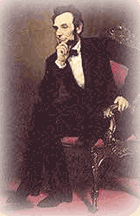 In 1831, Abe Lincoln moved to New Salem, Illinois, near Springfield. He held various jobs there, including storekeeper and mill operator. In 1832, he led a militia contingent in the Black Hawk War, but saw no action. Back in New Salem, Lincoln failed in the grocery business, incurring a heavy debt. He worked as a surveyor and rail-splitter and began the study of law.
Beginning his political career as a Whig, Lincoln was elected to the first of four terms in the Illinois legislature in 1834. Two years later, he was admitted to the bar and subsequently embarked upon several law partnership ventures, the most notable being that with William Herndon, later a Lincoln biographer. He became aligned with the Whig Party and developed a reputation as a skillful attorney. In 1842, he married Mary Todd, the daughter of a socially prominent Lexington family.
Abraham Lincoln was elected to Congress in 1847, but quickly got on the wrong side of the voters by opposing the Mexican War and doubting President Polk’s assertion that the Mexicans had fired the first shot. He provided active support for Zachary Taylor in the Election of 1848, but was disappointed when he did not receive a political appointment from the victor.
Lincoln’s law practice prospered in the early 1850s, but he reentered the political realm after the passage of the Kansas-Nebraska Act in 1854. His criticism of Stephen A. Douglas led him back into the political area; Lincoln was elected to the state legislature, but declined in order to pursue an unsuccessful senatorial bid in 1856.
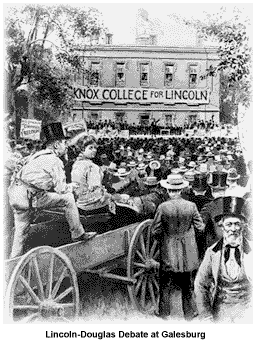 That year, Lincoln left the Whigs for the new Republican Party and quickly rose in influence, receiving consideration for a vice presidential nomination that year. In the following year, the Dred Scott decision dealt a blow to Republican hopes to contain slavery. In a speech in Springfield on June 26, 1857, Lincoln expressed Republican at the position taken by Douglas that lawabiding citizens should respect this decision of the Supreme Court:
If this important decision had been made by the unanimous concurrence of the judges, and without any apparent partisan bias, and in accordance with legal public expectation and with the steady practice of the departments throughout our history, and had been in no part based on assumed historical facts which are not really true; or, if wanting in some of these, it had been before the court more than once, and had there been affirmed and reaffirmed through a course of years, it then might be, perhaps would be, factious, nay, even revolutionary, not to acquiesce in it as a precedent.In 1858, Lincoln was the Republican Party choice for the Senate seat then held by the Democrat Douglas. The two engaged in a series of exchanges, the Lincoln-Douglas Debates, in which Lincoln spelled out his views on the most contentious issue of the day. He regarded slavery as a moral wrong that should not be extended to the territories; however, Lincoln did not advocate the abolition of the institution in the states where it already existed, nor did he believe in the equality of the races. Douglas regained his seat, but Lincoln emerged as a national figure and a leading candidate for the Election of 1860.But when, as is true, we find it wanting in all these claims to the public confidence, it is not resistance, it is not factious, it is not even disrespectful, to treat it as not having yet quite established a settled doctrine for the country.
Abraham Lincoln did much to enhance his chances for the Republican nomination with a speech he delivered at Cooper Union in New York City, February 1860. He offered an alternative to the unflinching abolitionism of William H. Seward and talked of conciliation efforts with the South.
The 1860 Republican convention was held in Chicago in mid-May. The Democrats had been forced to suspend their nominating process, begun in Charleston, without a candidate and had not yet reconvened in Baltimore. Seward led on the first ballot, but was overtaken by Lincoln, who wonon the convention`s third ballot, due largely to skillful campaign management and widely held fears about Seward`s radical views. The splintering of the Democratic Party assured Lincoln’s victory.
As the inauguration approached, Lincoln entered Washington at midnight and in disguise, prompting charges of cowardice from his critics. By the time he took office, seven states had seceded. The President’s stated aim was to preserve the Union, but he made the critical decision to send supplies to Fort Sumter, a move regarded by the South as an act of war. The first shots of the Civil War were fired on April 12, 1861.
Lincoln took immediate military action, summoning the state militias to federal service, calling for volunteers and suspending habeas corpus in critical areas.
As president, Abraham Lincoln differed markedly from his counterpart, Jefferson Davis. Lincoln placed ability before compatibility, appointing his rival Seward as secretary of state, the outspoken abolitionist Salmon P. Chase as treasury secretary, the Democrat Edwin Stanton as war secretary. As a military leader, he got off to a poor start. Federal soldiers were not prepared for the initial push to Richmond, which resulted in a crushing defeat. Conditions were worsened by his selection of ineffective military commanders. The news from the battlefront continued to be discouraging until the battle of Antietam (September 1862). In early 1863, Lincoln issued the Emancipation Proclamation, a move fostered by a combination of moral, political and diplomatic concerns. Military leadership continued to be a nagging problem until Lincoln gave the command to Ulysses S. Grant, the hero of Vicksburg.
Abraham Lincoln, despite his total lack of travel abroad, established a competent record in foreign affairs. He generally deferred to Secretary of State Seward, but intervened at opportune times.
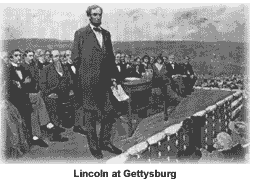 Abraham Lincoln is regarded by most authorities as America’s greatest president, despite the fact that many others in that office had superior education and experience. His greatest contribution lay in preserving the Union. Perhaps the most eloquent expression of his conviction regarding this was his address given on November 19, 1863 at the Gettysburg battlefield, where many thousands of Union and Confederate soldiers had lost their lives.
His absolute conviction that he was taking the proper course of action enabled him to persevere while others recoiled at the immense cost and suffering caused by the war, leading them to entertain thoughts of peace without victory. Lincoln had little military experience, but was forced to develop such skills because his early generals repeatedly proved to be inept.
Abraham Lincoln was not a highly experienced national politician in 1860, but his humor and willingness not to address every criticism earned him the trust of many political leaders. In an age of overblown oratory, Lincoln made his points with simple eloquence.
Lincoln was widely criticized for his suspension of habeas corpus, but he was acting in accord with his vision of what the presidency should be like during wartime. His view of an expanded executive was eclipsed in the post-war years, but would revive under Theodore Roosevelt.
On April 14, 1865, Abraham Lincoln was assassinated by a Southern sympathizer, John Wilkes Booth.