
Women`s suffrage may be defined as women`s right to vote in political circumstances.
Backdrop to a drama
"In the new code of laws which I suppose it will be necessary for you to make I desire you would remember the ladies and be more generous and favorable to them than your ancestors." Abigail Adams in a letter to her husband, March 31, 1776.
Treated as chattel in patriarchal societies from time immemorial, women nonetheless helped well beyond childbearing and menial labor to make those cultures flourish. They often exerted unofficial influence over their menfolk and occasionally were monarchs.
In emerging democracies, women had no voting rights, but many in congenial circumstances enjoyed social and family connections that accorded them more influence than some men who had the franchise.
In America, women worked shoulder to shoulder with men to build the country. Many were influential, such as Lady Deborah Moody (1586-1659) a respected community leader who brought settlers seeking religious freedom to Gravesend at New Amsterdam (later New York); Pocahontas (1595-1617), who purportedly saved the life of Captain John Smith at the hands of her father, Chief Powhatan, later married John Rolfe and met royalty in England; and Abigail Adams (1744-1818), who wrote lucidly about her life and time in letters, and exerted political influence over her president husband, John, and son, John Quincy.
During colonial times, some women paid taxes and were thus able to vote—except in New York and Virginia. The Revolutionary War was a period of progressive thinking about women`s rights, but the Continental Congress left the question of the vote to the states. The New Jersey Constitution accorded the vote to women, but in 1807 it was rescinded.
Conditions in the 1830s provoked women to press for suffrage; they were increasingly in the factory labor force, but were not treated equally. Progressive men who struggled for such causes as temperance, abolition and educational reform realized they needed women`s support. Suffragists were usually advocates of such change. In return, they were accorded more of a voice in public matters.
A prairie fire
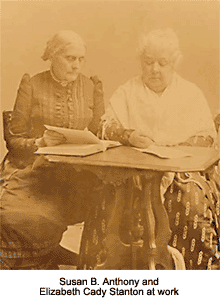 In 1840, the World Anti-Slavery Convention in London may have been the spark of a blaze, when two American delegates, Elizabeth Cady Stanton and Lucretia Mott, were refused permission to speak. Stanton said later, "We resolved to hold a convention as soon as we returned home, and form a society to advocate the rights of women." Eight years later, Stanton and Mott organized the first women`s suffrage convention in the United States at Seneca Falls, New York; the proceedings provoked much public discussion. The meeting`s Declaration of Sentiments, modeled on the Declaration of Independence, spelled out many demands for equality.
That declaration spread the fire of a revolution that would reach every facet of society. With reason, women regarded themselves as second-class citizens; in addition to not having the vote, they had few property rights, faced educational and employment barriers, and had no legal protection in divorce and child custody cases. Women`s rights leaders were convinced that suffrage would be the most effective means to reconstruct this unfair social structure. In 1850, Lucy Stone organized the Women`s Rights Convention at Worcester, Massachusetts; its distinction lay in being a national assembly of women and men.
Although most men were deeply opposed to letting women vote, a few reformers, notably in Massachusetts, supported women on this issue. In 1853, the Massachusetts legislature received a petition, drafted by a group that included Wendell Phillips and William Lloyd Garrison, which began:
We deem the extension to woman of all civil rights a measure of vital importance to the welfare and progress of the state. On every principle of natural justice, as well as by the nature of our institutions, she is as fully entitled as man to vote and to be eligible to office. In governments based on force, it might be pretended with some plausibility that woman being supposed physically weaker than man should be excluded from the state. But ours is a government professedly resting on the consent of the governed. Woman is surely as competent to give that consent as man.
Susan B. Anthony and Stanton founded the National Woman Suffrage Association in May 1869. These women had reacted to the 15th Amendment, passed that year, which accorded emancipated black men the vote—but not women. The NWSA chose to agitate for another Constitutional amendment. A similar, but more moderate organization, the American Woman Suffrage Association, approached the state legislatures, rather than the federal government, to win women the vote.*
Victory
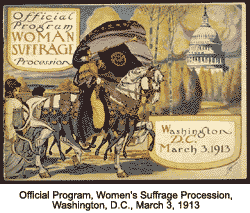 Resistance began to burn down when the territorial legislature of Wyoming granted women the vote in 1869; it was the first permanent suffrage law in U.S. history. By the 1890s, several states had granted suffrage. When by 1913 there were 12 states, the National Woman`s Party, led by Alice Paul, decided to harness the voting power of women in those states to push a suffrage resolution through Congress. They were part of a confederacy of suffragists, temperance groups, other women`s organizations and reform-prone lawmakers.
 When suffragettes were jailed for their protests, they embraced the fact. Doris Stevens, writing in 1917, explained the position:
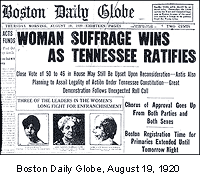
We decided, in the fact of extended imprisonment, to demand to be treated as political prisoners. We felt that, as a matter of principle, this was the dignified and self-respecting thing to do, since we had offended politically, not criminally. We believed further that a determined, organized effort to make clear to a wider public the political nature of the offense would intensify the administration`s embarrassment and so accelerate their final surrender.The country`s involvement in World War I required the support of women; this provided the suffragists their decisive fire power. When the U.S. entered the war in 1917, a woman suffrage amendment was submitted in the House of Representatives. By 1919, it had passed both houses of Congress and was soon ratified by the necessary 36 states. The 19th Amendment, also called the Susan B. Anthony Amendment, became law in August 1920.