
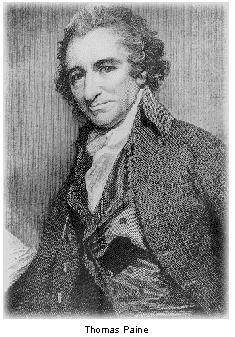
In early 1776, American public opinion was deeply divided over the issue of declaring independence from Britain. A discernible drift toward independence was occurring, but the publication of Thomas Paine’s Common Sense and news of King George III’s decision to hire foreign mercenary soldiers to fight in America radicalized the views of many.
 On May 10, the Continental Congress adopted a resolution that urged the states to form their own independent governments to replace the defunct royal governments. Despite this action, opinion remained divided over the wisdom of having Congress itself make a statement of independence.
On June 7, 1776, the Virginia delegate Richard Henry Lee, acting in accord with the instructions which the Virginia convention had given their delegation, brought three resolutions before the Congress:
The supporters of Lee`s resolutions, men such as John Adams, Lee, and Wythe, viewed the declaration as a simple recognition of fact. In their minds, King George had already created the rupture by essentially declaring war on the colonies. They considered an immediate declaration to be good policy, because delay risked seeing the military situation deteriorate, making the declaration less likely to succeed with the Continental powers. They doubted that the reluctance of the middle colonies would break the united front, and they hinted that the foot-draggers were hoping to position themselves in the rear so as to risk the least should the enterprise fail.
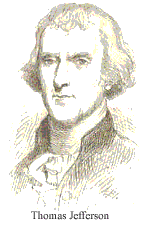
The resolutions appeared to enjoy strong support, but conservatives continued to hope for reconciliation and delayed action. Before a adjourning to July 1, committees were appointed to draft supporting statements. The independence issue was assigned to Robert Livingston of New York, Benjamin Franklin of Pennsylvania, Roger Sherman of Connecticut, John Adams of Massachusetts, and Thomas Jefferson of Virginia, the only Southerner.
 On Monday, July 1, the House returned to action as a committee of the whole and continued the debate. On a vote considering the original Virginia resolutions, nine colonies were in favor. South Carolina and Pennsylvania voted against, New York abstained, declaring that they lacked instructions to allow them to vote in favor, and Delaware`s two attending delegates split.
On July 2, 12 of the colonies voted in favor of Lee’s first resolution; only the New York delegation 1 again abstained, since it had not received instructions from home. From this portion of a letter from John Adams to his wife on July 3, it is evident that he thought the date of the adoption, July 2, would be the most celebrated:
The second day of July, 1776, will be memorable epoch in the history of America. I am apt to believe that it will be celebrated by succeeding generations, as the great Anniversary Festival. It ought to be commemorated, as the day of deliverance by solemn acts of devotion to God Almighty. It ought to be solemnized with pomp, shews, games, sports, guns, bells, bonfires and illuminations, from one end of the continent to the other, from this time forward forever. You will think me transported with enthusiasm; but I am not. I am well aware of the toil, and blood, and treasure, that it will cost us to maintain this declaration, and support and defend these states. Yet, through all the gloom, I can see the rays of light and glory; I can see that the end is more than worth all the means, and that posterity will triumph, although you and I may rue, which I hope we shall not.Two days later, July 4, the Congress approved the final version of the declaration presented by the committee. It was signed by John Hancock, president of the Congress, and Charles Thomson, the secretary.
The Declaration of Independence was largely the work of Thomas Jefferson, who at the time was more concerned about his wife`s failing health and about drafting a new constitution for Virginia. Nevertheless, the final product contained only a few significant changes from Jefferson`s draft. The original draft contained a condemnation of the British slave trade, but that provision was stricken at the insistence of pro-slavery delegates. Also absent in the final version was a denunciation of the British people, rather than the government.
The Declaration (see text) is composed of several parts:
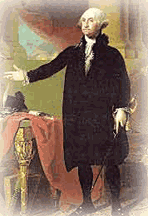 On July 5, Hancock sent copies of the document to the states. The first public reading of the Declaration took place on July 8 before a huge throng in Philadelphia. George Washington ordered that the document be read to the assembled Continental Army on July 9.
The formal signing on engrossed2 parchment was accomplished by 50 delegates on August 2, 1776. One delegate signed later that month, three others in September, one in November and Thomas McKean of Delaware, not until 1781. Notable non-signers were John Dickinson, who did not sign as a matter of principle, and Robert Livingston, who had been recalled by his state before he had the chance to sign it.
On July 5, Hancock sent copies of the document to the states. The first public reading of the Declaration took place on July 8 before a huge throng in Philadelphia. George Washington ordered that the document be read to the assembled Continental Army on July 9.
The formal signing on engrossed2 parchment was accomplished by 50 delegates on August 2, 1776. One delegate signed later that month, three others in September, one in November and Thomas McKean of Delaware, not until 1781. Notable non-signers were John Dickinson, who did not sign as a matter of principle, and Robert Livingston, who had been recalled by his state before he had the chance to sign it.In 1924, Louis Marshall, chairman of the American Jewish Relief Committee, wrote President Coolidge, urging him not to sign the National Origins bill which would restrict immigration from many non-WASP European countries and essentially eliminate it from Japan. He said:
... and one of the projectors of this bill has declared it to be a new Declaration of Independence, forgetting that the old Declaration, in reciting the injuries and usurpations of the British monarch, charged: "He has endeavored to prevent the population of these States, for thsy purpose obstructing the laws of naturalization of foreigners; refusing to pass others to encourage their migrations hither, and raising the conditions of new appropriations of lands." Let us not forget that what has made ours a noble nation has been the fact that we have received the oppressed and have admitted to our shores men and women who were worthy of sharing the opportunities afforded by our tremendous national resources, which, to an extraordinary extent, still clamor for development.
2. Engrossing is the process of having a legal document written in large, distinct letters. It appears that Timothy Matlack of Pennsylvania, who had performed this service earlier for the Congress, prepared formal engrossed versions of the Declaration.
See timeline of the American Revolution.