Share Would you like more applicants for your scholarships?
Spread the Word on U-S-History for free.
Emancipation Proclamation
Civil War
Early in the war President Lincoln was careful to stress he was fighting to preserve the Union, not for the abolition of slavery. On two occasions he overruled military commanders who had abolished slavery in areas they controlled. He treaded with great care on the matter because of the importance of preserving the loyalty of the slave-owning Border States.
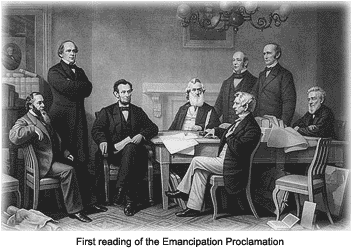
In early 1862, Lincoln worked on the idea of emancipation secretly before broaching the subject with his cabinet. He was cautioned by Secretary of State William H. Seward to delay any announcement until the Union’s military fortunes improved, fearing that proclaiming freedom for the slaves might appear to be a move of desperation.
In September 1862, shortly after the Battle of Antietam, Lincoln issued a preliminary emancipation proclamation. As of January 1, 1863, all slaves were to be freed in those areas still in rebellion against the federal government. He repeated his oft-stated positions that he was dedicated to restoring the Union and not ending slavery entirely, and that he supported the concept of compensated emancipation.
Criticized by some for not abolishing slavery everywhere, Lincoln argued that he did not have the power to do so; only Congress and the Border States had that authority.
Reaction in the South was predictable. Many claimed that they had known all along that Lincoln was an abolitionist. Others feared that the Proclamation would touch off a series of slave rebellions.
By issuing the Proclamation, Lincoln addressed several issues:
Military: Lincoln claimed that the Proclamation was a military necessity, that it was a prime means of undermining the Confederacy by seizing enemy property
Foreign Affairs: England and France had long been flirting with the idea of recognizing the Confederacy, but the Proclamation ended any inclination to do so; the South had seriously misjudged the importance of cotton to Europe.
On the other hand, certain risks were involved. Lincoln was certain to be criticized by the Peace Democrats who wanted an early negotiated peace with the South. Fellow Republicans were worried that the Proclamation would weaken support at the polls. White Northern workers were especially concerned about emancipation, fearing that freed blacks would migrate north and take their jobs.
Lincoln and the Radical Republicans feared that emancipation might not pass constitutional muster after the war. This pushed them toward a permanent fix which they found in the Thirteenth Amendment, which was passed by the Senate in April 1864. House approval did not come until January 1865 and ratification by the states in December 1865.
And by virtue of the power, and for the purpose aforesaid, I do order and declare that all persons held as slaves within said designated States, and parts of States, are, and henceforward shall be free; and that the Executive government of the United States, including the military and naval authorities thereof, will recognize and maintain the freedom of said persons.
By the President: ABRAHAM LINCOLN
WILLIAM H. SEWARD, Secretary of State.
Off-site search results for "Emancipation Proclamation"...
Emancipation Proclamation Despite the political backlash, the Emancipation Proclamation went into effect on January 1, 1863, ending slavery in areas in rebellion. Ohio Historical Society, 2005, "Emancipation Proclamation", Ohio History Central: An OEmancipation Proclamation went into effect on January 1, 1863, ending slavery in areas in rebellion. Ohio Historical Society, 2005, "Emancipation Proclamation", Ohio History Central: An OEmancipation Proclamation", Ohio History Central: An Online Encyclopedia of ... http://www.ohiohistorycentral.org/entry.php?rec=1492
Emancipation Proclamation Title: Emancipation Proclamation Author: Abraham Lincoln Year Published: 1862 THE EMANCIPATION PROCLAMATION: By the President of the United States of America: A PROCLAMATION Whereas on the 22nd day of September, A.D. 186Emancipation Proclamation Author: Abraham Lincoln Year Published: 1862 THE EMANCIPATION PROCLAMATION: By the President of the United States of America: A PROCLAMATION Whereas on the 22nd day of September, A.D. 186EMANCIPATION PROCLAMATION: By the President of the United States of America: A PROCLAMATION Whereas on the 22nd day of September, A.D. 1862, a proclamation was ... http://www.civics-online.org/library/formatted/texts/emancipation.html
Emancipation Proclamation The Emancipation Proclamation The Emancipation Proclamation Whereas, On the twenty-second day of September, in the year of our Lord one thousand eight hundred and sixty-two, a proclamation was issued by the PresidentEmancipation Proclamation The Emancipation Proclamation Whereas, On the twenty-second day of September, in the year of our Lord one thousand eight hundred and sixty-two, a proclamation was issued by the PresidentEmancipation Proclamation Whereas, On the twenty-second day of September, in the year of our Lord one thousand eight hundred and sixty-two, a proclamation was issued by the President of the United States ... http://wilstar.com/holidays/emanproc.htm
Students using u-s-history.com will often want to learn about colleges and universities in the United States, particularly their admissions policies and available financial aid. Click here for colleges and universities arranged alphabetically by state. Most colleges and universities offer financial aid and that information is available through the admissions office or somewhere else on their Web site.
Copyright 2001-2010 by Online Highways LLC. All rights reserved.