The Democratic Party was in disarray in 1860 when they convened in Charleston, South Carolina to choose their presidential candidate. Southern elements insisted that the nominating convention make a strong statement supporting slavery in the territories. Western elements, however, opposed that stance and argued for an endorsement of Popular Sovereignty. The latter position prevailed and the Southern delegates walked out.
 The Northern Democrats later met in Baltimore, Maryland, and nominated Stephen A. Douglas. Following the violence in "Bleeding Kansas," Douglas had lost much support within the party; however, he had reclaimed his prominence by denouncing Buchanan and the Lecompton constitution in 1858.
The Southern Democrats reconvened in Richmond, Virginia and nominated John C. Breckinridge; the platform pledged the protection of slavery in the territories. A moderate position was sought by the Constitutional Union Party, which nominated John Bell. The party, composed mostly of former Whigs, enjoyed some strength in the Border States, but lacked any semblance of vigor and was dubbed the "Old Gentlemen's Party."
William H. Seward confidently anticipated the nomination from the Republican Party in 1860. The party leaders, however, realized that they had to become more than simply the focal point for antislavery sentiment. Included in the platform were calls for a moderately higher tariff, federally sponsored internal improvements, a homestead bill and federal assistance for a transcontinental railroad to be built over the central route. On slavery, the Republicans proclaimed that each state could decide the issue within its own borders and that no one (Congress or the territorial legislatures) could legalize slavery in the territories.
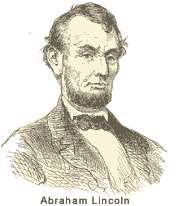
Abraham Lincoln was a respected state politician in Illinois. He was attractive to the Republican delegates because he was a talented speaker, had a moderate position on slavery and was a Westerner who could mount a challenge to Douglas. Seward led on the first few ballots, but Lincoln remained in contention. On the third ballot Lincoln prevailed, his victory due largely to the skillful maneuverings of his campaign managers. They lined up votes with promises of patronage and jammed the convention with Lincoln supporters.
During the campaign, Lincoln ventured into the South where he preached the value of the Union. In almost the same breath he also warned against secession and pledged that he would, if necessary, act with the conviction of Andrew Jackson in the Nullification Crisis almost 30 years earlier.
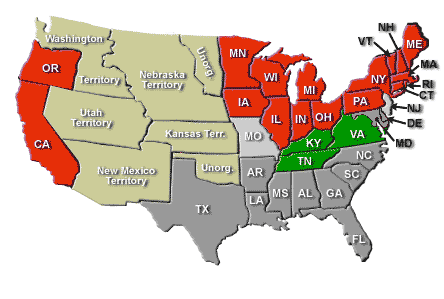
Lincoln's strength was confined to the populous Northern states, but he won a decisive victory in the Electoral College. However, he polled only about 40 percent of the popular vote. Douglas garnered an impressive popular vote, but barely made a showing in the electoral tally.
| Election of 1860 Candidates |
Party
|
Electoral Vote
|
Popular
Vote |
| Abraham Lincoln (Illinois) Hannibal Hamlin (Maine) |
Republican
|
180
|
1,865,593
|
| Stephen A. Douglas (Illinois) Herschel V. Johnson (Ga.) |
(Northern)
Democratic |
12
|
1,382,713
|
| John C. Breckinridge (Ky.) Joseph Lane (Oregon) |
Southern (Independent) Democrat
|
72
|
848,356
|
| John Bell (Tennessee) Edward Everett (Mass.) |
Constitutional Union
|
39
|
592,906
|