
Fort Sumter was a fortified federal facility whose purpose was to guard the mouth of Charleston harbor. It was constructed in the 1830s on a man-made island composed of granite and seashells. The fort boasted walls eight to 12 feet thick and 50 feet high.
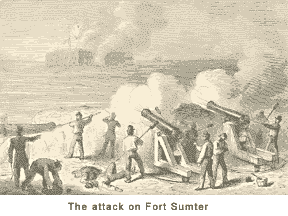 By 1861 Fort Sumter was in some disrepair and meagerly manned, but was one of two major federal installations in the South that had not been taken over by Confederate forces. The commander, Major Robert Anderson, had sent word to Washington that supplies were running low.
The political leaders on both sides faced a dilemma.
Jefferson Davis was not anxious to move against Fort Sumter or Fort Pickens (at Pensacola, Florida). He felt strongly that it was necessary to secure a foreign alliance before hostilities began. Further, more time was needed to lure other slave states into the Confederacy. This caution angered radical Southerners.
Abraham Lincoln also wanted to move with caution. Fearing assassination, he had disguised himself for the train ride into Washington for his inauguration in March 1861. He hoped to prevent the still-loyal slave states from joining the Confederacy. When word of Anderson’s plight arrived, Lincoln decided to resupply the fort rather than surrender it. The onus for firing the first shot would rest on the South.
Lincoln informed South Carolina authorities that he was dispatching a ship carrying food, not arms. The state officials decided that allowing the ship to pass would amount to cowardice and instructed General P.G.T. Beauregard to open artillery fire on April 12, 1861. Fort Sumter surrendered the next day. The Civil War had begun.
Lincoln commenced mobilization by summoning militia forces and putting out a call for volunteers. A blockade of Southern port cities was proclaimed.
Before the end of May the states of Virginia, Arkansas, Tennessee and North Carolina joined the Confederacy, bringing the total number of seceded states to eleven.
By 1861 Fort Sumter was in some disrepair and meagerly manned, but was one of two major federal installations in the South that had not been taken over by Confederate forces. The commander, Major Robert Anderson, had sent word to Washington that supplies were running low.
The political leaders on both sides faced a dilemma.
Jefferson Davis was not anxious to move against Fort Sumter or Fort Pickens (at Pensacola, Florida). He felt strongly that it was necessary to secure a foreign alliance before hostilities began. Further, more time was needed to lure other slave states into the Confederacy. This caution angered radical Southerners.
Abraham Lincoln also wanted to move with caution. Fearing assassination, he had disguised himself for the train ride into Washington for his inauguration in March 1861. He hoped to prevent the still-loyal slave states from joining the Confederacy. When word of Anderson’s plight arrived, Lincoln decided to resupply the fort rather than surrender it. The onus for firing the first shot would rest on the South.
Lincoln informed South Carolina authorities that he was dispatching a ship carrying food, not arms. The state officials decided that allowing the ship to pass would amount to cowardice and instructed General P.G.T. Beauregard to open artillery fire on April 12, 1861. Fort Sumter surrendered the next day. The Civil War had begun.
Lincoln commenced mobilization by summoning militia forces and putting out a call for volunteers. A blockade of Southern port cities was proclaimed.
Before the end of May the states of Virginia, Arkansas, Tennessee and North Carolina joined the Confederacy, bringing the total number of seceded states to eleven.