spacer


spacer
nav

Start Your Visit With ...

Historical Timelines
Chronological Eras
Information Tables
General Interest Maps
Glossary
History Quizzes
nav

Read and Post Comments


Follow OregonCoastMag on Twitter

Share
Would you like more applicants for your scholarships? Spread the Word on U-S-History for free.


Common Sense

Literature, January 1776

The fighting at Lexington and Concord did not immediately transform American public opinion into supporting independence from Britain. Instead, a great debate was touched off, which took place in the homes, taverns and assemblies of the colonists.
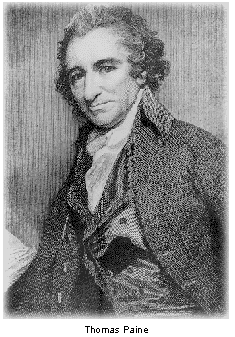
Thomas Paine

One of the most important elements of this debate was furnished by Thomas Paine, who published the pamphlet Common Sense in January 1776. It is arguably the most successful political essay in American history and may have done for the War for Independence what Uncle Tom’s Cabin did for the Civil War.

Paine made the following points:

  • Governments, even good ones, are at best necessary evils; they were less desirable the farther the government was from the governed.

  • Ignoring the lingering loyalty many Americans still felt for the king, he argued ardently for independence. Monarchy was branded an absurd form of government and George III a “Royal Brute.”

  • It made no sense, in Paine's mind, for a small country like Britain, an island, to rule a continent like America.

  • Independence would foster peace and prosperity. An independent America could avoid the senseless progression of European wars and grow rich by trading with all countries, not just the mother country.
Presented in a popular form, Common Sense reached a large audience and helped to sway the undecided to support independence.


See chronology of the War for Independence.

Off-site search results for "Common Sense"...

What effects did Common Sense by Thomas Paine have on the Americans?
This feeling was strongly aided by Thomas Paine's treatise, named "Common Sense" by Dr. Rush of Philadelphia, and expressing in clear and forcible statement the most radical democratic opinions. However disputable some of Paine's arguments may ...
http://www.publicbookshelf.com/public_html/The_Great_Republic_By_the_M ...

Common Sense
Title: Common Sense Author: Thomas Paine Year Published: 1776 COMMON SENSE by Thomas Paine   INTRODUCTION PERHAPS the sentiments contained in the following pages, are not yet sufficiently fashionable to procure them general favor; a long habit ...
http://www.civics-online.org/library/formatted/texts/commonsense.html

True Common Sense
I appeal to your true common sense. The following questions will be discussed in this article ( and future articles) and a common sense answer will show just how spurious the rebel logic has become. Taxation without representation? Every citizen ...
http://www.americanrevolution.org/loyalist2.html


Top 10 Most Viewed Pages

1. The Progressive Movement

2. Eastern Woodland Culture

3. First Continental Congress

4. Roaring Twenties

5. Quartering Act

6. Historical Eras

7. Stamp Act

8. Proclamation of 1763

9. Jacques Cartier

10. The Temperance Movement


spacer


Students using u-s-history.com will often want to learn about colleges and universities in the United States, particularly their admissions policies and available financial aid. Click here for colleges and universities arranged alphabetically by state. Most colleges and universities offer financial aid and that information is available through the admissions office or somewhere else on their Web site.

Copyright 2001-2010 by Online Highways LLC. All rights reserved.