
"Stand your ground. Don't fire unless fired upon, but if they mean to have a war let it begin here." Captain John Paarker, to his Minute Men on Lexington Green, April 19, 1775. The early months of 1775 were a period of great anxiety in Massachusetts. The city of Boston housed a large contingent of British soldiers who nursed antipathy with an increasingly sullen populace. Insults and fights between the two sides were commonplace. The tension was heightened by economic dislocation. The port of Boston had been closed in retaliation for the earlier Tea Party and traditional forms of self-government had been replaced by royal authority. Many of the Patriot leaders feared arrest and had left the city for the comparative safety of smaller communities in the countryside.
In the village of Lexington west of Boston, the residents had been preparing for a fight they thought was imminent. They had accumulated powder and shot during the winter, but the high cost of those items had made target practice a rarity. On the evening of April 18, 1775, many of Captain John Parker’s militiamen gathered in a local tavern to await word about the movement of British soldiers, an event that had been rumored for several days. The presence of John Hancock and Samuel Adams, the two men most wanted by royal authorities, made Lexington a logical choice for the redcoats' attention. Further, the neighboring town of Concord had recently hosted the illegal Provincial Congress and was thought to harbor a rich cache of arms.
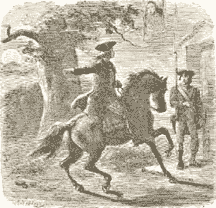 Confirmation of the British advance was delivered to Lexington by Paul Revere and William Dawes. In the early hours of April 19 the Minutemen, so called because of their pledge to be ready to fight "at a minute’s notice," began to gather on the village green. During the night, the size of the force changed constantly as some men quietly departed for their homes and others appeared to lend their support.
As the British advance party approached shortly after dawn, 77 Minutemen were instructed by Captain Parker: "Stand your ground; don't fire unless fired upon, but if they mean to have a war, let it begin here." The British commander, who was pleasantly surprised by the small size of the American force, ordered the colonists to throw down their arms and disperse. Some began to obey the order to leave, but held on to their arms. At that point a shot was fired. Who actually fired that first shot cannot be answered with certainty, but a number of experts have theorized that it was probably an American who may have fired from a hidden position — perhaps from behind a stone fence or from the nearby tavern. Other shots quickly followed, and when the smoke cleared, eight Americans lay dead and 10 were wounded. One British soldier was slightly wounded. The outmatched Minutemen retreated into the nearby woods and the redcoats proceeded westward to their main objective, Concord.