
The Central Pacific Railroad was chartered by Congress, through the Pacific Railroad Act of 1862, to construct a portion of the first transcontinental line, starting in Sacramento and proceeding eastward. Many considered a railroad running through the nation's interior to be the key to westward expansion and the future of the country. A transcontinental route would greatly reduce the time it took to cross the continent, develop the nation's vast interior, encourage settlement, promote trade, and fuel industry. Congress felt it was also essentially to the national defense.
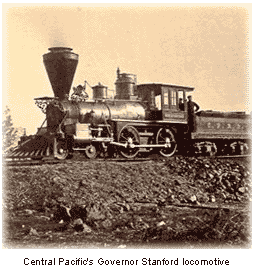 A large Chinese workforce, numbering 10,000 or more who were originally drawn to California by the Gold Rush, was drafted into the effort. By the second year, nine out of ten of the workers were Chinese immigrants. Much of the construction work, especially the dangerous assignments, was accomplished by those immigrants. The line crossed the Sierra Nevada Mountains into Nevada, followed the Humboldt River and linked with the competing Union Pacific Railroad at Promontory Point near Ogden, Utah, on May 10, 1869. It was now possible to leave San Francisco and arrive in New York in 10 days, instead of up to six grueling months. It is unclear how many men died in the effort, or what the actual cost of its construction.
The Central Pacific Railroad was the project of two of the great railroad barons of the day, Leland Stanford and Collis P. Huntington. While the Central Pacific lost out in the race to construct the most mileage, it was an immediate financial success; lands received in government grants were sold to ready buyers, which provided sufficient income to cover construction costs.
A large Chinese workforce, numbering 10,000 or more who were originally drawn to California by the Gold Rush, was drafted into the effort. By the second year, nine out of ten of the workers were Chinese immigrants. Much of the construction work, especially the dangerous assignments, was accomplished by those immigrants. The line crossed the Sierra Nevada Mountains into Nevada, followed the Humboldt River and linked with the competing Union Pacific Railroad at Promontory Point near Ogden, Utah, on May 10, 1869. It was now possible to leave San Francisco and arrive in New York in 10 days, instead of up to six grueling months. It is unclear how many men died in the effort, or what the actual cost of its construction.
The Central Pacific Railroad was the project of two of the great railroad barons of the day, Leland Stanford and Collis P. Huntington. While the Central Pacific lost out in the race to construct the most mileage, it was an immediate financial success; lands received in government grants were sold to ready buyers, which provided sufficient income to cover construction costs.