
The idea of an intercolonial meeting was advanced in 1773 by Benjamin Franklin, but failed to gain much support until after the Port of Boston was closed in response to the Boston Tea Party. When in May, 1774, the Boston Committee of Correspondence circulated letter urging the colonies to stop trading with England, the response from New York's Committee of 51, where the discussion was dominated by merchants, declined to participate in a boycott of English trade and suggested instead a continental congress:
Upon these reasons we conclude that a congress of deputies from the colonies in general is of the utmost moment; that it ought to be assembled without delay, and some unanimous resolution formed in this fatal emergency, not only respecting your deplorable circumstances, but for the security of our common rights.On May 27, 1774, the Virginia House of Burgesses proposed a continental congress. A special convention was held on August 1 to elect delegates to the meeting in Philadelphia the following month. Thomas Jefferson, a delegate from Albemarle County, introduced a "Summary View of the Rights of British America." It failed to gain the support of the Virginia convention, but it brought attention to Jefferson as an exponent of the American cause.
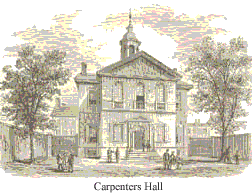
The First Continental Congress convened in Philadelphia's Carpenters Hall on September 5, 1774. Twelve of the 13 colonies sent delegates. Georgia decided against roiling the waters; they were facing attacks from the restive Creek on their borders and desperately needed the support of regular British soldiers.
The Congress, which continued in session until late October, did not advocate independence; it sought rather to right the wrongs that had been inflicted on the colonies and hoped that a unified voice would gain them a hearing in London.
 Joseph Galloway of Pennsylvania, representing conservative views, introduced a "Plan of Union of Great Britain and the Colonies," which began on a highly conciliatory note:
Resolved, that this Congress will apply to His Majesty for a redress of grievances under which his faithful subjects in America labor; and assure him that the colonies hold in abhorrence the idea of being considered independent communities on the British government, and most ardently desire the establishment of a political union, not only among themselves but with the mother state, upon chose principles of safety and freedom which are essential in the constitution of all free governments, and particularly that of the British legislature.Galloway's plan was well received by many delegates but was supported by only five colonies, against six opposed. Galloway's tendency towards compromise was soon eclipsed with the arrival of the Suffolk Resolves.
Some of the most prominent figures of the era were among the 55 delegates in attendance, including George Washington, Samuel Adams, John Adams, Patrick Henry, Richard Henry Lee, John Jay and John Dickinson.
They were mostly people of social standing and made their livings from trade, farming and the law. Many were initially unknown to one another and vast differences existed on some of the issues, but important friendships flourished. Frequent dinners and gatherings were held and were attended by all except the spartan Sam Adams.
Major actions taken by the Congress included the following:
Resolved, that this Congress will apply to His Majesty for a redress of grievances under which his faithful subjects in America labor; and assure him that the colonies hold in abhorrence the idea of being considered independent communities on the British government, and most ardently desire the establishment of a political union, not only among themselves but with the mother state, upon chose principles of safety and freedom which are essential in the constitution of all free governments, and particularly that of the British legislature.
The resulting discussion further polarized the Congress. The radical elements eventually gained the upper hand; a majority of the colonies voted to endorse the Resolves and against Galloway's plan.
These agreements were to be enforced by a group of committees in each community, which would publish the names of merchants defying the boycott, confiscate contraband, and encourage public frugality.
The radical elements were critical of the Declaration because it conceded the right of Parliament to regulate colonial trade, a traditional view long held by most Americans, but one that was losing favor in the mid-1770s.
The First Continental Congress was regarded as a success by both the general public and the delegates. The latter, despite heated and frequent disagreements, had come to understand the problems and aspirations of people living in other colonies.
Many of the friendships forged there would make easier the gargantuan task of governing the new nation in the coming years.