
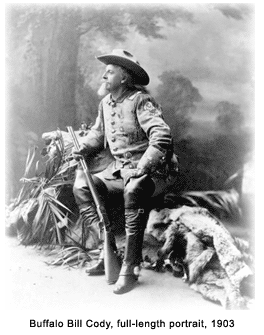
 Born William Frederick Cody, "Buffalo Bill" earned his nickname after being named as chief buffalo meat provider for the Kansas Pacific Railroad, a southern branch of the Union Pacific, as it pushed its way across the midsection of America following the Civil War. Cody is known to have killed 4,280 head of buffalo in 17 months.
The early years
Born in Scott County, Iowa, in 1846, Bill grew up on the grasslands of the Midwest. When his father died in 1857, the family moved to Kansas, where Bill worked for a wagon-freight company as a mounted messenger and cattle wrangler.
In 1859, at the prairie-toughened age of 13, he tried his luck as a "Fifty-niner," prospecting in the Pikes Peak gold rush. The following year, Bill joined the Pony Express when they wanted "skinny, expert riders willing to risk death daily."
During the Civil War, Bill served as a Union scout in campaigns against the Kiowa and Comanche. In 1863, he enlisted at the age of 17 with the Seventh Kansas Cavalry, which went to battle in Missouri and Tennessee. Following the war, Bill married Louisa Frederici in St. Louis and from Fort Ellsworth, Kansas, continued with the army as a scout/dispatch carrier.
The legend begins
In 1868, Cody returned to the army as chief of scouts for the Fifth Cavalry and took part in 16 battles, including the defeat of the Cheyenne at Summit Springs, Colorado, in 1869. For his service and "gallantry in action," he was awarded the Congressional Medal of Honor in 1872.
Thanks to a number of dime novels by Ned Buntline, beginning in 1869, the public persona of Buffalo Bill evolved into a romanticised hero worship. Buntline alluded that Cody was every bit in the same class of frontiersman as his close friend Wild Bill Hickock, as well as Kit Carson, and Davy Crockett. The novels were, indeed, a heady mixture of fact and fiction.
In 1872, Buntline urged Cody to take his new mantle to the stage by starring in his, Buntline's, play, The Scouts of the Plains. Cody capitalized on his innate showmanship in pulling off the gig, and was applauded by an appreciative audience. Cody remained on stage for 11 seasons and became an author as well. He finished the first edition of his autobiography in 1879, and stumped his own style of Buffalo Bill novels. Eventually, Cody would write about 1,700 of those frontier tales.
In the theater off-seasons, Cody guided wealthy Easterners and European nobility, including the Grand Duke Alexis of Russia, who was 19 years old at the time, on hunting expeditions and stage-coach rides. In 1876, he returned to America's service as an army scout in the Indian campaign that followed Custer’s demise at the Little Bighorn.
In 1883 at the age of 37, Cody organized Buffalo Bill’s Wild West Show, an outdoor spectacle that vividly portrayed some of the most idyllic and enchanting moments of frontier life. The show included a buffalo hunt with real buffaloes, an Indian attack on the Deadwood stage with real Indians, and a Pony Express ride.
The show was said to boasted as many as 1,200 performers, including Arabs, Cossacks, Gauchos, Mongols, and Turks, as well as Native Americans, decked out in the regalia of their respective cultures. Among the star attractions of the group were Annie Oakley, dubbed "Little Sure Shot," and Sitting Bull , who took his place during the finale — a spicy reenactment of Custer's Last Stand.
The show was a precursor to today's modern rodeo with a large dash of circus and history lesson thrown in. It mixed sentimentality with sensationalism, and proved to be a huge success, touring America for 20 years. Its tour through Europe in 1887 included a command performance before Queen Victoria. In 1893, the troupe performed as part of the Chicago World's Columbian Exposition, now known as the World's Fair.
In 1890, Cody was once again called back by the army during Indian uprisings associated with the Ghost Dance. He arrived with some Indians from his troupe who proved to be effective peacemakers, and even traveled to Wounded Knee following the massacre to help restore order.
The last days
Cody made a good deal of money from the show, but lost it to mismanagement and investment schemes that failed to pan out. In the end, even the Wild West show was confiscated by creditors.
Cody died in January 1917, and is buried in a tomb at the summit of Lookout Mountain near Denver, Colorado.
Born William Frederick Cody, "Buffalo Bill" earned his nickname after being named as chief buffalo meat provider for the Kansas Pacific Railroad, a southern branch of the Union Pacific, as it pushed its way across the midsection of America following the Civil War. Cody is known to have killed 4,280 head of buffalo in 17 months.
The early years
Born in Scott County, Iowa, in 1846, Bill grew up on the grasslands of the Midwest. When his father died in 1857, the family moved to Kansas, where Bill worked for a wagon-freight company as a mounted messenger and cattle wrangler.
In 1859, at the prairie-toughened age of 13, he tried his luck as a "Fifty-niner," prospecting in the Pikes Peak gold rush. The following year, Bill joined the Pony Express when they wanted "skinny, expert riders willing to risk death daily."
During the Civil War, Bill served as a Union scout in campaigns against the Kiowa and Comanche. In 1863, he enlisted at the age of 17 with the Seventh Kansas Cavalry, which went to battle in Missouri and Tennessee. Following the war, Bill married Louisa Frederici in St. Louis and from Fort Ellsworth, Kansas, continued with the army as a scout/dispatch carrier.
The legend begins
In 1868, Cody returned to the army as chief of scouts for the Fifth Cavalry and took part in 16 battles, including the defeat of the Cheyenne at Summit Springs, Colorado, in 1869. For his service and "gallantry in action," he was awarded the Congressional Medal of Honor in 1872.
Thanks to a number of dime novels by Ned Buntline, beginning in 1869, the public persona of Buffalo Bill evolved into a romanticised hero worship. Buntline alluded that Cody was every bit in the same class of frontiersman as his close friend Wild Bill Hickock, as well as Kit Carson, and Davy Crockett. The novels were, indeed, a heady mixture of fact and fiction.
In 1872, Buntline urged Cody to take his new mantle to the stage by starring in his, Buntline's, play, The Scouts of the Plains. Cody capitalized on his innate showmanship in pulling off the gig, and was applauded by an appreciative audience. Cody remained on stage for 11 seasons and became an author as well. He finished the first edition of his autobiography in 1879, and stumped his own style of Buffalo Bill novels. Eventually, Cody would write about 1,700 of those frontier tales.
In the theater off-seasons, Cody guided wealthy Easterners and European nobility, including the Grand Duke Alexis of Russia, who was 19 years old at the time, on hunting expeditions and stage-coach rides. In 1876, he returned to America's service as an army scout in the Indian campaign that followed Custer’s demise at the Little Bighorn.
In 1883 at the age of 37, Cody organized Buffalo Bill’s Wild West Show, an outdoor spectacle that vividly portrayed some of the most idyllic and enchanting moments of frontier life. The show included a buffalo hunt with real buffaloes, an Indian attack on the Deadwood stage with real Indians, and a Pony Express ride.
The show was said to boasted as many as 1,200 performers, including Arabs, Cossacks, Gauchos, Mongols, and Turks, as well as Native Americans, decked out in the regalia of their respective cultures. Among the star attractions of the group were Annie Oakley, dubbed "Little Sure Shot," and Sitting Bull , who took his place during the finale — a spicy reenactment of Custer's Last Stand.
The show was a precursor to today's modern rodeo with a large dash of circus and history lesson thrown in. It mixed sentimentality with sensationalism, and proved to be a huge success, touring America for 20 years. Its tour through Europe in 1887 included a command performance before Queen Victoria. In 1893, the troupe performed as part of the Chicago World's Columbian Exposition, now known as the World's Fair.
In 1890, Cody was once again called back by the army during Indian uprisings associated with the Ghost Dance. He arrived with some Indians from his troupe who proved to be effective peacemakers, and even traveled to Wounded Knee following the massacre to help restore order.
The last days
Cody made a good deal of money from the show, but lost it to mismanagement and investment schemes that failed to pan out. In the end, even the Wild West show was confiscated by creditors.
Cody died in January 1917, and is buried in a tomb at the summit of Lookout Mountain near Denver, Colorado.