
The background behind this infamous battle, also known as "Custer's Last Stand," comprises an effort to subdue Native Americans living in the Dakota and Montana territories who were fighting for their nomadic way of life.
Discovery of gold in the nearby Black Hills in 1874, triggered an influx of white prospectors into Native American territory and led to assaults on the prospectors by the Sioux (Lakota), under Chief Sitting Bull , Chief Crazy Horse, and Chief Gall .
In the spring of 1876, the U.S. Army launched an expedition against the Lakota and their allies the Cheyenne. The tribes had not complied with an ultimatum to return to reservations in the Dakotas and Nebraska after U.S. negotiations to acquire the Black Hills, held to be sacred by the Indians, had failed in the fall of 1875.
The central figure in the battle was George A. Custer, an army officer who won notoriety as an Indian fighter in the West. On June 25, 1876, Custer and about 225 soldiers under his immediate command were defeated by Indians in "Custer's Last Stand," the Battle of the Little Big Horn. Not one of Custer's men survived.
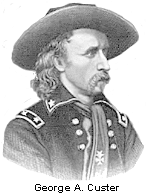 During the Civil War, Custer had distinguished himself as a cavalry officer and was breveted* one of the youngest generals in the Union Army. In a postwar reorganization, Custer was given the rank of captain, but he joined the Seventh Cavalry Regiment in 1866, and later became a lieutenant colonel. He won greater fame as he fought Indians in the Southwest and in the Dakota and Montana territories.
In early 1876, from his Chicago HQ General Sheridan ordered a concentration of troops along the upper Yellowstone River to capture or disperse the many bands of Dakotas who were hunting in the area. In June, the department commander General Terry, along with Custer with his regiment from Fort Abraham Lincoln, marched overland to the Yellowstone River, where they were met by a steamboat with supplies and ammunition. At the mouth of Rosebud Creek, a tributary of the Yellowstone, Custer received his final orders from Terry to locate and disperse the Indians.
As the soldiers moved into Montana Territory, scouts, seeing campfire smoke and other signs, relayed that an Indian encampment probably lay ahead. Custer decided to assail the encampment before infantry and other support arrived. It is often stated that this was in violation of his orders, but official records strongly suggest that Terry gave Custer a free hand in dealing with the situation, based on Custer's experience in this kind of warfare. Unfortunately for Custer, this led to his Last Stand.
Four days later, on June 25, Custer spied the village about 15 miles off. It lay in a valley along the Little Big Horn River. Ignoring his scouts' higher estimates, Custer believed there would be only about 1,000 Indians who could be rounded up easily by the 647 men in his regiment. Actually, between 2,500 and 5,000 Indians were in the camp. It was the largest assemblage of hostile tribes in Western history.
Custer immediately ordered an attack. He split his regiment into three columns: one under Captain Frederick W. Benteen, one under Major Marcus A. Reno, and one under himself.
Benteen was ordered off to the left to search the valleys for Indians. Custer ordered Reno to charge ahead across the river and attack the Indian village. Custer's column advanced onto high ground to the right, apparently to attack the side or rear of the village.
After bloody fighting in the valley, Reno retreated across the river and went up the bluffs. Benteen's bloodied column joined Reno's men and they took up a defensive position. The soldiers held off the Indians until Terry arrived on June 27.
About five miles away, sometime during the fighting in the valley and the first shooting on the bluffs, the warriors of Crazy Horse and Gall defeated Custer and his column. This ended "Custer's Last Stand."
Retaliation by U.S. Army forces was swift. The Lakota were scattered and Crazy Horse was murdered while under guard.