
Edward Teller was one of the physicists who participated in The Manhattan Project, which developed the first atomic bomb for the United States in 1945. After the war, he advocated the development of the much more powerful Hydrogen Bomb, and eventually took charge of its development. For this, he became known as the Father of the Hydrogen Bomb.
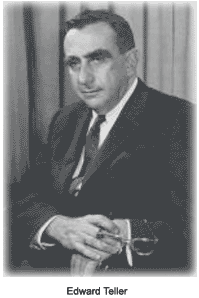 Teller was born on January 15, 1908, in Budapest, Hungary, into an affluent Jewish family. When he was 10, the end of the First World War brought independence to Hungary. The political turmoil that followed created many disruptions in Teller's education. In 1926, he left Budapest to study chemical engineering at Karlsruhe in Germany. There he became intrigued by new developments in physics, and transferred in 1928 to the University of Munich and later to the University of Leipzig, where he studied with Werner Heisenberg, one of the luminaries of physics. He received his PhD from Leipzig in 1930.
With the rise to power of the Nazis, Teller realized that there was no future for him in Germany. He emigrated first to Denmark, where he worked with Niels Bohr at the Institute for Theoretical Physics, later working briefly in London before moving to the United States in 1935.
In the United States, Teller became one of the leading researchers in physics. He was one of those alarmed by the progress of German physicists, which they felt could eventually lead to a German atomic bomb. He helped persuade Einstein to write to Roosevelt in 1939. When Roosevelt authorized the Manhattan Project, Teller worked first with Enrico Fermi at the University of Chicago, then with J. Robert Oppenheimer at Berkeley. In 1943, he went to the government's remote lab at Los Alamos, New Mexico, where he stayed through the development and testing of the first atomic bomb.
As early as 1940, Teller had speculated that an atomic fission explosion could be used to detonate a still larger explosion based on fusion. The hydrogen bomb was not pursued during World War II, due to the enormous challenges involved in the simpler fission weapon. Teller was disappointed but he didn't forget his ambition. After the war, he continued to advocate for development of the superbomb. When the Soviet Union exploded their own atomic bomb in 1948, President Harry S. Truman authorized the development of the hydrogen bomb. The first one was successfully exploded at Eniwitok Atoll in the Pacific Ocean in 1952.
The hydrogen bomb demonstrated a deep rift between Teller and Oppenheimer over the future of weapons. When Oppenheimer was being investigated, Teller made no actual accusations, but his failure to support his former associate was regarded as a contributing factor to Oppenheimer's loss of security clearance.
Believing that the US needed a laboratory whose staff was unambiguously behind weapons development, Teller advocated the establishment of a second facility. He was rewarded when the Lawrence Livermore Laboratory in California was constructed. He joined the lab as a consultant. Later, he was made associate director and finally director. His last 25 years were spent working with the Hoover Institute for the Study of War, Revolution, and Peace at Stanford University. He died at his home on the campus on September 9, 2003.
Teller was born on January 15, 1908, in Budapest, Hungary, into an affluent Jewish family. When he was 10, the end of the First World War brought independence to Hungary. The political turmoil that followed created many disruptions in Teller's education. In 1926, he left Budapest to study chemical engineering at Karlsruhe in Germany. There he became intrigued by new developments in physics, and transferred in 1928 to the University of Munich and later to the University of Leipzig, where he studied with Werner Heisenberg, one of the luminaries of physics. He received his PhD from Leipzig in 1930.
With the rise to power of the Nazis, Teller realized that there was no future for him in Germany. He emigrated first to Denmark, where he worked with Niels Bohr at the Institute for Theoretical Physics, later working briefly in London before moving to the United States in 1935.
In the United States, Teller became one of the leading researchers in physics. He was one of those alarmed by the progress of German physicists, which they felt could eventually lead to a German atomic bomb. He helped persuade Einstein to write to Roosevelt in 1939. When Roosevelt authorized the Manhattan Project, Teller worked first with Enrico Fermi at the University of Chicago, then with J. Robert Oppenheimer at Berkeley. In 1943, he went to the government's remote lab at Los Alamos, New Mexico, where he stayed through the development and testing of the first atomic bomb.
As early as 1940, Teller had speculated that an atomic fission explosion could be used to detonate a still larger explosion based on fusion. The hydrogen bomb was not pursued during World War II, due to the enormous challenges involved in the simpler fission weapon. Teller was disappointed but he didn't forget his ambition. After the war, he continued to advocate for development of the superbomb. When the Soviet Union exploded their own atomic bomb in 1948, President Harry S. Truman authorized the development of the hydrogen bomb. The first one was successfully exploded at Eniwitok Atoll in the Pacific Ocean in 1952.
The hydrogen bomb demonstrated a deep rift between Teller and Oppenheimer over the future of weapons. When Oppenheimer was being investigated, Teller made no actual accusations, but his failure to support his former associate was regarded as a contributing factor to Oppenheimer's loss of security clearance.
Believing that the US needed a laboratory whose staff was unambiguously behind weapons development, Teller advocated the establishment of a second facility. He was rewarded when the Lawrence Livermore Laboratory in California was constructed. He joined the lab as a consultant. Later, he was made associate director and finally director. His last 25 years were spent working with the Hoover Institute for the Study of War, Revolution, and Peace at Stanford University. He died at his home on the campus on September 9, 2003.