
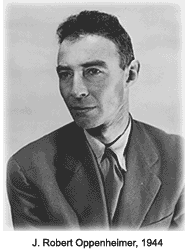
J. Robert Oppenheimer led the scientific efforts which produced the first atomic bomb for the United States, in 1945. Despite his brilliant achievements at the Manhattan Project, Oppenheimer's misgivings about atomic weaponry in general led to his isolation from government weapons research in the years following the war.
Oppenheimer was born in New York City on April 22, 1904. His Upper West Side Jewish family provided him with an early life of some affluence. He attended the New York School for Ethical Culture, which schooled him in the humanities, but he excelled even more in science. After graduating from Harvard, Oppenheimer went to Europe and spent time at the University of Gottingen.
Returning to the United States in 1929, Oppenheimer took a position with the Berkeley campus of the University of California. Although well regarded, his work as a physicist did not put him in the front ranks worldwide. Nevertheless, he demonstrated leadership by building the physicists department at Berkeley into one of the best.
During the 1930s, The Great Depression and the rise of fascism in Europe prompted Oppenheimer to become involved in campus politics. His circle of friends at the time included a number of political radicals. Such contacts were common for members of university communities at the time and Oppenheimer did not develop any permanent radical views. Unfortunately, these associations came back to haunt him decades later.
 At the outset of the Manhattan Project, Oppenheimer was given the task of calculating the critical mass of uranium that would be required. His project team at Berkeley, dubbed the "luminaries," included Edward Teller. Oppenheimer's reputation as both a scientist and administrator led to his eventual appointment as the chief scientist of the Manhattan Project.
He moved to Los Alamos, New Mexico, where the main bomb research was centered. During his tenure, there evolved a delicate balance between the two aspects of his job. The entire operation was a military secret, and armies operate on a "need to know" basis. At the same time, the scientific challenges were enormous and science operates best in an atmosphere of free exchange.
In co-operation with General Leslie R. Groves, the person with ultimate control over the project, Oppenheimer was able to obtain enough freedom for his researchers without compromising security. The culmination came in the summer of 1945. The first test was conducted at Trinity in the New Mexico desert on July 16, 1945. Two bombs were dropped on Japan in early August, bringing the war in the Pacific to a quick end.
After witnessing the first test at Trinity, Oppenheimer wrote that some laughed, some cried, and through his mind floated a line from the Bhagavadgita: "I am become death: the destroyer of worlds." His ambivalance towards the use of science for military ends led to his opposition to the development of a Hydrogen Bomb after the war.
Unfortunately for him, the Soviet Union exploded its own atomic weapon in 1948, creating tremendous pressure for the US to develop the even larger fusion weapon. His opposition provoked suspicions that he was disloyal and public hearings were held in 1953. Although he was not identified as a spy, his security clearance was revoked. In later life, his reputation was rehabilitated, however Oppenheimer would never again head a major research organization. He died of throat cancer on February 18, 1967.
At the outset of the Manhattan Project, Oppenheimer was given the task of calculating the critical mass of uranium that would be required. His project team at Berkeley, dubbed the "luminaries," included Edward Teller. Oppenheimer's reputation as both a scientist and administrator led to his eventual appointment as the chief scientist of the Manhattan Project.
He moved to Los Alamos, New Mexico, where the main bomb research was centered. During his tenure, there evolved a delicate balance between the two aspects of his job. The entire operation was a military secret, and armies operate on a "need to know" basis. At the same time, the scientific challenges were enormous and science operates best in an atmosphere of free exchange.
In co-operation with General Leslie R. Groves, the person with ultimate control over the project, Oppenheimer was able to obtain enough freedom for his researchers without compromising security. The culmination came in the summer of 1945. The first test was conducted at Trinity in the New Mexico desert on July 16, 1945. Two bombs were dropped on Japan in early August, bringing the war in the Pacific to a quick end.
After witnessing the first test at Trinity, Oppenheimer wrote that some laughed, some cried, and through his mind floated a line from the Bhagavadgita: "I am become death: the destroyer of worlds." His ambivalance towards the use of science for military ends led to his opposition to the development of a Hydrogen Bomb after the war.
Unfortunately for him, the Soviet Union exploded its own atomic weapon in 1948, creating tremendous pressure for the US to develop the even larger fusion weapon. His opposition provoked suspicions that he was disloyal and public hearings were held in 1953. Although he was not identified as a spy, his security clearance was revoked. In later life, his reputation was rehabilitated, however Oppenheimer would never again head a major research organization. He died of throat cancer on February 18, 1967.