
Enrico Fermi was the foremost Italian physicist of the 20th century. Like many of his colleagues, he left Europe to avoid political dictatorship. Upon arriving in the United States, he devoted his energies to the national interests of his adopted country.
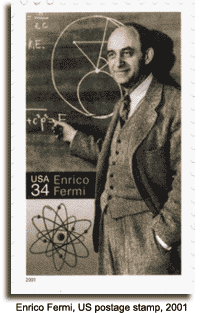 Fermi was born on September 29, 1901, in Rome. His father was a chief inspector of the Italian Ministry of Communications. At an early age, he showed talent for mathematics. He spent four years at the University of Pisa, where he earned his Ph.D. in 1922. After a scholarship to work with Max Born in Gottingen and a Rockefeller Fellowship to study with Ehrenfest in Leyden, he returned to Italy to take the post of Lecturer in Mathematical Physics and Mechanics at the University of Florence.
In the following years, Fermi worked on problems relating to fundamental particles. He developed a mathematical treatment that became known as Fermi's Statistics to describe the behavior of a class of particles now known as fermions. For his work, he received the Nobel Prize in Physics in 1938.
Immediately after receiving the award, Fermi left for the United States, where he took a post as Professor of Physics at Columbia University in New York City, which he held until 1942. Realizing the potential of atomic fission, Fermi became deeply involved in the research that led to the development of the atomic bomb. His best known contribution was the experiment at the University of Chicago that led to the first sustained atomic reaction in December 1942. He spent the remainder of the World War II years at the Manhattan Project laboratory in Los Alamos.
After the war, Fermi became a professor at the Institute for Nuclear Studies at the University of Chicago. He remained there until his untimely death in 1954. Fermi National Accelerator Laboratory in Batavia, 40 miles west of Chicago, is named after Enrico Fermi.
Fermi was born on September 29, 1901, in Rome. His father was a chief inspector of the Italian Ministry of Communications. At an early age, he showed talent for mathematics. He spent four years at the University of Pisa, where he earned his Ph.D. in 1922. After a scholarship to work with Max Born in Gottingen and a Rockefeller Fellowship to study with Ehrenfest in Leyden, he returned to Italy to take the post of Lecturer in Mathematical Physics and Mechanics at the University of Florence.
In the following years, Fermi worked on problems relating to fundamental particles. He developed a mathematical treatment that became known as Fermi's Statistics to describe the behavior of a class of particles now known as fermions. For his work, he received the Nobel Prize in Physics in 1938.
Immediately after receiving the award, Fermi left for the United States, where he took a post as Professor of Physics at Columbia University in New York City, which he held until 1942. Realizing the potential of atomic fission, Fermi became deeply involved in the research that led to the development of the atomic bomb. His best known contribution was the experiment at the University of Chicago that led to the first sustained atomic reaction in December 1942. He spent the remainder of the World War II years at the Manhattan Project laboratory in Los Alamos.
After the war, Fermi became a professor at the Institute for Nuclear Studies at the University of Chicago. He remained there until his untimely death in 1954. Fermi National Accelerator Laboratory in Batavia, 40 miles west of Chicago, is named after Enrico Fermi.