
Charles Evans Hughes, a noted early 20th century jurist and political figure, was born in Glens Falls, New York, and was educated at Brown University and the Columbia Law School. He began a highly successful law practice in New York City in 1884, that was interrupted by a brief stint as a professor at Cornell University.
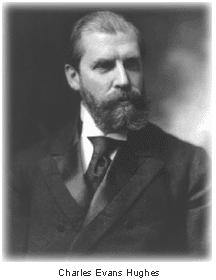 Hughes gained public recognition in the early 1900s by serving as counsel to several legislative investigating committees in New York. His work with the Stevens Gas Commission unearthed utility practices that were detrimental to the public good; and with the Armstrong Commission, insurance industry abuses were brought to light.
In 1906, Charles Evans Hughes defeated the famed publisher, William Randolph Hearst, for governor of New York with backing from fellow Republican Theodore Roosevelt. Hughes established a progressive record in his two terms in office by securing labor legislation, insurance reform and the creation of a Public Service Commission. He resigned in 1910 to accept an appointment to the U.S. Supreme Court from William Howard Taft.
Hughes stepped down from the Court in 1916 to a run for president on the Republican ticket. He also was nominated by the Bull Moose Party, but Roosevelt’s war-like rhetoric was not helpful to Hughes. In an extremely close election, Hughes lost to the incumbent Woodrow Wilson.
Charles Evans Hughes resumed the practice of law, which he continued until 1921, when he was selected by Warren Harding to be secretary of state. He was successful in securing a separate peace with Germany, concluding arbitration treaties with a number of Latin American nations and, most significantly, negotiating a series of treaties at the Washington Conference on Naval Limitation of Armaments (1921-22). Following Harding’s death, Hughes continued at State during Calvin Coolidge’s first term, but returned to private practice in 1925.
Charles Evans Hughes held a number of high profile positions during the mid and late 1920s. He headed a commission to reform New York state government (1926), and served on both the Permanent Court of Arbitration (1926-30) and the Permanent Court of International Justice (1928-30).
In 1930, Hughes was nominated Chief Justice of the U.S. Supreme Court by Herbert Hoover. Liberal senators assumed that Hughes would hold conservative positions and made his nomination hearing an unpleasant experience, but after gaining confirmation, he provided a swing vote during the critical Depression and New Deal eras.
He supported Franklin Roosevelt’s decision not to pay government obligations in gold, provided a critical vote upholding collective bargaining rights under the Wagner Act, and upheld the controversial Social Security Act.
On other occasions, however, Charles Evans Hughes dealt severe blows to the New Deal, most notably in Schechter Poultry Corporation v. United States (1935), in which he voted with the majority to strike down the National Industrial Recovery Act. In 1937, Hughes publicly opposed Roosevelt’s plan to pack the Supreme Court with sympathetic justices and offered his opinion in writing to the Senate Judiciary Committee.
Critics have suggested that some of Hughes’ pro-New Deal stances were prompted by a desire to weaken the court-packing scheme, not by conviction.
Charles Evans Hughes retired in 1941 and died in Osterville, Massachusetts, on 27th August, 1948.
As a prominent politician about whom presidential aspirations were considered, the question of his qualification for the presidency under the provisions of the Constitution were debated. An article by Breckinridge Long of the St. Louis Bar presented the case that he was not, based on the fact that although the Fourteenth Amendment gave citizenship to all persons born on U.S. soil, Hughes had been born earlier, at a time when citizenship devolved through the father, and Hughes` father was an English subject:
Hughes gained public recognition in the early 1900s by serving as counsel to several legislative investigating committees in New York. His work with the Stevens Gas Commission unearthed utility practices that were detrimental to the public good; and with the Armstrong Commission, insurance industry abuses were brought to light.
In 1906, Charles Evans Hughes defeated the famed publisher, William Randolph Hearst, for governor of New York with backing from fellow Republican Theodore Roosevelt. Hughes established a progressive record in his two terms in office by securing labor legislation, insurance reform and the creation of a Public Service Commission. He resigned in 1910 to accept an appointment to the U.S. Supreme Court from William Howard Taft.
Hughes stepped down from the Court in 1916 to a run for president on the Republican ticket. He also was nominated by the Bull Moose Party, but Roosevelt’s war-like rhetoric was not helpful to Hughes. In an extremely close election, Hughes lost to the incumbent Woodrow Wilson.
Charles Evans Hughes resumed the practice of law, which he continued until 1921, when he was selected by Warren Harding to be secretary of state. He was successful in securing a separate peace with Germany, concluding arbitration treaties with a number of Latin American nations and, most significantly, negotiating a series of treaties at the Washington Conference on Naval Limitation of Armaments (1921-22). Following Harding’s death, Hughes continued at State during Calvin Coolidge’s first term, but returned to private practice in 1925.
Charles Evans Hughes held a number of high profile positions during the mid and late 1920s. He headed a commission to reform New York state government (1926), and served on both the Permanent Court of Arbitration (1926-30) and the Permanent Court of International Justice (1928-30).
In 1930, Hughes was nominated Chief Justice of the U.S. Supreme Court by Herbert Hoover. Liberal senators assumed that Hughes would hold conservative positions and made his nomination hearing an unpleasant experience, but after gaining confirmation, he provided a swing vote during the critical Depression and New Deal eras.
He supported Franklin Roosevelt’s decision not to pay government obligations in gold, provided a critical vote upholding collective bargaining rights under the Wagner Act, and upheld the controversial Social Security Act.
On other occasions, however, Charles Evans Hughes dealt severe blows to the New Deal, most notably in Schechter Poultry Corporation v. United States (1935), in which he voted with the majority to strike down the National Industrial Recovery Act. In 1937, Hughes publicly opposed Roosevelt’s plan to pack the Supreme Court with sympathetic justices and offered his opinion in writing to the Senate Judiciary Committee.
Critics have suggested that some of Hughes’ pro-New Deal stances were prompted by a desire to weaken the court-packing scheme, not by conviction.
Charles Evans Hughes retired in 1941 and died in Osterville, Massachusetts, on 27th August, 1948.
As a prominent politician about whom presidential aspirations were considered, the question of his qualification for the presidency under the provisions of the Constitution were debated. An article by Breckinridge Long of the St. Louis Bar presented the case that he was not, based on the fact that although the Fourteenth Amendment gave citizenship to all persons born on U.S. soil, Hughes had been born earlier, at a time when citizenship devolved through the father, and Hughes` father was an English subject:
The very year Mr. Hughes was born, the government to which he now pays allegiance officially recognized that it had not the right to call his father to defend the flag and that it had not the right to call him to defend the flag. The government he now aspires to preside over classed him under the general head of “Aliens” the year he was born and drew a line of distinction between him and “natural born citizens”—between him and those to whom it owed protection and from whom it had a right to claim protection.The question was never adjudicated as Hughes was never nominated, let alone elected, to the presidency.