
Thomas Gage was a dedicated military commander and colonial official, but his unyielding personality contributed to his inability to stem the growth of revolutionary fervor during a crucial time in British history.
Gage was born at Firle, Sussex, England, a descendant of a Norman family dating to the Conquest. He was educated at the Westminster School and in 1740 was commissioned a lieutenant in the British army, later serving in Scotland and Flanders.
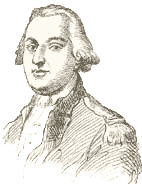 In 1754, Gage was assigned to North America for service in the French and Indian War. The following year he joined the disastrous Braddock campaign in western Pennsylvania, sharing hardships with George Washington, Horatio Gates and Charles Lee.
Gage was named the military governor of Montréal in 1760 and later was promoted to major general. In 1763, he became the commander of British soldiers in North America. Initially the mild-mannered general, who was married to an American woman, enjoyed considerable popularity.
New policies intended to strengthen central control of the empire touched off unrest in the American colonies. In 1768, reacting to local opposition to the Townshend Acts, Gage established a military garrison in Boston. He was promoted to lieutenant general in 1770.
In 1772, Gage returned to England during the temporary lull that followed the repeal of the Townshend duties and the violence of the Boston Massacre. However, tensions mounted again following the Boston Tea Party and the enactment of the punitive Coercive Acts, which Gage had helped to draft. In May 1774, he was returned to America, this time as military commander and royal governor of Massachusetts, replacing Thomas Hutchinson in the latter position. He was at this point the most powerful British official in the colonies, having vast authority over military, diplomatic and commercial matters as well as responsibility for relationships with the Indian tribes.
Gage’s strict enforcement of the Coercive Acts stirred opposition among the populace in Boston. He reacted by declaring martial law in late 1774 and began a program of collecting stores of powder from various militia repositories in the fear that armed force might be used against governing officials. These seizures continued into the following year when Gage dispatched soldiers into the countryside on April 18 to both collect arms in storage at Concord, then apprehend (unsuccessfully) Samuel Adams and John Hancock, arguably the two most vocal opponents of royal authority. The ensuing skirmishes at Lexington and Concord marked the first overt actions in what would become a war for independence.
Despite the outbreak of violence in April, Gage continued for nearly two months to believe that peace could be revived. In an effort to restore calm, he offered pardon to all except Adams and Hancock. Hope of reconciliation faded quickly, however. Gage ordered William Howe to attack a newly occupied and highly threatening American position on Breed’s Hill outside of Boston on June 17. The British offensive, known to posterity at the Battle of Bunker Hill, was successful, but at a tremendous cost, and much criticism of Gage followed. He was later recalled to London on the pretext of conferring on war plans, but instead was forced into virtual retirement. Howe succeeded him in the military command in the 13 colonies and Sir Guy Carleton was given similar power in Canada.
Gage was a "hawk" until the end. Even on board the ship that was taking him back to England, he composed a letter to Lord Dartmouth on October 15, advising him of the need for a general war against the colonies:
In 1754, Gage was assigned to North America for service in the French and Indian War. The following year he joined the disastrous Braddock campaign in western Pennsylvania, sharing hardships with George Washington, Horatio Gates and Charles Lee.
Gage was named the military governor of Montréal in 1760 and later was promoted to major general. In 1763, he became the commander of British soldiers in North America. Initially the mild-mannered general, who was married to an American woman, enjoyed considerable popularity.
New policies intended to strengthen central control of the empire touched off unrest in the American colonies. In 1768, reacting to local opposition to the Townshend Acts, Gage established a military garrison in Boston. He was promoted to lieutenant general in 1770.
In 1772, Gage returned to England during the temporary lull that followed the repeal of the Townshend duties and the violence of the Boston Massacre. However, tensions mounted again following the Boston Tea Party and the enactment of the punitive Coercive Acts, which Gage had helped to draft. In May 1774, he was returned to America, this time as military commander and royal governor of Massachusetts, replacing Thomas Hutchinson in the latter position. He was at this point the most powerful British official in the colonies, having vast authority over military, diplomatic and commercial matters as well as responsibility for relationships with the Indian tribes.
Gage’s strict enforcement of the Coercive Acts stirred opposition among the populace in Boston. He reacted by declaring martial law in late 1774 and began a program of collecting stores of powder from various militia repositories in the fear that armed force might be used against governing officials. These seizures continued into the following year when Gage dispatched soldiers into the countryside on April 18 to both collect arms in storage at Concord, then apprehend (unsuccessfully) Samuel Adams and John Hancock, arguably the two most vocal opponents of royal authority. The ensuing skirmishes at Lexington and Concord marked the first overt actions in what would become a war for independence.
Despite the outbreak of violence in April, Gage continued for nearly two months to believe that peace could be revived. In an effort to restore calm, he offered pardon to all except Adams and Hancock. Hope of reconciliation faded quickly, however. Gage ordered William Howe to attack a newly occupied and highly threatening American position on Breed’s Hill outside of Boston on June 17. The British offensive, known to posterity at the Battle of Bunker Hill, was successful, but at a tremendous cost, and much criticism of Gage followed. He was later recalled to London on the pretext of conferring on war plans, but instead was forced into virtual retirement. Howe succeeded him in the military command in the 13 colonies and Sir Guy Carleton was given similar power in Canada.
Gage was a "hawk" until the end. Even on board the ship that was taking him back to England, he composed a letter to Lord Dartmouth on October 15, advising him of the need for a general war against the colonies:
They give out that they expect peace on their own terms, through the inability of Britain to contend with them; and it is no wonder that such reports gain credit with the people, when letters from England and English newspapers give so much encouragement to rebellion. Many people are of the opinion that the Rebels will not hold together another year; but, though the Country will be very greatly distressed, and the people tired of the work, I will take the liberty to say, that from their presumption, arrogance, and encouragement from England, we can rely on nothing but our force to procure even decent terms of peace; and that if it was ever necessary to obtain peace through the means of war, it is highly so in the present juncture.Not only did Gage’s narrow view of his responsibilities serve to increase discontent in America during the 1760s and 1770s, but his scathing reports on colonial affairs did much to harden attitudes in London.