
Relations between the six Apache tribes, whose lands lay in the Southwest, and white settlers, progressively deteriorated with the ebb of Spanish domination in Mexico. By the mid-1800s, when the United States took over the region from Mexico, Apache lands lay open to the relentless American westward movement, which is sometimes referred to as Manifest Destiny.
Like elsewhere on the continent, the U.S. government's policy was to relegate Indians to reservations, but the Apaches rebelled. The natives' fierce, but ultimately hopeless resistance that persisted until the turn of the 20th century brought national notoriety to several of the Apache leaders, among them Geronimo, Cochise, Mangas Coloradas, and Victorio.
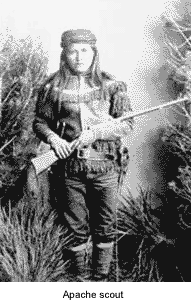 Apache terror ravaged settlements in Texas, New Mexico, Arizona and Mexico for nearly four decades. The warlike Apaches detested reservation existence. They resolved to lead their lives as they had in pre-European days, or die in the attempt.
In the 1860s, they took advantage of frontier army post closures because of the Civil War to step up their forays. Leaders headed small parties of audacious, merciless braves in hundreds of surprise assaults on white outposts.
A classic instance occurred in 1885 when approximately a dozen Apache braves fled from a reservation. In a month they covered an estimated 1,200 miles on horseback, slew nearly 40 persons, and stole more than 200 mules and horses. U.S. soldiers chased them, but the renegades eventually made it to the relative safety of Mexico.
The government ultimately opted for a program to cripple the tribes. Soldiers' marching orders were to "kill every Indian man capable of bearing arms and capture the women and children." Some leaders and their people survived, capitulated and went on to live peacefully on reservations, but other little bands fought on until the turn of the century.
Apache terror ravaged settlements in Texas, New Mexico, Arizona and Mexico for nearly four decades. The warlike Apaches detested reservation existence. They resolved to lead their lives as they had in pre-European days, or die in the attempt.
In the 1860s, they took advantage of frontier army post closures because of the Civil War to step up their forays. Leaders headed small parties of audacious, merciless braves in hundreds of surprise assaults on white outposts.
A classic instance occurred in 1885 when approximately a dozen Apache braves fled from a reservation. In a month they covered an estimated 1,200 miles on horseback, slew nearly 40 persons, and stole more than 200 mules and horses. U.S. soldiers chased them, but the renegades eventually made it to the relative safety of Mexico.
The government ultimately opted for a program to cripple the tribes. Soldiers' marching orders were to "kill every Indian man capable of bearing arms and capture the women and children." Some leaders and their people survived, capitulated and went on to live peacefully on reservations, but other little bands fought on until the turn of the century.