
The religious changes that occurred in England during the early 1500s were less concerned with doctrinal matters than was the case with the great Protestant Reformation then under way in continental Europe. Henry VIII, initially a staunch Roman Catholic, split with the Church over dynastic concerns: He sought to perpetuate the line of Tudor monarchs. Despite the emergence of an independent English church, religious loyalties remained deeply divided for decades.
In fact, the Church of England differed little from the Catholic Church, except for the central issue of allegiance to the pope. This lingering similarity was a matter of deep concern to many who felt that the English Reformation had not gone far enough.
The name "puritan" came to be used to describe members of the Church of England who wished to purify it of all semblances to the Roman Catholic Church, in particular the liturgy, vestments and episcopal hierarchy. The Puritans emphasized that they did not wish to destroy the Church of England, nor did they want to separate from it. Their sole aim was to restore it to its original purity.
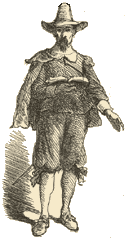 A radical minority within the Puritan movement, the Separatists, wanted to remove itself from the tainted English church and worship in its own independent congregations.
The death of Elizabeth I in 1603 brought profound changes to England. The new king, James I, bruised the feelings of many by asserting his “divine right” to rule and by supporting the business ventures and public careers of many English Catholics. These trends were deeply disturbing to the Puritans, many of whom began to entertain thoughts of escaping their increasingly repressive environment.
In spite of the fact they had left England, the Puritans who sailed to Massachusetts Bay in 1630 maintained they were not separatists, but wanted to purify the Church of England by establishing "a city upon a hill" as an example of how godly people should live.
Puritan political influence had largely disappeared in Massachusetts by the end of the 17th century, but attitudes associated with it remained. The Puritans, heirs to the Calvinist tradition, had emphasized that suffering was necessary to redeem oneself from original sin and that hard work not only produces wealth, but strong moral character (the "Puritan Ethic"). Those who did not devote themselves to hard work were in mortal danger of falling into evil ways. This stern devotion to seriousness and "getting ahead" became hallmarks of the Yankee character.
Although Puritanism as a theological movement had died out by the twentieth century, the term "puritanism" remained as a metaphor. H.L. Mencken wrote on the subject of Puritanism as a Literary Force in 1917:
A radical minority within the Puritan movement, the Separatists, wanted to remove itself from the tainted English church and worship in its own independent congregations.
The death of Elizabeth I in 1603 brought profound changes to England. The new king, James I, bruised the feelings of many by asserting his “divine right” to rule and by supporting the business ventures and public careers of many English Catholics. These trends were deeply disturbing to the Puritans, many of whom began to entertain thoughts of escaping their increasingly repressive environment.
In spite of the fact they had left England, the Puritans who sailed to Massachusetts Bay in 1630 maintained they were not separatists, but wanted to purify the Church of England by establishing "a city upon a hill" as an example of how godly people should live.
Puritan political influence had largely disappeared in Massachusetts by the end of the 17th century, but attitudes associated with it remained. The Puritans, heirs to the Calvinist tradition, had emphasized that suffering was necessary to redeem oneself from original sin and that hard work not only produces wealth, but strong moral character (the "Puritan Ethic"). Those who did not devote themselves to hard work were in mortal danger of falling into evil ways. This stern devotion to seriousness and "getting ahead" became hallmarks of the Yankee character.
Although Puritanism as a theological movement had died out by the twentieth century, the term "puritanism" remained as a metaphor. H.L. Mencken wrote on the subject of Puritanism as a Literary Force in 1917:
That primitive demonology still survives in the barbaric doctrines of the Methodists and Baptists, particularly in the South; but it has been ameliorated, even there, by a growing sense of the divine grace, and so the old God of Plymouth Rock, as practically conceived,is now scarcely worse than the average jail warden or Italian padrone. On the ethical side, however, Calvinism is dying a much harder death, and we are still a long way from the enlightenment. Save where Continental influences have measurably corrupted the Puritan idea—e.g., in such cities as New York, San Francisco and New Orleans,—the prevailing American view of the world and its mysteries is still a moral one, and no other human concern gets half the attention that is endlessly lavished upon the problem of conduct, particularly of the other fellow. It needed no official announcement to define the function and office of the republic as that of an international expert in morals, and the mentor and exemplar of the more backward nations. Within, as well as without, the eternal rapping of knuckles and proclaiming of new austerities goes on. The American, save in moments of conscious and swiftly lamented deviltry, casts up all ponderable values, including even the values of beauty, in terms of right and wrong. He is beyond all things else, a judge and a policeman; he believes firmly that there is a mysterious power in law; he supports and embellishes its operation with a fanatical vigilance.