spacer


spacer
nav

Chronological Eras
Information Tables
General Interest Maps
Glossary
History Quizzes

nav

California
Florida
New York
Oregon
Washington

nav

Read and Post Comments


Colonial America
Bacon's Rebellion
1676

During the 1670s, the administration of veteran Virginia governor Sir William Berkeley became unpopular with small farmers and frontiersmen, because of the following reasons:
  • Restrictions on the right to vote — the institution of a new land ownership requirement
  • Higher taxes
  • Low tobacco prices
  • A pervasive sense of subordination to an aristocratic minority
  • Lack of protection from Native American attacks.
The Indian problem was particularly vexing. In earlier times, Berkeley had worked to establish peace with the tribes and successfully negotiated a settlement in which lands east of the Blue Ridge Mountains were reserved for the white settlers. However, during the 1640s and 1650s, the burgeoning population began to spill over into Indian lands west of the mountains. This clear violation of treaty obligations led to deadly clashes between the races. Many Virginians, including many unemployed former indentured servants, thought the governor stood on the wrong side of this issue.

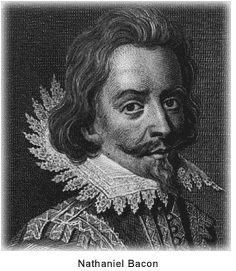
Nathaniel Bacon

In 1673, Nathaniel Bacon, a distant relative of Governor Berkeley, emigrated from England under murky circumstances and set up a small plantation on the James River. He rose rapidly in public esteem and was appointed to the governor’s council. The Indian issue soon polarized the two men.

After failing to extract a promise of action against the tribes, Bacon recruited a small armed force and in 1676 conducted two forays against the enemy. Berkeley was incensed, but Bacon became a popular hero and was elected to the House of Burgesses. When Bacon tried to take his seat in the assembly, he was arrested by the governor’s agents.

Soon released, Bacon raised a small army again and marched on Jamestown. The governor fled and the burgesses hastily enacted measures designed to subdue the Indians. Berkeley quickly returned with soldiers of his own and branded Bacon a rebel. The rebel forces initially prevailed, but they doubted their ability to hold out in Jamestown for an extended period and opted to torch the village instead.

Bacon became ill with dysentery and died in the fall of 1676; the rebellion collapsed immediately. Berkeley briefly returned to power and relentlessly hunted down the rebels before being recalled to England.

The rebellion's results were mixed: An unpopular governor had been temporarily removed. Real progress was made toward thwarting the Indian threat. The tribes realized that they stood little chance against the settlers' superior firepower and signed another peace treaty in 1677.

However, the political strength of the common farmers and laborers had not improved - they would long remain in the shadow of the Tidewater gentry. Further, these plantation-owning families came to realize that unemployed former indentured servants were a threat to social stability. They turned increasingly to the use of slaves, who were regarded as a safer source of labor and were less expensive.


Today the Jamestown National Historic Site and the Yorktown Battlefield are parts of the larger Colonial National Historic Park.
See Indian Wars Time Table.

Off-site search results for "Bacon's Rebellion"...

Bacon's Rebellion
... the People (30 July 1676) Robert Beverley on Bacon's Rebellion (1704) Legacy of Bacon's Rebellion Library of Congress Beginning, Progress, and Conclusion of Bacon's Rebellion in Virginia, In the Years 1675 and 1676 (in SerieBacon's Rebellion (1704) Legacy of Bacon's Rebellion Library of Congress Beginning, Progress, and Conclusion of Bacon's Rebellion in Virginia, In the Years 1675 and 1676 (in SerieBacon's Rebellion Library of Congress Beginning, Progress, and Conclusion of Bacon's Rebellion in Virginia, In the Years 1675 and 1676 (in SerieBacon's Rebellion in Virginia, In the Years 1675 and 1676 (in Series 8: Virginia ...
http://www.virginiaplaces.org/military/bacon.html

Bacon's Rebellion
The central figures in Bacon's Rebellion were opposites. Governor Sir William Berkeley, seventy when the crisis began, was a veteran of the English Civil Wars, a frontier Indian fighter, a King's favorite in his first term as GovernoBacon's Rebellion were opposites. Governor Sir William Berkeley, seventy when the crisis began, was a veteran of the English Civil Wars, a frontier Indian fighter, a King's favorite in his first term as Governor in the 1640 ...
http://www.nps.gov/colo/Jthanout/BacRebel.html

The Bacon rebellion
... the rebel Bacon,--when the whole assembly unanimously shouted, "Bacon! Bacon! Bacon!" and withdrew from the field, still repeating the name of that popular leader, the Patrick Henry of his day, and leaving the aged cavalier governor and his ...
http://www.publicbookshelf.com/public_html/The_Great_Republic_By_the_M ...

Sponsors of U-S-History.com:

Sponsor this site