
During the 1610s, the small English colony at Jamestown was essentially a failure. Fearful of losing their investment, the officers of the Virginia Company of London embarked upon a series of reforms designed to attract more people to the troubled settlement. They began by ending the company monopoly on land ownership, believing that the colonists would display greater initiative if they had an ownership position in the venture. Company officials also made justice in Virginia more predictable by adopting English common law as the basis of their system, which replaced the whims of the governor as the final voice on legal matters. In 1620 the company dispatched a boatload of marriageable women to the colony in an effort to create a more stable society. The going rate was 120 pounds of tobacco for each bride.
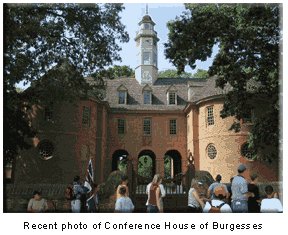 An additional inducement was provided by the company’s effort to make local government in Virginia more responsive to the colonists. In July 1619, a meeting of the House of Burgesses was held in Jamestown, the first such assembly in the Americas. The initial session accomplished little, however. It was cut short by an outbreak of malaria. The assembly comprised 22 members who represented the following constituencies:
Voting for the burgesses was limited to landowning males, 17 years of age or older.
In 1624, Virginia became a royal colony. The House of Burgesses continued to meet, but its influence became severely restricted. Despite limitations on its actions, the assembly listed within its later ranks such notables as George Washington, Thomas Jefferson and Patrick Henry, and would assume a major leadership role in the movement toward independence.