
James Monroe was born in Westmoreland County, Virginia, and was a schoolmate and friend of John Marshall. He attended the College of William and Mary, but left in 1776 to join the Continental Army. Monroe was wounded at Trenton and saw action at Brandywine and Monmouth.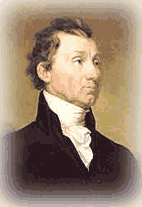
In 1782, Monroe was elected to the Virginia assembly and later to the Continental Congress. He thought the Articles of Confederation government needed a thorough overhaul, but opposed ratification of the Constitution in the Virginia Convention of 1789. Monroe's concerns were with the lack of democratic elements – no popular election of the president or senators and the absence of a Bill of Rights.
Despite his opposition to the Constitution, Monroe was elected to the Senate where he became allied with Thomas Jefferson and James Madison in opposition to the Federalist policies of Alexander Hamilton. From 1799 to 1802, he served as governor of Virginia.
Monroe was twice posted to France on diplomatic assignments, the second time in 1802 to negotiate the Louisiana Purchase. He also served as minister to Britain in 1807, where he failed to conclude a treaty affirming America's rights of neutrality.
Monroe challenged his friend Madison in the Election of 1808, an event that provoked their temporary estrangement. Their differences were eventually patched up, and Madison selected Monroe as secretary of state in 1811.
Monroe's victory in the Election of 1816 ushered in the "era of good feelings," a term indicating a relative lack of partisan bickering. It is true there was only one party at the time, but differences did exist on such vital issues as the tariff, the extension of slavery, and foreign affairs.
Major events that occurred during Monroe's two terms were the Missouri Compromise (1820), the Monroe Doctrine (1823), the acquisition of Florida, and the First Seminole War.
Monroe was a supporter of colonization for freed American slaves and was honored for this when the capital of Liberia, Monrovia, was named in his honor.
Monroe's retirement was not happy, owing primarily to financial problems. He had to sell his family homes and spent the final year of his life living with a daughter in New York City.
James Monroe was successful in keeping America out of war, but was not able to effectively address the simmering major issues of his day.