
Antipathy toward a strong central government was only one concern among those opposed to the Constitution. Of equal concern to many was the fear that the Constitution did not sufficiently protect individual rights and freedoms.
The concern for possible encroachment of personal liberties by state governments had already been manifested in the various state constitutions. That of Massachusetts, written by John Adams, adopted on June 15, 1780, and still today, as amended, the governing document of the commonwealth, began with a "Declaration of the Rights of the Inhabitants of the Commonwealth of Massachusetts," which ran to thirty articles and began with:
Article I. All men are born free and equal, and have certain natural, essential, and unalienable rights; among which may be reckoned the right of enjoying and defending their lives and liberties; that of acquiring, possessing, and protecting property; in fine, that of seeking and obtaining their safety and happiness.
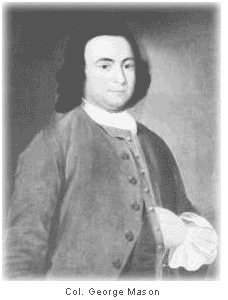 Virginian George Mason, author of Virginia's 1776 Declaration of Rights, was one of three delegates to the Constitutional Convention who refused to sign the final document because it did not enumerate individual rights. Together with Patrick Henry, he campaigned vigorously against ratification of the Constitution in Virginia. Indeed, five states, including Massachusetts, ratified the Constitution on the condition that such amendments be added immediately.
The first Congress convened in New York City in March, 1789. It was something of a role reversal when James Madison introduced the proposed amendments on June 8, 1789. It had been the position of Madison and the other Federalists that a bill of rights in the constitution was unnecessary, but there had been a clamor for one during the ratification process. Realizing that ratification would be difficult and perhaps impossible without pledging to add immediate amendments, the Federalists had switched their position. On September 25, 1789, twelve amendments were proposed by Congress. The first state to ratify the ten that became the Bill of Rights was New Jersey on November 20. On December 15, 1791, Virginia became the 11th state to ratify them and the Bill of Rights came into force. The final ratification from the 14 states then in existence came on April 19, 1792, when Connecticut approved the ten amendments. Vermont had both become a state and ratified the constitution with the amendments before this date.
The Bill of Rights comprises the first 10 amendments to the U.S. Constitution. Among their provisions:
The Bill of Rights is a series of Amendments to the Constitution and, therefore, is not subject to repeal by Congressional action.
Over the years, the Supreme Court has refined the precise meaning of the Bill of Rights through many court cases that established precedents. The First Amendment right to "free speech" has been extended to artistic expression and political demonstrations such as burning the American flag. Freedom of religion has been interpreted as denying the routine preference for Christianity that was universal in 1789. The right to bear arms is controversial at both the low end (handguns) and high end (assault weapons). The powers reserved to the states have been interpreted more narrowly since the New Deal. The two amendments proposed at the same time were not properly concerned with individual rights. One concerning representation in the House of Representatives has never been ratified. The other, regarding increases in salaries during terms of office, was ratified as the 27th amendment two centuries after being proposed by Congress.