
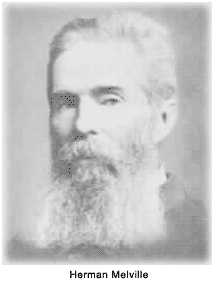
 Herman Melville was an American novelist, essayist and poet. He was popular during his early life, but his fame faded later. His materpiece, Moby Dick, was "rediscovered" in the 20th century.
Early years
Herman Melville was born in New York City on August 1, 1819. Born into an established merchant family, he was the third child of eight to Allan and Maria Gansevoort Melville. One of his grandfathers had taken part in the Boston Tea Party. Allan Melville, an importer of French dry goods, went bankrupt and died when Herman was 12. Maria Melville was left to rear the children, with her wealthy family's occasional help.
In 1826, Herman suffered permanently weakened eyesight from a bout of scarlet fever. In 1835, he enrolled in the Albany Classical School of New York, but dropped out and taught himself by devouring Shakespeare as well as historical, anthropological, and technical works. He began to work at the age of 12; he was a clerk, teacher, and farmhand, among other occupations.
Herman Melville was an American novelist, essayist and poet. He was popular during his early life, but his fame faded later. His materpiece, Moby Dick, was "rediscovered" in the 20th century.
Early years
Herman Melville was born in New York City on August 1, 1819. Born into an established merchant family, he was the third child of eight to Allan and Maria Gansevoort Melville. One of his grandfathers had taken part in the Boston Tea Party. Allan Melville, an importer of French dry goods, went bankrupt and died when Herman was 12. Maria Melville was left to rear the children, with her wealthy family's occasional help.
In 1826, Herman suffered permanently weakened eyesight from a bout of scarlet fever. In 1835, he enrolled in the Albany Classical School of New York, but dropped out and taught himself by devouring Shakespeare as well as historical, anthropological, and technical works. He began to work at the age of 12; he was a clerk, teacher, and farmhand, among other occupations.
In search of adventure, Herman shipped out as a cabin boy on the whaler Acushnet in 1839. He later joined the U.S. Navy, and experienced long voyages on ships sailing in the Atlantic and the South Seas. During that time, he lived briefly among the Typee cannibals in the Marquesas Islands. In his mid-twenties, Herman returned to his mother's house to write about his adventures. Publishing In 1846, Melville published Typee, the first work that told of his journeys and sojourn with the cannibals. The story told of a crew member of a whaling ship and his four months among a group of islanders in the Pacific Ocean, where he learned the distinction between savages and cannibals. Melville published its sequel, Omoo, in 1847. That story was based on his experiences in the Polynesian Islands, and was just as successful as its predecessor. On August 4, 1847, Melville married Elizabeth Shaw. The couple lived in New York City until 1850, when they purchased a farm in Pittsfield, Massachusetts, which they called Arrowhead. They lived there for 13 years. Neighboring author, Nathaniel Hawthorne, became a lifelong friend of Melville's. At Arrowhead, Melville wrote Moby Dick and Pierre. Those works did not win him the same success as his earlier books. Following poor reviews of Pierre, publishers became wary of his work. His main publisher, Harper’s, rejected his next manuscript, The Isle of the Cross, which has since been lost. Trying to make a living Bowing to financial need, Melville entered the lecture circuit. From 1857 to 1860, he spoke at lyceums, chiefly recounting his adventures in the South Seas. He also became a customs inspector for the City of New York, a post he held for 19 years. Later in his life, his works were no longer popular with a broad audience. He was not able to make money from writing, and depended on his wife's family, along with his own attempts at employment. Melville wrote a short novel, Billy Budd, which was kept in a tin can for 30 years. It was later published in 1924 and eventually was turned into an opera, play, and film. War poetry Melville was profoundly affected by the Civil War and it became the principal subject of his writing. Many of his family members participated in various aspects of the war, and through them, Melville became well connected to the events. He went to Washington, D.C. in 1861, and observed the Senate debating secession. He also made a trip to the front lines with his brother in 1864. Melville’s first book of published poems was Battle - Pieces and Aspects of the War, in 1866. The volume is regarded by numerous critics to be as ambitious and rich as any of his novels. Nevertheless, Melville remains relatively unrecognized as a poet. The falling pen Herman Melville died of a heart attack on September 28, 1891, at the age of 72. His remains were interred in the Woodlawn Cemetery in the Bronx, New York. At that time, he was nearly forgotten by all but a few admirers. During the week of Melville's death, The New York Times wrote: "There has died and been buried in this city ... a man who is so little known, even by name, to the generation now in the vigor of life that only one newspaper contained an obituary account of him, and this was but of three or four lines." It was not until the 1920s that the literary public began to recognize Herman Melville as one of America's finest writers.