
The Anti-Federalists opposed ratification of the Constitution and were typified by:
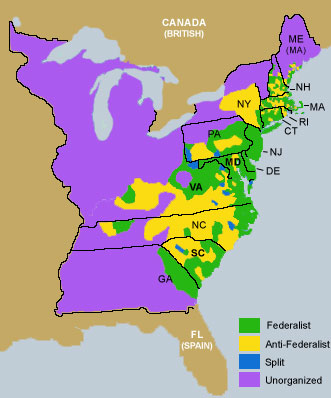
The first interesting question, therefore suggested, is, how far the states can be consolidated into one entire government on free principles. In considering this question extensive objects are to be taken into view, and important changes in the forms of government to be carefully attended to in all their consequences. The happiness of the people at large must be the great object with every honest statesman, and he will direct every movement to this point. If we are so situated as a people, as not to be able to enjoy equal happiness and advantages under one government, the consolidation of the states cannot be admitted.Anti-Federalists were concerned that the constitution did not equally divide power among the three branches of government. They also worried about giving the federal government the power to regulate commerce. An unknown Anti-Federalist who signed himself "Centinel" wrote a series of letters that appeared in the Philadelphia Independent Gazetteer in late 1787. One of the arguments for reforming the Articles of Confederation was that the requests for voluntary contributions from the states had been ignored. Centinel replied that this was more the fault of Congress than the states:
It is a maxim that a government ought to be cautious not to govern overmuch, for, when the cord of power is drawn too tight, it generally proves its destruction. The impracticability of complying with the requisitions of Congress has lessened the sense of obligation and duty in the people and thus weakened the ties of the Union; the opinion of power in a free government is much more efficacious than the exercise of it; it requires the maturity of time and repeated practice to give due energy and certainty to the operations of government.Anti-Federalists believed also that the Federalists were representing the interest of the "aristocratic" elements in society at the expense of the ordinary people in rural society. This was important at a time when the overwhelming majority of the population lived outside cities and earned a living by working the land. Luther Martin, who left the Constitutional Convention when he felt he could not support the direction it was taking, became a leading Anti-Federalist in Maryland. He argued that the constitution was fundamentally flawed in that it envisaged a compact between the people and the federal government, when the federal government could only be formed by an agreement of separate states that maintained their sovereignty. Anti-Federalists in Pennsylvania were frustrated by the rapid ratification engineered by the Federalist forces in that state, which was the second to do so. Robert Whitehill was prominent in the Anti-Federalist opposition to ratification, basing his views both on procedure and the failure of the new constitution to include a bill of rights. He put forward "Fourteen Points", in a document that was signed by 21 members of the Pennsylvania convention. Of these points, eight can be identified with provisions of the subsequent federal Bill of Rights. Writing under the pseudonym "Brutus," one or more Anti-Federalists composed responses to the arguments of The Federalist Papers. In one that appeared on January 31, 1788, Brutus noted the apparently unlimited power of the Supreme Court:
They will give the sense of every article of the constitution, that may from time to time come before them. And in their decisions they will not confine themselves to any fixed or established rules, but will determine, according to what appears to them, the reason and spirit of the constitution. The opinions of the supreme court, whatever they may be, will have the force of law; because there is no power provided in the constitution, that can correct their errors, or control their adjudications. From this court there is no appeal. And I conceive the legislature themselves, cannot set aside a judgment of this court, because they are authorised by the constitution to decide in the last resort.The term Anti-Federalist was later applied to the emerging political faction headed by Thomas Jefferson during the administration of George Washington. This faction would become known as both the Republican Party and the Democratic-Republican Party and later evolve into the Democratic Party.