
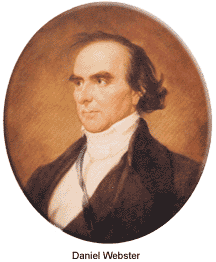
 Daniel Webster was born on January 18, 1782, in Salisbury (now Franklin), New Hampshire and educated at Phillips (Exeter) Academy and Dartmouth College. He studied law, taught briefly and was admitted to the New Hampshire bar in 1805. His law practice soon led him into political activities and he represented his home state in Congress from 1813 to 1817. Webster was a dependable ally of the New England shipping interests; he opposed the War of 1812, but did not lend his support to the Hartford Convention.
In 1816 Webster moved to Boston and became one of the nation’s leading attorneys. His participation in the Dartmouth College case and McCulloch v. Maryland left an enormous imprint on American constitutional law. Webster also matured into one of the great orators of his era, delivering notable speeches at the bicentennial of the founding of Plymouth in 1820 and the dedication of the Bunker Hill Monument in 1825.
When the Massachusetts Constitutional Convention met in 1820, Daniel Webster was against allowing all free men (slaves and women being ignored until much later) to vote for the upper house. In a speech at Plymouth Rock, he concluded:
Daniel Webster was born on January 18, 1782, in Salisbury (now Franklin), New Hampshire and educated at Phillips (Exeter) Academy and Dartmouth College. He studied law, taught briefly and was admitted to the New Hampshire bar in 1805. His law practice soon led him into political activities and he represented his home state in Congress from 1813 to 1817. Webster was a dependable ally of the New England shipping interests; he opposed the War of 1812, but did not lend his support to the Hartford Convention.
In 1816 Webster moved to Boston and became one of the nation’s leading attorneys. His participation in the Dartmouth College case and McCulloch v. Maryland left an enormous imprint on American constitutional law. Webster also matured into one of the great orators of his era, delivering notable speeches at the bicentennial of the founding of Plymouth in 1820 and the dedication of the Bunker Hill Monument in 1825.
When the Massachusetts Constitutional Convention met in 1820, Daniel Webster was against allowing all free men (slaves and women being ignored until much later) to vote for the upper house. In a speech at Plymouth Rock, he concluded:
In the nature of things, those who have not property, and see their neighbors possess much more than they think them need, cannot be favorable to laws made for the protection of property. When this class becomes numerous, it grows clamorous. It looks on property as its prey and plunder, and is naturally ready, at all times, for violence and revolution.The new Massachusetts constitution, when finally adopted, did not follow Webster's advice. Webster sympathized with the Greek revolution against Turkish oppression. Although he didn't go as far as Edward Everett, who recommended actual support for the rebels, Webster asked, "What do we not, as a people, owe to the principle of lawful resistance? to the principle that society shall govern itself?" His demand for at least verbal support from the United States was opposed by John Randolph of Roanoke. Webster was elected to Congress from Massachusetts in 1822 and served in the Senate from 1827 to 1841. During these years he underwent a political transformation, deserting his earlier free trade principles for strong support of the tariff. Webster had come to equate protectionism with the national interest. In 1830, in one of the greatest exchanges in Senate history, Webster opposed Nullification and argued for the supremacy of the federal government (Webster Hayne Debate). Webster and Andrew Jackson were united in their opposition to nullification, but disagreed on most other matters. The Boston Society for the Diffusion of Useful Knowledge was established in 1829 with Webster as one of its founding officers. He used the opportunity of a speech before the group in 1835 to expound his views on several subjects, where his Whig tendencies were distinctly at odds with Jacksonian Democrats. He viewed corporations as a means for financing progress, which would through the use of machines bring down prices to the benefit of all, all taking place in a society where a person's origins would not stand in the way of rising into higher economic classes. Webster yearned for the presidency, but failed to reach that ultimate goal — a disappointment he shared with such other great contemporaries as John C. Calhoun and Henry Clay. As secretary of state under William Henry Harrison and John Tyler, Webster negotiated the Webster-Ashburton Treaty in 1843, his greatest diplomatic achievement. His envoy Caleb Cushing negotiated the Treaty of Wanghia in 1844, which secured for the United States a fair basis for its Trade with China. From 1845 to 1850, Webster served again in the Senate where he worked on behalf of the Compromise of 1850. Inspired by John C. Calhoun's final speech, delivered on his behalf on March 4, Webster responded three days later with one of his greatest orations. Webster was personally opposed to slavery, but accommodated Southern concerns because of his deeply held belief that the preservation of the Union was more important than any other issue. This position cost him the support of anti-slavery groups in the North. From 1850 until his death, Webster was secretary of state under Millard Fillmore. When the Austrian charge d'affaires complained to him about American public support for the unsuccessful attempt by Hungarians to overthrow Austrian rule the previous year, Webster made clear that while official American policy might be neutral, it could be expected of the American public that they remain neutral in their opinions:
But the Undersigned goes further, and freely admits, that in proportion as these extraordinary events appeared to have their origin in those great ideas of responsible and popular governments, on which the American Constitutions themselves are wholly founded, they could not but command the warm sympathy of the People of this Country.Daniel Webster died on October 24, 1852, at his home in Marshfield, Massachusetts, after taking a fall from his horse and enduring a blow to his head.