
On September 11, 1814, the Battle of Plattsburgh became the most decisive engagement of the War of 1812. Lieutenant General Sir George Prevost`s failed invasion of the United States forced British ground troops back into Canada, and put an end to British plans to seize more American territory.
The fledgling United States navy defeated the world`s strongest naval power, on Lake Champlain. As a result, remaining British hopes of creating a homeland in the northwest for its Indian allies were abandoned.
Background
With an American Embargo Act against the British having been established in 1807, tensions between the U.S. and Great Britain remained high. On June 30, 1814, Governor General of Canada George Prevost received orders to establish a strong presence on Lake Champlain. By possessing exclusive navigation rights on the Great Lakes as well as possession of already conquered American soil, the British would be able to extend their already superior land and sea power.
 The primary targets of Plattsburgh and Sacket`s Harbor were pinpointed by British prime minister Lord Liverpool. With General Wellington`s troops enjoying a decisive victory over Napoleon, they began to shuttle their way into North America by the thousands with great confidence of destroying a patchwork-quilt American militia.
Preparing for battle
The Americans and British quickly began a shipbuilding race in the months leading up to the battle. Even though U.S. Commander Thomas Macdonough had close ties with the New York shipbuilder Noah Brown, America`s chances against the world`s best navy still looked like a long shot.
The USS Saratoga was Brown`s masterpiece. He launched the 120-foot marvel at the Vergennes shipyard in New York in the spring of 1814. Along with the completion of the Saratoga, the Americans had managed to build the 20-gun brig Eagle, which, amazingly, was completed in a record-breaking 17 days.
The British, however, were not far behind in their own ship-building process. They had managed to launch their newly constructed flagship, the 146-foot Confiance, at Isle aux Noix on the Richelieu River.
The primary targets of Plattsburgh and Sacket`s Harbor were pinpointed by British prime minister Lord Liverpool. With General Wellington`s troops enjoying a decisive victory over Napoleon, they began to shuttle their way into North America by the thousands with great confidence of destroying a patchwork-quilt American militia.
Preparing for battle
The Americans and British quickly began a shipbuilding race in the months leading up to the battle. Even though U.S. Commander Thomas Macdonough had close ties with the New York shipbuilder Noah Brown, America`s chances against the world`s best navy still looked like a long shot.
The USS Saratoga was Brown`s masterpiece. He launched the 120-foot marvel at the Vergennes shipyard in New York in the spring of 1814. Along with the completion of the Saratoga, the Americans had managed to build the 20-gun brig Eagle, which, amazingly, was completed in a record-breaking 17 days.
The British, however, were not far behind in their own ship-building process. They had managed to launch their newly constructed flagship, the 146-foot Confiance, at Isle aux Noix on the Richelieu River.
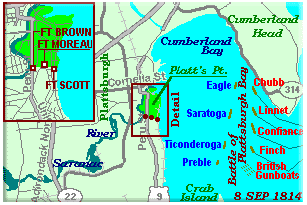
On the banks of Plattsburgh Bay By the end of the summer of 1814, Prevost had assembled a strike force of close to 10,000 soldiers, near Montreal. Many of those soldiers were well-trained, battle-hardened regular troops inspired by Wellington`s victory over Napoleon in Europe. On September 3, 1814, Prevost`s army crossed the Canadian border into New York State. At dawn on September 11, after having been encamped outside Plattsburgh for five days awaiting the navy, Great Britain`s Major General Frederick Philipse Robinson was eager to proceed to the banks of the Saranac River. While the British army moved down the western side of Lake Champlain, the American troops fell back to Plattsburgh and prepared to make a stand. At the same time, the ships of the British Navy under Captain George Downie moved slowly down the lake. The U.S. forces at Plattsburgh were commanded by Brigadier General Alexander Macomb. Macomb`s untrained volunteers were out-classed, outnumbered, extremely underpowered, and he knew it. If the Brits were to make their land offensive, Macomb had already made plans to blow up the town rather than let the enemy have it. The Americans were badly outnumbered, but had the support of the U.S. fleet under Thomas Macdonough. Realizing that the British had bigger ships and longer range guns, Macdonough anchored his squadron in Plattsburgh Bay and waited for the British Navy to come to him. Naval battle of Plattsburgh Under tremendous pressure from George Prevost, who was waiting outside Plattsburgh with his army, the British fleet prematurely sailed into battle. For two hours the ships exchanged a series of brutal assaults. Fifteen minutes into the battle, the British commander, George Downie, was decapitated by a 20-pound cannonball. Macdonough had a few tricks up his sleeve for the British. Remarkably, he was able to winch around his flagship around to deliver a fresh broadside against the British fleet. This stroke of genius made all difference; the British realized they were beaten, and they surrendered. After the war, Prevost`s poorly calculated conduct during the campaign was criticized by a naval court martial. He died before he could clear his name. Victory Just as Major General Robinson was about to order a free-for-all massacre on Macomb`s weak army of mostly farmers, a message was delivered to him stating that the British fleet had been defeated, and giving a direct order from Prevost to make a general retreat. In disbelief, Robinson`s troops (outnumbering the U.S. three to one) turned back for the Canadian border. While the British retreated, a loud cheer of victory could be heard by Macomb`s men as they waved their rifles above their heads in excitement. For the United States, the victory against overwhelming odds at Plattsburgh provided an important boost to national morale, ultimately ending the War of 1812.