
There must be no second-class citizens in this country. - President Dwight D. Eisenhower.
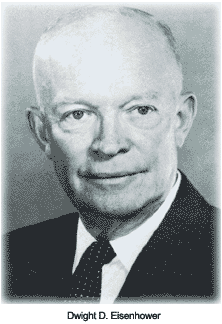 Dwight D. Eisenhower, General of the Army and the 34th President of the United States, was not only a remarkable soldier, but also a pivotal technician in the art of leadership.
Bringing to the presidency his stature as commanding general of the successful forces in Europe during World War II, Eisenhower obtained a truce in Korea and worked endlessly during his two terms to ease the tensions of the Cold War. Eisenhower's "Modern Republicanism" brought a sense of security and honor to an uncertain America.
Early years
Dwight David Eisenhower was born on October 14th, 1890, in a house by railroad tracks in Denison, Texas. His ancestors had emigrated from Germany to Pennsylvania early in the 18th century. After a short stay in Texas, the family moved to Abilene, Kansas.
His father, David, worked as a mechanic in a local creamery. His mother, Ida, a Mennonite, was a pacifist. Eisenhower respectfully did chores around the house, indulged a passion for hunting and fishing, while also enjoying baseball and football — becoming a star athlete. He had minimal interest in academic subjects, but eagerly read military history.
Eisenhower graduated from Abilene High School in 1909. After two years of working at odd jobs, he was appointed to the Naval Academy at Annapolis, but was too old for admittance. However, in 1910, he received an appointment to West Point.
West Point
Although Eisenhower had no preliminary ambitions to become a soldier, he entered West Point -- attracted by a free higher education -- and passed the entrance exams in 1911.
Eisenhower was an average student at the academy, but would later surprise the military community with exceptional ability. At one point, he nearly had to retire his studies owing to a sports injury. Ranking 61st out of 164 in his class, Eisenhower graduated in 1915.
World War I
While stationed at Fort Sam Houston, Texas, Eisenhower met his beloved and future first lady, Mamie Geneva Doud, whom he married in Denver, Colorado, on July 1, 1916. The couple produced two sons: Doud Dwight Eisenhower, who died in infancy from scarlet fever, and John Sheldon Doud Eisenhower.
Eisenhower was promoted to captain in 1917 when America entered World War I. Just two years into his army career, he had already been identified by his superiors as a young officer with excellent organizational skills. For this reason, Eisenhower was not posted abroad but sent to Camp Colt, Gettysburg.
At that camp, one of America’s first tank units was being formed, and it was Eisenhower’s task to train the men. His leadership skills became evident, and even though Eisenhower had not seen combat, he was awarded the Distinguished Service Medal.
Further education
Eisenhower would continue his involvement with tanks. He met Colonel George S. Patton, future tank general, at Camp Meade in Maryland. Eisenhower was assigned to the Panama Canal Zone in 1922, where Brigadier General Fox Connor swifly became his mentor. With considerable military-history expertise, General Connor taught Eisenhower strategy and tactics from his own experiences, as well as other political and military encounters.
In accordance with Connor, young Eisenhower was stationed at Fort Leavenworth, Kansas, where he attended the Command and General Staff School - a training ground for promising leaders. While there, Eisenhower received the honor of best student out of a class of 300 in 1926.
By 1928, Eisenhower had also graduated first in his class at the Army War College. The 38-year-old major was building an extraordinary resume, and high-ranking officials began to take notice.
General Douglas MacArthur, army chief of staff, quickly sought out Major Eisenhower. By 1932, Eisenhower, posting as an aide to MacArthur, began a rigorous task of building and training a Philippines army in Manila.
Eisenhower continued his call of duty with MacArthur's Army in the Philippines for seven years. In 1939, the "staff position" Lieutenant Colonel Eisenhower returned home.
A relatively small American army in proportion to the size of the nation existed in 1939. That would change with World War II.
World War II
With the threat of a second world war on the brink of unfolding, senior officers skilled in organization were on high demand — and Eisenhower's organizational skills were his strong suit. In 1941, he was promoted to the rank of brigadier general.
After the surprise attack on Pearl Harbor, General George C. Marshall, the army's chief of staff, put Eisenhower in charge of the War Plans Division based in Washington, D.C. In 1942, Marshall placed him in command of the invasion of North Africa. In 1944, he was made Supreme Allied Commander for the invasion of Normandy on D-Day.
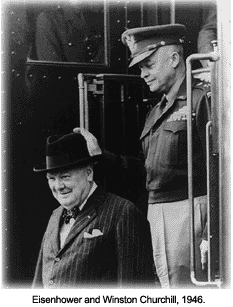 The meticulous planning Eisenhower had been responsible for overseeing, paid off. Compared to the numbers involved, few Allied troops were killed on D-Day, the exception being the casualties at bloody Omaha Beach, one of the landing zones. From Normandy in northern France, the Allies pushed out and Paris was freed in August.
On December 15th, 1944, in recognition of the work he had done, Eisenhower was promoted to the highest rank in the American army — General of the Army.* Just a few days later, Eisenhower had to put up defenses against the Germans' surprise counterattack in the Ardennes — the Battle of the Bulge. The Germans finally surrendered on May 7th, 1945.
After the war, Eisenhower served as U.S. Army Chief of Staff. In 1948, he retired from the army, later becoming president of Columbia University, and then head of NATO in 1950.
The meticulous planning Eisenhower had been responsible for overseeing, paid off. Compared to the numbers involved, few Allied troops were killed on D-Day, the exception being the casualties at bloody Omaha Beach, one of the landing zones. From Normandy in northern France, the Allies pushed out and Paris was freed in August.
On December 15th, 1944, in recognition of the work he had done, Eisenhower was promoted to the highest rank in the American army — General of the Army.* Just a few days later, Eisenhower had to put up defenses against the Germans' surprise counterattack in the Ardennes — the Battle of the Bulge. The Germans finally surrendered on May 7th, 1945.
After the war, Eisenhower served as U.S. Army Chief of Staff. In 1948, he retired from the army, later becoming president of Columbia University, and then head of NATO in 1950.
President of the United States
Eisenhower was a popular president throughout his two terms in office.
With a campaign slogan that couldn't miss, "I like Ike," Eisenhower and his vice president, Richard M. Nixon, posted landslide victories in both 1952 and 1956. His moderate Republican policies helped him secure many victories in Congress, where Democrats held the majority during six of the eight years that Eisenhower was in the White House.
Eisenhower helped to strengthen such established programs as Social Security and launch important new ones, such as the Interstate Highway System in 1956, which became the single largest public works program in U.S. history.** In domestic policy the president pursued a middle course, continuing most of the New Deal and Fair Deal programs, and emphasizing a balanced budget.
There were problems and failures as well as achievements. Although he signed civil rights legislation in 1957 and 1960, Eisenhower disliked having to deal with racial issues. He never endorsed the Supreme Court’s ruling in 1954, Brown v. Board of Education (Kansas), that racially segregated schools were unconstitutional, and he failed to use his moral authority as president to urge speedy compliance with the court’s decision. In 1957, he did send federal troops to Little Rock, Arkansas, when mobs tried to block the desegregation of Central High School, but he did so because he had a constitutional obligation to uphold the law, not necessarily because he supported integration.
Eisenhower also refrained from publicly criticizing Senator Joseph McCarthy, who used his powers to abuse the civil liberties of dozens of citizens whom he accused of anti-American activities. Eisenhower privately despised McCarthy, and he worked behind the scenes with congressional leaders to erode McCarthy's influence. Eisenhower’s indirect tactics eventually worked, but they also prolonged the senator’s power, since many people concluded that even the president was unwilling to confront McCarthy.
In September 1955, Eisenhower suffered a heart attack in Denver, Colorado.
After seven weeks he left the hospital, and in February 1956 doctors reported his recovery. In November he was elected for his second term.
Cold War
Six months after he became president, Eisenhower secured an agreement that ended three years of fighting in Korea. On only one other occasion, in Lebanon in 1958, did Eisenhower send combat troops into action. However, defense spending remained high as Eisenhower vigorously waged the Cold War, the acute ideological, political, military and economic contest between Communist countries and the West, just short of hot war. He placed new emphasis on nuclear strength — popularly known as "massive retaliation" — to prevent the outbreak of world war.
Eisenhower also frequently authorized the Central Intelligence Agency (CIA) to undertake secret interventions to overthrow unfriendly governments or protect reliable anti-Communist leaders whose power was threatened. The CIA helped topple the governments of Iran in 1953 and Guatemala in 1954, but it suffered an embarrassing failure in 1958 when it intervened in Indonesia. Eisenhower avoided war in Indochina in 1954 when he did not authorize an air strike to rescue French troops at the crucial Battle of Dien Bien Phu.
After the French granted independence to the nations of Indochina (Cambodia, Laos, and Vietnam), Eisenhower employed U.S. power and prestige to help create a non-Communist government in South Vietnam, an action that would exert disastrous long-term consequences.
The death of Joseph Stalin (1953), during Eisenhower's first term in office, caused shifts in relations with Russia. Eisenhower "waged peace," hoping to improve U.S.-Soviet relations. His attempts made it possible for future negotiations on a treaty that would ban nuclear testing in the air and seas. Unfortunately, the Soviet downing of a U.S. reconnaissance plane — the U-2 Spy Plane Incident of May 1, 1960 — ended any prospect of a treaty before Eisenhower left office.
Later years
Throughout and beyond his term as president, Eisenhower followed his mother's heart and concentrated on maintaining world peace. He watched in delight the development of his "Atoms for Peace" program — loans of American uranium to "have-not" nations for peaceful purposes.
Eisenhower, in his final address to Congress before he left office for his Gettysburg farm in January 1961, emphasized the necessity of maintaining adequate military strength, but cautioned:
In the councils of government, we must guard against the acquisition of unwarranted influence, whether sought or unsought, by the military-industrial complex. The potential for the disastrous rise of misplaced power exists and will persist. We must never let the weight of this combination endanger our liberties or democratic processes. We should take nothing for granted. Only an alert and knowledgeable citizenry can compel the proper meshing of the huge industrial and military machinery of defense with our peaceful methods and goals, so that security and liberty may prosper together.He concluded with a prayer for peace "in the goodness of time." Both themes remain timeless and urgent more than 40 years after his departure from this world on March 28, 1969, following a long battle with coronary heart disease. Mamie Eisenhower continued to live on the farm, devoting more time to family and friends, then died on November 1, 1979. Her remains are buried beside those of her husband and first child in a small chapel, on the grounds of the Eisenhower Library in Abilene, Kansas.