
The North African Campaign, or Desert War, took place in the North African desert during World War II between 1940 and 1943. North Africa is a region generally considered to include Algeria, Egypt, Libya, Mauritania, Morocco, Sudan, Tunisia, and the Western Sahara. Before World War II, European powers held long-established positions in the region. Algeria was a colony of France, Libya of Italy, and the British held two tiny but strategic points in the Mediterranean -- Gibraltar at the straits opening to the Atlantic and Malta in its center. France and particularly Britain heavily influenced Egypt as a result of their joint ownership of the Suez Canal. German influence was slight and there was no American bases. Italy was a full member of the Axis alliance but was not as committed to territorial aggrandizement as Germany. Until June 1940, the United States held out hope that Italy could be kept on the sidelines despite its philosophical inclinations, in the same way Franco was not bringing Spain into the war. However, five days after the Germans invaded France, Italy declared war on both Britain and France on June 10, 1940. Speaking at the University of Virginia on that very day, Roosevelt made clear the position of his government:
On this tenth day of June, 1940, the hand that held the dagger has struck it into the back of its neighbor. On this tenth day of June, 1940, in this University founded by the first great American teacher of democracy, we send forth our prayers and our hopes to those beyond the seas who are maintaining with magnificent valor their battle for freedom. In our American unity, we will pursue two obvious and simultaneous courses; we will extend to the opponents of force the material resources of this nation; and, at the same time, we will harness and speed up the use of those resources in order that we ourselves in the Americas may have equipment and training equal to the task of any emergency and every defense. All roads leading to the accomplishment of these objectives must be kept clear of obstructions. We will not slow down or detour. Signs and signals call for speed—full speed ahead.After the defeat of France and the withdrawal of British forces at Dunkirk, North Africa became the focus of land battle between the Axis and Allied forces. Without a declaration of war, American participation was limited to material support, with no American troops entering the conflict until 1942. The North African Campaign was fought mainly for two reasons. The first was the Suez Canal, which was crucial to controlling the Middle East. The second was Middle Eastern oil resources. Control of Egypt was especially important because it sat at the center of a vital geographic-strategic network that included the Eastern Mediterranean, Abyssinia (better known as Ethiopia, invaded by the Italians in 1936 and liberated by Britain in 1941), the Middle East as well as the Suez Canal. When Italian dictator Benito Mussolini declared war on the Allies on June 10, 1940, he already had more than a million men in the Italian army based in Libya. In neighboring Egypt, the British Army had only 36,000 men guarding the Suez Canal and the Arabian oil fields. Italian forces became a potential threat to Allied supply routes in the Red Sea and the Suez Canal.
 The early part of the North African Campaign was plagued by a lack of supplies on both sides. Sweeping battles took place that culminated with one side or the other`s supply lines growing too long while the other`s grew shorter. Major engagements of the campaign include the Battle of Gazala, First Battle of El Alamein, and the Second Battle of El Alamein. Most of the battles took place far to the east of the Italian bases and supply depots in Libya. By 1942, the Royal Navy had beaten the Italian fleet out of the Mediterranean, and allowed their own transports free movement. American forces landed in western North Africa in 1942.
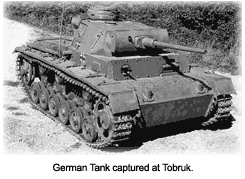
The Siege of Tobruk took place from April to August 1941. The Allied garrison, largely Australian, backed by British artillery and tanks, captured the fortress in the first Allied drive through Libya, and held it against great odds.
East African Campaign
The East African Campaign refers to the battles fought between British Commonwealth forces (including forces from India, South Africa, Nigeria, and Ghana) and Italy during World War II, often seen as part of the North African Campaign. The campaign began on August 4, when Italian forces stationed in Italian East Africa invaded British Somaliland, taking the capital on August 19. Commonwealth forces counterattacked from Sudan in the north and Kenya in the south. Those attacks were successful and resulted in total Italian defeat only 94 days after the initial invasion.
The early part of the North African Campaign was plagued by a lack of supplies on both sides. Sweeping battles took place that culminated with one side or the other`s supply lines growing too long while the other`s grew shorter. Major engagements of the campaign include the Battle of Gazala, First Battle of El Alamein, and the Second Battle of El Alamein. Most of the battles took place far to the east of the Italian bases and supply depots in Libya. By 1942, the Royal Navy had beaten the Italian fleet out of the Mediterranean, and allowed their own transports free movement. American forces landed in western North Africa in 1942.
The Siege of Tobruk took place from April to August 1941. The Allied garrison, largely Australian, backed by British artillery and tanks, captured the fortress in the first Allied drive through Libya, and held it against great odds.
East African Campaign
The East African Campaign refers to the battles fought between British Commonwealth forces (including forces from India, South Africa, Nigeria, and Ghana) and Italy during World War II, often seen as part of the North African Campaign. The campaign began on August 4, when Italian forces stationed in Italian East Africa invaded British Somaliland, taking the capital on August 19. Commonwealth forces counterattacked from Sudan in the north and Kenya in the south. Those attacks were successful and resulted in total Italian defeat only 94 days after the initial invasion.
 Western Desert Campaign
The Western Desert Campaign, or Libya-Egypt Campaign, began on September 13, 1940, when Italian forces stationed in Libya launched a small invasion into British-held Egypt and set up defensive forts. Allied forces were greatly outnumbered, but launched a counterattack called Operation Compass. It was more successful than planned and resulted in massive numbers of Italian prisoners of war and the advance of Allied forces up to El Agheila. However, Adolf Hitler had a plan to aid the Italians.
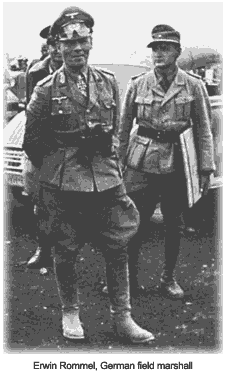
The Deutsches Afrikakorps controlled the German Panzer (tank) divisions in Libya and Egypt`s Western Desert. The Korps was commanded by "Desert Fox" General Erwin Rommel. Rommel launched an offensive that effectively returned both sides to their approximately original positions. Allied forces reorganized as the Eighth Army, which comprised units from armies of several countries, including Australia, India, South Africa, and New Zealand. The new formation launched an offensive and recaptured nearly all of the territory recently acquired by Rommel. After receiving supplies, Rommel attacked again and defeated the Allies. He drove them back to the border of Egypt, where he was finally stopped.
Western Desert Campaign
The Western Desert Campaign, or Libya-Egypt Campaign, began on September 13, 1940, when Italian forces stationed in Libya launched a small invasion into British-held Egypt and set up defensive forts. Allied forces were greatly outnumbered, but launched a counterattack called Operation Compass. It was more successful than planned and resulted in massive numbers of Italian prisoners of war and the advance of Allied forces up to El Agheila. However, Adolf Hitler had a plan to aid the Italians.
The Deutsches Afrikakorps controlled the German Panzer (tank) divisions in Libya and Egypt`s Western Desert. The Korps was commanded by "Desert Fox" General Erwin Rommel. Rommel launched an offensive that effectively returned both sides to their approximately original positions. Allied forces reorganized as the Eighth Army, which comprised units from armies of several countries, including Australia, India, South Africa, and New Zealand. The new formation launched an offensive and recaptured nearly all of the territory recently acquired by Rommel. After receiving supplies, Rommel attacked again and defeated the Allies. He drove them back to the border of Egypt, where he was finally stopped.
 Operation Torch
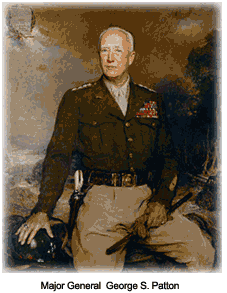
General Bernard Montgomery took over at that point as commander of Allied forces in North Africa. While British troops in Egypt were pushing the Germans west, U.S. forces under Major General George S. Patton Jr. led the invasion of French North Africa with the code name Operation Torch. There were specific objectives to the operation — to gain French-controlled Morocco, Algeria, and Tunisia as a base for enlisting the French empire in the war, to assist the British in the Libyan Desert, to open the Mediterranean to Allied shipping, and to provide a stepping stone for subsequent operations. The Allies hoped to force the Axis armies out of Africa, and also to relieve pressure on the Russian forces, which were struggling with a new German offensive in their homeland. Allied forces landed on the coast of Algeria and Morocco on November 8, 1942. The invasion caught the German high command completely by surprise. Eventually the French forces agreed to cease armed hostilities and allow Allied forces access to Tunisia.
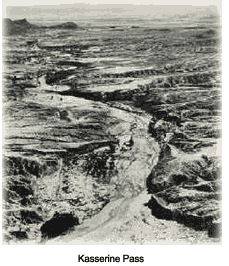
Rommel thus found himself between American and British forces, and managed to stall the Allies with a series of defensive operations, most notably with the Battle of the Kasserine Pass, in which American defenses crumbled due to the vast superiority of German tanks. The end result for the Americans was more than 1,000 dead, hundreds taken prisoner, and the loss of most of their heavy equipment. While some would call the Battle of Kasserine Pass a German victory, the indirect ramifications of the battle were felt just three days later. The Americans studied Kasserine Pass in detail and immediately initiated sweeping changes by restructuring command and coordinating aircraft with ground forces. That led to the Americans driving Rommel back through the Kasserine Pass towards his prepared position on the Mareth Line. Axis defenses were shattered, and the Allies managed to squeeze Axis forces until resistance in Africa ended with the surrender of more than 275,000 prisoners of war.
Operation Torch
General Bernard Montgomery took over at that point as commander of Allied forces in North Africa. While British troops in Egypt were pushing the Germans west, U.S. forces under Major General George S. Patton Jr. led the invasion of French North Africa with the code name Operation Torch. There were specific objectives to the operation — to gain French-controlled Morocco, Algeria, and Tunisia as a base for enlisting the French empire in the war, to assist the British in the Libyan Desert, to open the Mediterranean to Allied shipping, and to provide a stepping stone for subsequent operations. The Allies hoped to force the Axis armies out of Africa, and also to relieve pressure on the Russian forces, which were struggling with a new German offensive in their homeland. Allied forces landed on the coast of Algeria and Morocco on November 8, 1942. The invasion caught the German high command completely by surprise. Eventually the French forces agreed to cease armed hostilities and allow Allied forces access to Tunisia.
Rommel thus found himself between American and British forces, and managed to stall the Allies with a series of defensive operations, most notably with the Battle of the Kasserine Pass, in which American defenses crumbled due to the vast superiority of German tanks. The end result for the Americans was more than 1,000 dead, hundreds taken prisoner, and the loss of most of their heavy equipment. While some would call the Battle of Kasserine Pass a German victory, the indirect ramifications of the battle were felt just three days later. The Americans studied Kasserine Pass in detail and immediately initiated sweeping changes by restructuring command and coordinating aircraft with ground forces. That led to the Americans driving Rommel back through the Kasserine Pass towards his prepared position on the Mareth Line. Axis defenses were shattered, and the Allies managed to squeeze Axis forces until resistance in Africa ended with the surrender of more than 275,000 prisoners of war.
 On May 12, 1943, the last organized Axis army force in Africa surrendered. The Allies had killed, wounded, or captured about 350,000 Axis soldiers, and had suffered about 70,000 casualties. After the victory in the North African Campaign, the stage was set for the Italian Campaign to begin.