
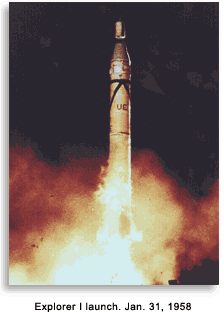
 On January 31, 1958, the United States launched its first satellite, known as Explorer 1, into orbit atop a modified Jupiter-C rocket. In so doing, it demonstrated that it was competitive in space with the Soviet Union, which had launched Sputnik nearly four months earlier.
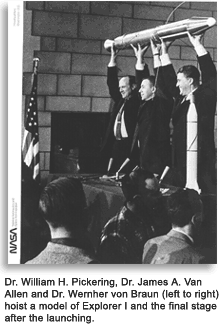
Scientist and engineer Wernher von Braun, while working at the U.S. Army Ballistic Missile Agency headquarters at Huntsville, Alabama, had headed the rocket project. The satellite itself was built by William Pickering and a team at the Jet Propulsion Laboratory (JPL) in Pasadena, California. At Iowa State University, Dr. James Van Allen, head of the physics department, and graduate student Wei Ching Lin, had constructed the cosmic-ray Geiger counters that constituted the science instruments of the Explorer mission.
On January 31, 1958, the United States launched its first satellite, known as Explorer 1, into orbit atop a modified Jupiter-C rocket. In so doing, it demonstrated that it was competitive in space with the Soviet Union, which had launched Sputnik nearly four months earlier.
Scientist and engineer Wernher von Braun, while working at the U.S. Army Ballistic Missile Agency headquarters at Huntsville, Alabama, had headed the rocket project. The satellite itself was built by William Pickering and a team at the Jet Propulsion Laboratory (JPL) in Pasadena, California. At Iowa State University, Dr. James Van Allen, head of the physics department, and graduate student Wei Ching Lin, had constructed the cosmic-ray Geiger counters that constituted the science instruments of the Explorer mission.
 Compared with the hefty 1,200 pound Sputnik 2, Explorer weighed a puny 18 pounds. Sputnik 2 had also carried the dog Laika, the first living thing to orbit the Earth. Laika survived four days before being overtaken by extreme temperatures when the cabin overheated. Van Allen's instruments, from this and two later Explorer satellites, discovered a previously unknown radiation belt around the planet. In Dr. Van Allen's honor, it was named the Van Allen Belt and was recognized as the greatest science contribution of the International Geophysical Year (1958).