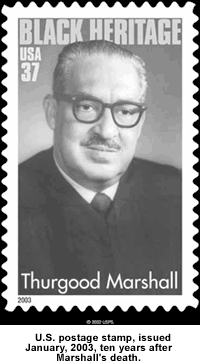
Thurgood Marshall was born in Baltimore, Maryland, on July 2, 1908. Marshall was the grandson of a slave. His father, William Marshall, made sure that his son gained an appreciation for the Constitution (text) from a young age.
Marshall completed high school in 1925 and graduated with honors from Lincoln University in Chester, Pennsylvania, in 1930. Just before his graduation, he married Vivian “Buster” Burey. After a 25-year marriage, she died from cancer in 1955. He remarried later.
Following his graduation in 1930, Thurgood Marshall applied to the University of Maryland Law School. He was not accepted because he was black, and that set in motion events of his future. That same year, Marshall was accepted to the Howard University Law School. A dynamic new dean, Charles Hamilton Houston, made sure that all of the students had the desire to apply the tenets of the Constitution (narrative) to all Americans.
In 1933, Marshall left Howard with a law degree and started a practice in Baltimore. The next year, he encountered the National Association for the Advancement of Colored People (NAACP) and became an active member.
From 1934 to 1961, the NAACP tapped him to travel throughout the United States to represent numerous kinds of court cases. Most of the clients had disputes involving questions of racial justice, which ranged from common crimes to appellate advocacy, raising the most-intricate matters of constitutional law.
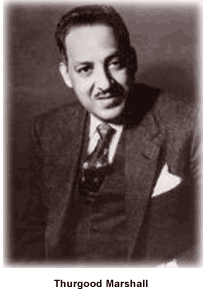 With the assistance of Charles Houston, Thurgood Marshall won his first major civil rights case, Murray v. Pearson, at the Maryland Supreme Court in 1935. The next year he became the assistant special counsel for the NAACP in New York. He then served as the chief counsel for the NAACP from 1938 to 1961. He guided the litigation that dismantled the legal underpinnings of Jim Crow segregation.
Beginning in 1940, Marshall won 29 of 32 U.S. Supreme Court cases. One of the first big cases was Smith vs. Allwrite in 1944, which overthrew the South's “White Primary." The White Primary was the practice of excluding African Americans from the Democratic Party. It was most common in a state where that party controlled state government.
His next successful win was Shelley v. Kraemer in 1948. That case involved the Supreme Court striking down the legality of racially restrictive covenants and forced the state courts to end racially restrictive real estate covenants.
In 1950, Thurgood Marshall won two more cases, Sweatt vs. Painter and McLaurin vs. Oklahoma State Regents, which were graduate-school integration cases. The next year he went to South Korea and Japan to investigate charges of racism in the United States armed forces. He discovered that the military was committing “rigid segregation” as a part of daily life, in spite of the fact that President Harry S. Truman had desegregated the armed forces in 1947.
Marshall went on to achieve a landmark victory with the case of Brown vs. Board of Education of Topeka (1954). That Supreme Court decision demolished the legal basis for segregation in America. It also made state-enforced racial segregation in public schools invalid.
In 1961, Thurgood Marshall was the first African American to be appointed to the United States Court of Appeals. He defended civil-rights demonstrators by winning a Circuit Court case, Garner vs. Louisiana.
Following numerous victories, Thurgood Marshall was nominated to the Second Court of Appeals by President John F. Kennedy in 1961. In that capacity, he issued 112 rulings. All of the rulings set in place by Marshall were later upheld by the Supreme Court. In 1965, he was appointed to be the United States Solicitor General by President Lyndon B. Johnson. While in this position, in which he argued for the government, he won 14 of 19 cases between 1965 and 1967.
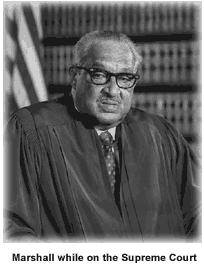 In 1967, Thurgood Thurgood Marshall became the first African American to be an associate justice on the United States Supreme Court. He was nominated by President Johnson, who declared that it was "the right thing to do, the right time to do it, the right man and the right place."
Marshall wanted to uphold positive gender and racial action policies in every case where they were challenged. During his 24 years, he became a vocal liberal on a court dominated by conservatives. He pressed for the government to assist with important benefits to people, including education, legal services, and access to courts.
He wanted those benefits to be available to everyone, regardless of their ability to afford them. He succeeded in fashioning new protections under the law for women, children, homeless persons, and prisoners.
Thurgood Marshall's steadfast progressive voting record included trenchant support for Constitutional protection of individual rights, in particular the rights of criminal suspects versus the government. Justice William Brennan was Marshall's most reliable confederate, who predictably voted with him against the death penalty. Marshall's backing of Affirmative Action prompted his stout dissent in Regents of the University of California vs. Bakke (1978), in which the University of California Davis medical school had, by setting a 16 percent minority quota, discriminated against a white applicant, Allan Bakke. As appointments by Presidents Nixon and Reagan altered the court's point of view, Marshall ended up more often in the voting minority.
Citing poor health, Thurgood Marshall stepped down from the court in 1991. In retirement, he was a vocal critic of the court. Marshall died on January 24, 1993, at age 84.