
Cotton Mather was a member of one of the most distinguished early Massachusetts families. Born in Boston, the son of Increase Mather and the grandson of John Cotton and Richard Mather, young Mather grew up under the watchful eye of the community and became the object of great expectations.
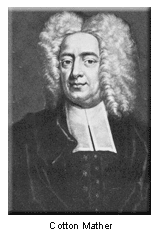 He entered Harvard at age 12, having already mastered Latin and Greek. He graduated six years later with a master’s degree, which was presented to him by his father, the president of the college.
Mather was deeply devoted to prayer and Bible study, but also harbored strong scientific interests that caused him to consider medicine as a vocation. Mather was initially doubtful about his prospects in the ministry because on account of persistent stuttering, perhaps attributable to the pressure of expectations placed upon him.
Through diligence, however, he managed to overcome his speech impediment and was ordained in 1685. He served with his father at North Church in Boston for 40 years.
Few figures in early American history have as many vocal admirers and detractors as Cotton Mather. He benefited the Massachusetts community by his lifelong commitment to doing good. His reform efforts included pleas to educators to motivate students through rewards, rather than punishments.
In the scientific realm, he was an early advocate for Smallpox inoculation, a stand that earned him the antipathy of many of his neighbors. He took the bold step of inoculating his son, who almost died from the procedure. Mather also took an active role in political matters, most notably by agitating against the governorship of Edmund Andros.
The Salem witchcraft hysteria is often cited to illustrate the narrow-minded side of Mather’s character. Like most educated people of the Western world, Mather believed that certain individuals had entered into compacts with the Devil and given up their souls in return for the powers of witchcraft.
His publication of Memorable Providences Relating to Witchcraft and Possession in 1689, probably increased public interest in the topic and may have contributed to the events that followed. Mather stood firmly behind the efforts to prosecute accused witches and urged the court to admit spectral evidence, the testimony of spirits who spoke through the victims of witchcraft.
As the frenzy spread to all elements of society, however, Mather modified his position. Some have suggested that he also tried to conceal his guiding hand in the early events.
Mather was the author of nearly 400 works — books, pamphlets, published sermons, and scientific tracts. His Magnalia Christi Americana (1702) was an extended ecclesiastical history of New England. While popular in its day, many later readers have found it difficult to overlook Mather’s constant interjection of his own views and judgments.
Puritanism was as much motivated to encourage work as worship. In 1701, Cotton Math wrote A Christian at His Calling, which began:
Every Christian ordinarily should have a calling. That is to say, there should be some special business, and some settled business, wherein a Christian should for the most part spend the most of his time; and this, that so he may glorify God... There is a variety of callings in the world; even as there are various objects, about which the callings of men are conversant, and various designs unto which the callings of men are intended. Some callings, are more immediately, to serve the souls of our neighbors; and some their safety and some their defense; and some their bodies; and some their estates; and some their delights. But it is not lawful for a Christian ordinarily to live without some calling or another, until infirmities have unhappily disabled him. Indeed a man cannot live without the help of other men. But how can a man reasonably look for the help of other men, if he be not in some calling helpful to other men?...His well-received Essays to Do Good (1710) urged all individuals to act for the betterment of the community. An account of his inoculation activities earned Mather membership in the Royal Society in London, making him the first American-born person to be so honored.
Cotton Mather was both a great and a tragic figure. His influence during his day was immense, but his efforts were increasingly directed toward a Massachusetts society that no longer existed. As the early decades of the 18th century passed, fewer citizens felt their society was in peril. The threats of Indian attack and starvation were long gone, and only Mather and his closest followers seemed to fear divine retribution for abandoning the strict tenets of the Puritan past.