
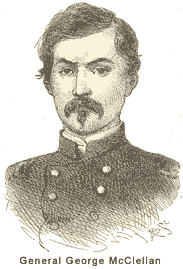
George McClellan was a native of Philadelphia, where he was born on December 3, 1826, and attended the University of Pennsylvania. In 1846 he graduated second in his class from West Point. McClellan served with distinction under Winfield Scott in the Mexican War. From 1848 to 1851 he taught military engineering at West Point. Following that assignment, he spent several years surveying routes for railroads, most significantly the path of the Northern Pacific across the Cascades.
 In 1855-56, McClellan was on assignment in the Crimea to study European warfare and submitted an exhaustive report on the siege of Sebastopol. At this time, he also designed the “McClellan saddle” by modifying European models; this saddle remained in use by American forces until the cavalry was disbanded.
McClellan resigned from the service in 1857 and became the head of engineering for the Illinois Central Railroad, an organization represented by attorney Abraham Lincoln. In 1860, McClellan was appointed president of the Ohio & Mississippi Railroad.
Following the outbreak of hostilities in 1861, McClellan reentered the service and was given command of federal forces in western Virginia. He was successful in defeating Confederate forces in a number of minor engagements, but received enough recognition to become known as the “Young Napoleon.” The nickname was partially inspired by his military successes, but also by his imperious manner of dealing with people.
Following the First Battle of Bull Run, McClellan was given command of the eastern federal forces, soldiers that would become the Army of the Potomac. His assignment was to protect the nation’s capital from Confederate attack and destroy the opposition forces in northern Virginia. McClellan’s efforts transformed the army, restoring discipline and morale. He failed, however, to engage the enemy, pleading instead for more soldiers, time and supplies. Lincoln grew tired of the delays and issued an order for the army to advance. McClellan balked and was able to convince the President that further delay was necessary.
In the spring of 1862, McClellan finally launched the “Peninsular Campaign,” an effort to take the Confederate capital of Richmond by advancing up the peninsula between the York and James rivers. McClellan’s forces won more battles than they lost, but were forced to retreat after the Seven Days` Battles. The objectives of taking Richmond and destroying the northern Confederate army were not achieved. Lincoln was displeased; McClellan responded by publicly criticizing the president and the War Department. The press, which had been clamoring for action, branded the general as “Mac the Unready.”
Following the Second Battle of Bull Run, McClellan commanded Union forces protecting Washington. He repeated his success with whipping the soldiers into fighting shape and was able to stop the army of Robert E. Lee at the Battle of Antietam. However, McClellan failed to take the initiative and pursue Lee’s forces. Lincoln was again dismayed and in November 1862 removed the general from his command.
McClellan waited for another military appointment, but none was forthcoming. Meanwhile, he emerged as a political figure. His sympathies lay with the states’ rights positions of the Democrats, but he was dedicated fully to preserving the Union. In 1864 McClellan received the party`s nomination and, early on, appeared to be in excellent position to defeat Lincoln in the Election of 1864. Improving reports from the front, however, enabled Lincoln to win handily in the fall. McClellan resigned from the army and took his family on an extended tour of Europe.
McClellan returned to the United States in 1868 and was later appointed chief engineer of the New York Department of Docks. In 1872 he was named the president of the Atlantic & Great Western Railroad. Remaining active in politics, McClellan was elected governor of New Jersey in 1877. His final years were devoted to traveling and writing. He justified his military career in McClellan’s Own Story (1877).
George B. McClellan was a truly brilliant military engineer and superior administrator. His lack of battlefield initiative, however, demonstrated a great weakness in the educational program of West Point where the emphasis was on training technicians, not warriors. It should be noted, however, that McClellan’s reluctance had some political roots; as a Democratic presidential hopeful he had no interest in crushing the South, only in defeating the forces of disunion. He died in Orange, New Jersey, on October 29, 1885.
In 1855-56, McClellan was on assignment in the Crimea to study European warfare and submitted an exhaustive report on the siege of Sebastopol. At this time, he also designed the “McClellan saddle” by modifying European models; this saddle remained in use by American forces until the cavalry was disbanded.
McClellan resigned from the service in 1857 and became the head of engineering for the Illinois Central Railroad, an organization represented by attorney Abraham Lincoln. In 1860, McClellan was appointed president of the Ohio & Mississippi Railroad.
Following the outbreak of hostilities in 1861, McClellan reentered the service and was given command of federal forces in western Virginia. He was successful in defeating Confederate forces in a number of minor engagements, but received enough recognition to become known as the “Young Napoleon.” The nickname was partially inspired by his military successes, but also by his imperious manner of dealing with people.
Following the First Battle of Bull Run, McClellan was given command of the eastern federal forces, soldiers that would become the Army of the Potomac. His assignment was to protect the nation’s capital from Confederate attack and destroy the opposition forces in northern Virginia. McClellan’s efforts transformed the army, restoring discipline and morale. He failed, however, to engage the enemy, pleading instead for more soldiers, time and supplies. Lincoln grew tired of the delays and issued an order for the army to advance. McClellan balked and was able to convince the President that further delay was necessary.
In the spring of 1862, McClellan finally launched the “Peninsular Campaign,” an effort to take the Confederate capital of Richmond by advancing up the peninsula between the York and James rivers. McClellan’s forces won more battles than they lost, but were forced to retreat after the Seven Days` Battles. The objectives of taking Richmond and destroying the northern Confederate army were not achieved. Lincoln was displeased; McClellan responded by publicly criticizing the president and the War Department. The press, which had been clamoring for action, branded the general as “Mac the Unready.”
Following the Second Battle of Bull Run, McClellan commanded Union forces protecting Washington. He repeated his success with whipping the soldiers into fighting shape and was able to stop the army of Robert E. Lee at the Battle of Antietam. However, McClellan failed to take the initiative and pursue Lee’s forces. Lincoln was again dismayed and in November 1862 removed the general from his command.
McClellan waited for another military appointment, but none was forthcoming. Meanwhile, he emerged as a political figure. His sympathies lay with the states’ rights positions of the Democrats, but he was dedicated fully to preserving the Union. In 1864 McClellan received the party`s nomination and, early on, appeared to be in excellent position to defeat Lincoln in the Election of 1864. Improving reports from the front, however, enabled Lincoln to win handily in the fall. McClellan resigned from the army and took his family on an extended tour of Europe.
McClellan returned to the United States in 1868 and was later appointed chief engineer of the New York Department of Docks. In 1872 he was named the president of the Atlantic & Great Western Railroad. Remaining active in politics, McClellan was elected governor of New Jersey in 1877. His final years were devoted to traveling and writing. He justified his military career in McClellan’s Own Story (1877).
George B. McClellan was a truly brilliant military engineer and superior administrator. His lack of battlefield initiative, however, demonstrated a great weakness in the educational program of West Point where the emphasis was on training technicians, not warriors. It should be noted, however, that McClellan’s reluctance had some political roots; as a Democratic presidential hopeful he had no interest in crushing the South, only in defeating the forces of disunion. He died in Orange, New Jersey, on October 29, 1885.