Gospel of Wealth: Putting the Best Face on Extreme Riches
The Gospel of Wealth, or sometimes the Gospel of Success, was the term for a notion promoted by many successful businessmen that their massive wealth was a social benefit for all. The Gospel of Wealth was a softer and more palatable version of Social Darwinism. The advocates linked wealth with responsibility, arguing that those with great material possessions had equally great obligations to society. No formal organization existed to put forth this viewpoint, but the following individuals represent a range of viewpoints:
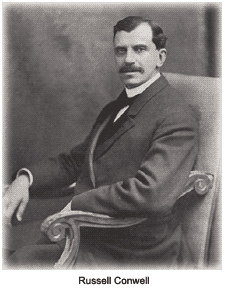
- Russell H. Conwell (1843–1925), a Baptist minister in Philadelphia, became an extremely wealthy man by delivering his stock lecture, Acres of Diamonds, to paying audiences. Conwell stressed the idea that wealth was available to all people and it was not necessary to travel afar in search of it. Opportunities existed in every village and town if only people would take the trouble to look. In his view, God was responsible for directing wealth to those who could use it for beneficial purposes. Conwell, the founder of Temple University in Philadelphia, became one of the great public speakers of his day and delivered his talk more than 6,000 times.
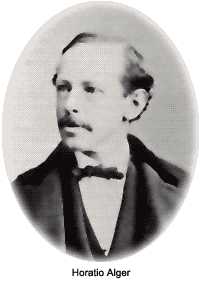
- Horatio Alger (1834-1899) was the son of a Unitarian minister and graduated with degrees from Harvard College and Harvard Divinity. He was rejected for service in the Civil War and became a minister on Cape Cod. Alger turned to writing after losing his pulpit under somewhat mysterious circumstances. In 1867, he published the first of more than 100 short novels depicting rags-to-riches stories meant to inspire the nation’s youth. Bearing such titles as Ragged Dick and Tattered Tom, the novels traced the rise of street urchins to positions of wealth and prominence. The virtues of loyalty, hard work, faith, thrift and clean living were trumpeted. Alger’s work made no pretense of literary merit, but was intended to convey the idea that great rewards awaited those who applied themselves and followed the rules. Alger, whose name became synonymous with successful fortune-seeking, sold more than 100 million books.
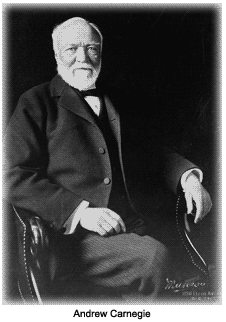 Andrew Carnegie">
- ^Andrew Carnegie^ (1835-1919), one of the great financial giants of his era, published an essay titled The Gospel of Wealth in 1889, in which he argued that the accumulation of wealth was beneficial to society and the government should take no action to impede it. Carnegie believed the rich were trustees of their money, holding it until proper public uses could be discovered. Unlike many of his contemporaries, Carnegie practiced what he preached and spent his last years giving away his vast fortune. One of his many charitable ventures was the funding of more than 2,800 public libraries. Carnegie wrote, “The man who dies rich dies disgraced.”
