
The great Shawnee chief and British ally Tecumseh had traveled South to recruit the Creeks to resist the American war effort. The Creeks did not decide to side with the British out of fondness; their bone of contention was with Americans who were seizing native homelands. In 1813, a series of raids was launched against white settlements, culminating in the capture of Fort Mims (north of Mobile, Alabama) in August 1813.
Andrew Jackson had attempted to secure a commission at the beginning of the war, but was turned down by Madison on account of the former's support of James Monroe in 1808. Nevertheless, with matters getting out of control on the southern frontier, Jackson was eventually given a command. He assembled a force of Tennessee volunteers and friendly Choctaws, rivals of the Creeks. Several indecisive battles ensued, notable principally for the volunteers' tendency to bolt when under attack. Jackson had several of his soldiers executed and order was quickly restored.
 The power of the Creeks was destroyed at the Battle of Horseshoe Bend in March 1814. Jackson began to emerge as a national figure.
In November 1814, Jackson captured Pensacola, Florida without authorization from his superiors. His aim was to end a threat posed by a small British garrison that had caused trouble in the area.
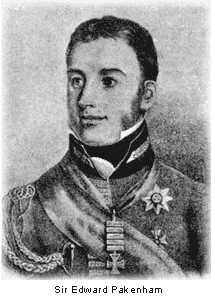
Unknown to Jackson, Major General Sir Edward Pakenham had prepared 3,000 soldiers in Jamaica and was sailing to New Orleans to open a British offensive in the South. Pakenham’s army was supplemented by other soldiers brought from England. The opposing armies met in the famed January 1815 Battle of New Orleans.
The power of the Creeks was destroyed at the Battle of Horseshoe Bend in March 1814. Jackson began to emerge as a national figure.
In November 1814, Jackson captured Pensacola, Florida without authorization from his superiors. His aim was to end a threat posed by a small British garrison that had caused trouble in the area.
Unknown to Jackson, Major General Sir Edward Pakenham had prepared 3,000 soldiers in Jamaica and was sailing to New Orleans to open a British offensive in the South. Pakenham’s army was supplemented by other soldiers brought from England. The opposing armies met in the famed January 1815 Battle of New Orleans.