Canadian Campaigns
In 1812, the United States prepared a three-pronged attack on Canada over the following routes:
- Lake Champlain. American forces were to move northward on Lake Champlain, follow the Richelieu River, and then west to Montreal. This phase of the campaign never really got off the ground. New York militia soldiers marched a few miles from their homes, and then refused to go farther. The American soldiers pulled back to regroup for a later try.
- Niagara Frontier. American forces were expected to flood into Ontario across the Niagara River. The largely volunteer army, however, bravely marched up to the border, but refused to leave New York State – a disturbing pattern for militia forces.
- Detroit. Prospects for a successful invasion of Upper Canada from Detroit appeared promising. A superior force was gathered under General William Hull, a veteran of the War for Independence, but the opportunity was squandered and the Americans surrendered Detroit in August without firing a shot. Hull’s incompetence was rewarded with a court-martial and a death sentence; he was, however, pardoned by President Madison.
An invasion of Canada was planned again in 1813, but the campaign failed to achieve its objective. However, two important victories were recorded:
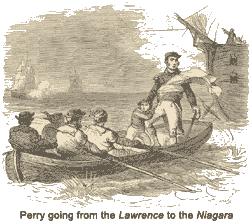
- Battle of Lake Erie. American forces under Oliver Hazard Perry constructed a small fleet out of green wood to challenge the British on Lake Erie. The two navies engaged on September 10, 1813, in a battle that lasted several hours. Perry’s flagship, the Lawrence, sustained heavy damage and he was forced to abandon ship in a small rowboat to seek safety on the Niagara. The American fleet rallied and forced the British forces to surrender.
Perry sent the following muted message to William Henry Harrison to announce his victory, “We have met the enemy and they are ours.” This American victory enabled Harrison to re-occupy Detroit.
- Battle of the Thames. In October 1813, a superior American force under Harrison forced the British out of Detroit. He pursued the British soldiers and their Native American allies under Tecumseh. General Henry Proctor, the British commander, retreated along the Thames River, but was forced to take up a nearly indefensible battle position near Chatham, Ontario. An American cavalry charge broke the opposition lines, creating a rout. Tecumseh was killed, effectively ending native cooperation with the British. General Proctor was court-martialed later for his actions at the Thames.
Additional fighting took place in Canada in 1814, but under altered circumstances. The war against Napoleon in Europe was drawing to a close and British soldiers were being transferred to North America.
- Battle of Chippewa. On July 5, 1814, American forces under Jacob Brown and Winfield Scott were celebrating independence; they were surprised by British regulars. This encounter on the Canadian side of the Niagara River was an old-style open field battle. The British lines broke and retired from the field, but both armies remained intact.
- Battle of Lundy’s Lane. This engagement was fought near Niagara Falls on July 25, 1814. American forces were led again by Brown and Scott. The protracted battle lasted five hours and resulted in more than 800 casualties on each side. Both armies claimed victory, but the British held the field at the end of the battle.
The American foray into Canada in 1814 was not defeated in the military sense; however, stalemate had the same effect as a loss. The Canadian invasion failed again.
