
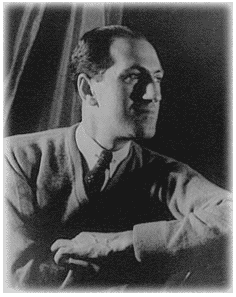
 George Gershwin was a gifted American composer. Most of his works were written with his older brother, Ira, who was a lyricist. George composed music for Broadway as well as the classical concert hall. Some of the greatest singers and musicians have recorded Gershwin songs, including Frank Sinatra, Billie Holiday, John Coltrane, and Judy Garland, along with numerous others.
Early years
George Gershwin was named Jacob Gershovitz at his birth on September 26, 1898, in Brooklyn, New York. He was the second of four children born to Morris and Rose Gershovitz.
Ira was George`s elder brother. He was expected to be the musician in the family. When the boys’ parents purchased a piano for Ira, they were surprised when George began to learn by ear. Both boys were given piano lessons. In 1912, George began to study with Charles Hambitzer, who became his strongest influence. Hambitzer introduced George to the music of Ravel, Chopin, and a broad spectrum of other classical piano masters.
George Gershwin was a gifted American composer. Most of his works were written with his older brother, Ira, who was a lyricist. George composed music for Broadway as well as the classical concert hall. Some of the greatest singers and musicians have recorded Gershwin songs, including Frank Sinatra, Billie Holiday, John Coltrane, and Judy Garland, along with numerous others.
Early years
George Gershwin was named Jacob Gershovitz at his birth on September 26, 1898, in Brooklyn, New York. He was the second of four children born to Morris and Rose Gershovitz.
Ira was George`s elder brother. He was expected to be the musician in the family. When the boys’ parents purchased a piano for Ira, they were surprised when George began to learn by ear. Both boys were given piano lessons. In 1912, George began to study with Charles Hambitzer, who became his strongest influence. Hambitzer introduced George to the music of Ravel, Chopin, and a broad spectrum of other classical piano masters.
Rapid rise George’s first job as a performer was as a piano pounder for a publishing company on Tin Pan Alley. His first commercial success was "Rialto Ripples" in 1916. He scored his first national hit in 1918 with "Swanee." Meanwhile, George was writing successful concert hall music, beginning with Rhapsody in Blue (1924). That piece was originally scored for piano and Jazz band, but was later arranged for symphony orchestra. It combined Jazz elements with the romantic heritage of classical music. The Concerto in F for piano and orchestra (1925), a larger work in three movements, also used blues and Jazzlike effects. Gershwin, an accomplished pianist, was the soloist in both those works` first performances. In 1924, George and Ira collaborated on a musical comedy, Lady Be Good, which included "Fascinating Rhythm" and "The Man I Love." George wrote the music and Ira wrote the lyrics. They followed that up with Oh Kay! in 1926, Funny Face in 1927, and in 1931, Of Thee I Sing, which was the first musical production to win a [#3694:Pulitzer] Prize. George continued to utilize his multiple talents with An American in Paris (1928). That symphonic poem is melodic, rhythmically arousing, imaginatively orchestrated, and genuinely American. Gershwin`s last symphonic work, for piano and orchestra, comprises variations on "I Got Rhythm." Porgy and Bess opened in 1935, billed as "an American folk opera," at the Alvin Theater in New York City. The music was composed by George Gershwin and the libretto by Ira Gershwin and DuBose Heyward. It was based on the latter`s novel, Porgy and the stage drama of the same name that he co-authored with his wife Dorothy. Today, it is revered by many as one of the finest examples of opera penned by an American composer. Porgy also is controversial, because it is considered by some to be racist. In 1936, George and Ira signed a contract with RKO Film Studios, and they moved to Hollywood, California. They supplied the songs for the movies Shall we Dance? and Damsel in Distress, both in 1937, and in 1938, The Goldwyn Follies. Those songs were considered to be the brothers` best collaborative works. Death in early middle age On July 11, 1938, when George was in Hollywood working on the score of the Goldwyn Follies, he collapsed and died. It was ruled that a brain tumor had taken his life; he was 38 years old. George was buried at the Westchester Hills Cemetery in Hastings-on-Hudson, New York. George had had a 10-year affair with composer Kay Swift. She had been a frequent consultant of George’s, and he named the musical Oh Kay! after her. Following George`s death, Kay arranged some of his music, transcribed some of his recordings, and collaborated with Ira on several other projects.