Share Would you like more applicants for your scholarships?
Spread the Word on U-S-History for free.
Electoral College
Electoral College
Article II, Section 1 of the U.S. Constitution provides for the Electoral College to be the device for electing the president and vice president. Each state was entitled to the number of electors equal to the sum of its senators plus its representatives. At the time of voting, each elector was to cast two ballots, supposedly selecting the two most qualified candidates. No distinction was to be made between the offices of president and vice president, but the candidate with the highest number of votes (if a majority) was to assume the former office and the runner-up the latter.
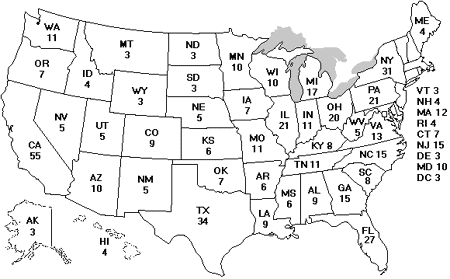
In case of a tie or plurality, a disputed election was to be submitted to the House of Representatives, where each state would cast a single vote.
The states were responsible for determining how to select the electors. Some states used popular elections, while others turned the task over to the state legislatures.
The idea of using the Electoral College was favored by the framers of the Constitution as a means of avoiding direct election, which was feared by many as too democratic.
Off-site search results for "Electoral College"...
Electoral College Top 20 ... a list of the individuals who have received the most votes for President in the Electoral College. 1.Franklin D. Roosevelt1,876 2.Richard Nixon1,040 3.Ronald Reagan1,015 4.Dwight D. Eisenhower 899 5.Bill Clinton 749 6.WoodroElectoral College. 1.Franklin D. Roosevelt1,876 2.Richard Nixon1,040 3.Ronald Reagan1,015 4.Dwight D. Eisenhower 899 5.Bill Clinton 749 6.Woodrow Wilson712 7 ... http://www.presidentsusa.net/electoralcollege.html
Electoral College 2000 ... Electoral College 2000, Alphabetical Order Electoral College 2000, Population Electoral College 2000, Poll Closing Time The number of electors for each state is equal to the number of Representatives plus the number of Senators. Electoral College 2000, Alphabetical Order Electoral College 2000, Population Electoral College 2000, Poll Closing Time The number of electors for each state is equal to the number of Representatives plus the number of Senators. Electoral College 2000, Population Electoral College 2000, Poll Closing Time The number of electors for each state is equal to the number of Representatives plus the number of Senators. Electoral College 2000, Poll Closing Time The number of electors for each state is equal to the number of Representatives plus the number of Senators. The candidate ... http://www.thegreenpapers.com/Electors.html
Students using u-s-history.com will often want to learn about colleges and universities in the United States, particularly their admissions policies and available financial aid. Click here for colleges and universities arranged alphabetically by state. Most colleges and universities offer financial aid and that information is available through the admissions office or somewhere else on their Web site.
Copyright 2001-2010 by Online Highways LLC. All rights reserved.