
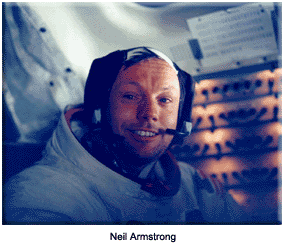
 Former test pilot and astronaut Neil Armstrong was the first man to walk on the surface of the moon in 1969, and was quoted as saying, “That's one small step for Man, one giant leap for mankind.”
Early years
Neil Alden Armstrong was born near Wapakoneta, Ohio, on August 5, 1930. He was a Eagle Scout in his youth. As an adult, he was recognized with the Distinguished Eagle Scout Award and the Silver Buffalo Award by the Boy Scouts of America.
In 1950, he served in the Korean War as a U.S. Navy fighter pilot. He flew 78 combat missions and received the Air Medal with two Gold Stars. Following the war, Armstrong enrolled in Purdue University. He graduated in 1955 with a bachelor of science degree in aeronautical engineering.
Armstrong then became a civilian test pilot with the National Advisory Committee for Aeronautics (NACA), the predecessor to NASA. He flew at the High-Speed Flight Station at Edwards Air Force Base, California. He was at the controls on many high-speed aircraft, including the 4,000-mph X-15. Armstrong flew more than 200 different kinds of aircraft, including jets, rockets, helicopters and gliders.
Into space
In 1962, Armstrong was transferred to astronaut status, and he served as the backup command pilot for the Gemini 5 mission in 1965. He was then assigned as command pilot for the Gemini 8 mission that was launched on March 16, 1966. Armstrong became the first to successfully dock two vehicles in space. He became the backup command pilot for the Gemini 11 mission in 1966, and also served as commander of the backup crew for the Apollo 8 lunar orbital mission in 1968.
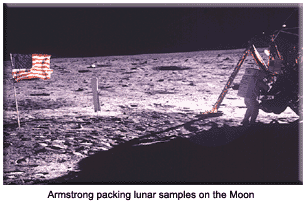 On July 16, 1969, the Apollo 11 mission was launched from the Kennedy Space Center in Florida. Neil Armstrong commanded the mission, along with Edwin “Buzz” Aldrin, the lunar module pilot; and command module pilot Michael Collins. The landing on the moon took place on July 20, 1969. After the landing on the moon Neil Armstrong's first words were: “Houston, Tranquility Base here. The Eagle has landed.” Six hours later, Armstrong climbed out of the lunar module and became the first person in history to walk on the moon. That is when his famous words were spoken: “That's one small step for Man, one giant leap for mankind.”
Post-lunar career
Following the lunar landing and a triumphal return, Armstrong took the position of Deputy Associate Administrator for Aeronautics, NASA Headquarters, in Washington, D.C. He was the overseer of the overall research and technology work related to aeronautics.
He became a professor of aerospace engineering at the University of Cincinnati from 1971 to 1979, followed by serving as chairman of Computing Technologies for Aviation, Inc. in Charlottesville, Virginia, from 1982 to 1992.
Armstrong also has served as a member of the National Commission on Space, from 1985 to 1986. He was the vice-chairman of the Presidential Commission on the Space Shuttle Challenger Accident in 1986, and served as chairman of the Presidential Advisory Committee for the Peace Corps from 1971 to 1973.
Honors for a pioneer
Armstrong has received honorary doctorates from 17 countries, and is the recipient of many other honors, including:
On July 16, 1969, the Apollo 11 mission was launched from the Kennedy Space Center in Florida. Neil Armstrong commanded the mission, along with Edwin “Buzz” Aldrin, the lunar module pilot; and command module pilot Michael Collins. The landing on the moon took place on July 20, 1969. After the landing on the moon Neil Armstrong's first words were: “Houston, Tranquility Base here. The Eagle has landed.” Six hours later, Armstrong climbed out of the lunar module and became the first person in history to walk on the moon. That is when his famous words were spoken: “That's one small step for Man, one giant leap for mankind.”
Post-lunar career
Following the lunar landing and a triumphal return, Armstrong took the position of Deputy Associate Administrator for Aeronautics, NASA Headquarters, in Washington, D.C. He was the overseer of the overall research and technology work related to aeronautics.
He became a professor of aerospace engineering at the University of Cincinnati from 1971 to 1979, followed by serving as chairman of Computing Technologies for Aviation, Inc. in Charlottesville, Virginia, from 1982 to 1992.
Armstrong also has served as a member of the National Commission on Space, from 1985 to 1986. He was the vice-chairman of the Presidential Commission on the Space Shuttle Challenger Accident in 1986, and served as chairman of the Presidential Advisory Committee for the Peace Corps from 1971 to 1973.
Honors for a pioneer
Armstrong has received honorary doctorates from 17 countries, and is the recipient of many other honors, including:
Neil Armstrong married Janet Shearon in 1956, and they have two sons. He lives in Ohio, and lives a secluded life.