
Few in the history of medicine and science have contributed as much to the world as Dr. Albert B. Sabin. Sabin was the developer of the oral live virus polio vaccine, which has saved the lives of countless millions.
Childhood and education
Albert Bruce Sabin was born in 1906 in Bia?ystok, Russia (now Poland). He and his family emigrated in to America in 1921, settling in Paterson, New Jersey. In 1930, Sabin became a naturalized citizen. He studied medicine at New York University, then interned at New York City’s Bellevue Hospital. He became the head of pediatric research at the University of Cincinnati.
 A prolific researcher
Dr. Sabin documented research in more than 350 scientific papers. Some of that research included work on pneumonia, encephalitis, toxoplasmosis, viruses, sand-fly fever, dengue and cancer. However, his passion was poliomyelitis (polio). Sabin turned his attention to it following World War II. He first thought the polio virus gained entrance through the respiratory tract, then found evidence that entry was through the digestive system.
Two vaccines compared
With the growing numbers of people affected with polio, he and other researchers, most notably Dr. Jonas Salk in Pittsburgh, sought a vaccine to prevent or to ameliorate the crippling disease. Salk's vaccine, called the "killed" vaccine, was tested and released for use in 1955. It was effective in preventing most of the complications of polio, but did not prevent the initial infection from occurring. Sabin's vaccine became available some five years later, when the United States Public Health Service endorsed his "live" virus vaccine for polio in 1961.
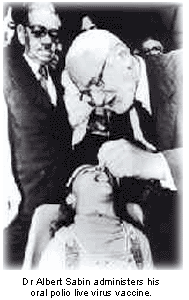
Sabin's oral vaccine offered advantages, especially in less-developed countries. One was the ease of administration: no shots. The second was that the live vaccine provided both intestinal and bodily immunity (killed vaccine provided bodily immunity alone, meaning immunized persons were still carriers). The third advantage was that it produced lifelong immunity without the need of a booster shot or vaccination.
By the time the U.S. Public Health Service approved testing, more than 80 million people outside the United States had already taken Sabin's vaccine. The first U.S. test was held on "Sabin Sunday," April 24, 1960.
Scientist and humanitarian
Throughout Albert Sabin’s life, he served on numerous advisory research committees. He received 46 honorary degrees from U.S. and foreign universities. He continued into his eighties to exert a significant impact on the international scientific community. Sabin's contributions were not just in the scientific world; he also was known as a humanitarian. He died in 1993, and is buried in Arlington National Cemetery.
A prolific researcher
Dr. Sabin documented research in more than 350 scientific papers. Some of that research included work on pneumonia, encephalitis, toxoplasmosis, viruses, sand-fly fever, dengue and cancer. However, his passion was poliomyelitis (polio). Sabin turned his attention to it following World War II. He first thought the polio virus gained entrance through the respiratory tract, then found evidence that entry was through the digestive system.
Two vaccines compared
With the growing numbers of people affected with polio, he and other researchers, most notably Dr. Jonas Salk in Pittsburgh, sought a vaccine to prevent or to ameliorate the crippling disease. Salk's vaccine, called the "killed" vaccine, was tested and released for use in 1955. It was effective in preventing most of the complications of polio, but did not prevent the initial infection from occurring. Sabin's vaccine became available some five years later, when the United States Public Health Service endorsed his "live" virus vaccine for polio in 1961.
Sabin's oral vaccine offered advantages, especially in less-developed countries. One was the ease of administration: no shots. The second was that the live vaccine provided both intestinal and bodily immunity (killed vaccine provided bodily immunity alone, meaning immunized persons were still carriers). The third advantage was that it produced lifelong immunity without the need of a booster shot or vaccination.
By the time the U.S. Public Health Service approved testing, more than 80 million people outside the United States had already taken Sabin's vaccine. The first U.S. test was held on "Sabin Sunday," April 24, 1960.
Scientist and humanitarian
Throughout Albert Sabin’s life, he served on numerous advisory research committees. He received 46 honorary degrees from U.S. and foreign universities. He continued into his eighties to exert a significant impact on the international scientific community. Sabin's contributions were not just in the scientific world; he also was known as a humanitarian. He died in 1993, and is buried in Arlington National Cemetery.