
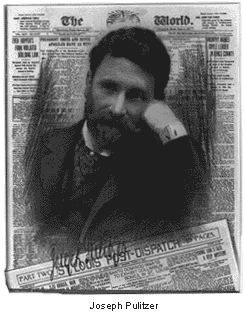
 Joseph Pulitzer was an American journalist and publisher who created, along with William Randolph Hearst, a new and controversial kind of journalism. Pulitzer supported organized labor, attacked trusts and monopolies, and exposed political corruption. He was committed to raising the standards of the journalism profession. Pulitzer was the founder of the Pulitzer Prize, the most prestigious award in American journalism.
Pulitzer was born in Mako, Hungary, on April 10, 1847. His father was a wealthy grain merchant of Magyar-Jewish origin, and his German mother was a devout Roman Catholic. Joseph grew up in Budapest, and was educated in private schools and by tutors.
He wanted to become a soldier, but his attempts to enlist in the Austrian Army, Napoleon's Foreign Legion for duty in Mexico, and the British Army for service in India, all failed owing to his weak eyesight and frail health. However, in Hamburg, Germany, he encountered a bounty recruiter for the U.S. Union Army and contracted to enlist as a substitute for a draftee, a procedure permitted under the Civil War draft system.
Pulitzer arrived in the United States in 1864, and settled in St. Louis, Missouri. His first jobs included working as a mule tender, waiter, and hack driver before he studied English at the Mercantile Library. In 1868, Pulitzer was recruited by Carl Schurz for his daily paper, the Westliche Post, published in German.
In 1878, Pultizer married Kate Davis, a niece of Jefferson Davis. In the same year, he acquired the St. Louis Post-Dispatch. He worked on the paper from morning to night. Determined to make it appealing to the public, he published investigative articles and editorials that assailed government corruption, wealthy tax-dodgers, and gamblers. The approach was effective, and the paper prospered with circulation reaching new heights.
In 1883, Pulitzer purchased the New York World for an estimated $300,000. He promised to use the paper to expose fraud, fight all public evils and abuses, and battle for the people with sincerity. He used one of his artists, Richard F. Outcault, to create cartoons depicting life in the slums. They were extremely popular with the readers; sales reached 600,000, making it the largest-circulating newspaper in the country.
Pulitzer worked with Nellie Bly, who pioneered investigative reporting by writing articles about poverty, housing, and labor conditions in New York City.
In 1895, Hearst purchased the New York Journal, which led to a journalistic war between Pulitzer and Hearst. That competition, particularly the coverage before and during the Spanish-American War, linked Pulitzer's name with the term yellow journalism.
In 1909, following the New York World's exposé of a fraudulent $40 million payment by the U.S. to the French Panama Canal Company, Pulitzer was indicted for libeling Theodore Roosevelt and J.P. Morgan. The courts dismissed the indictments, thus chalking up a victory for freedom of the press.
In 1892, Pulitzer offered Columbia University money to set up the country's first school of journalism; however, the university president turned down the offer.
In 1902, Columbia's new president, Nicholas Murray Butler, was much more receptive to the notion of a school. The dream would not be fulfilled until after Pulitzer’s death.
He left the university $2 million in his will, which led to the creation of the Columbia University Graduate School of Journalism in 1912*. Today, Columbia's Graduate School of Journalism is among the most prestigious in the world.
Joseph Pulitzer died aboard his yacht in the Charleston, South Carolina harbor, in 1911. He was laid to rest in the Woodlawn Cemetery in the Bronx, New York.
In 1917, the first Pulitzer Prizes were awarded, in accordance with Pulitzer's wishes. More than 2,000 entries are submitted each year; only 21 awards are normally conferred.
Joseph Pulitzer was an American journalist and publisher who created, along with William Randolph Hearst, a new and controversial kind of journalism. Pulitzer supported organized labor, attacked trusts and monopolies, and exposed political corruption. He was committed to raising the standards of the journalism profession. Pulitzer was the founder of the Pulitzer Prize, the most prestigious award in American journalism.
Pulitzer was born in Mako, Hungary, on April 10, 1847. His father was a wealthy grain merchant of Magyar-Jewish origin, and his German mother was a devout Roman Catholic. Joseph grew up in Budapest, and was educated in private schools and by tutors.
He wanted to become a soldier, but his attempts to enlist in the Austrian Army, Napoleon's Foreign Legion for duty in Mexico, and the British Army for service in India, all failed owing to his weak eyesight and frail health. However, in Hamburg, Germany, he encountered a bounty recruiter for the U.S. Union Army and contracted to enlist as a substitute for a draftee, a procedure permitted under the Civil War draft system.
Pulitzer arrived in the United States in 1864, and settled in St. Louis, Missouri. His first jobs included working as a mule tender, waiter, and hack driver before he studied English at the Mercantile Library. In 1868, Pulitzer was recruited by Carl Schurz for his daily paper, the Westliche Post, published in German.
In 1878, Pultizer married Kate Davis, a niece of Jefferson Davis. In the same year, he acquired the St. Louis Post-Dispatch. He worked on the paper from morning to night. Determined to make it appealing to the public, he published investigative articles and editorials that assailed government corruption, wealthy tax-dodgers, and gamblers. The approach was effective, and the paper prospered with circulation reaching new heights.
In 1883, Pulitzer purchased the New York World for an estimated $300,000. He promised to use the paper to expose fraud, fight all public evils and abuses, and battle for the people with sincerity. He used one of his artists, Richard F. Outcault, to create cartoons depicting life in the slums. They were extremely popular with the readers; sales reached 600,000, making it the largest-circulating newspaper in the country.
Pulitzer worked with Nellie Bly, who pioneered investigative reporting by writing articles about poverty, housing, and labor conditions in New York City.
In 1895, Hearst purchased the New York Journal, which led to a journalistic war between Pulitzer and Hearst. That competition, particularly the coverage before and during the Spanish-American War, linked Pulitzer's name with the term yellow journalism.
In 1909, following the New York World's exposé of a fraudulent $40 million payment by the U.S. to the French Panama Canal Company, Pulitzer was indicted for libeling Theodore Roosevelt and J.P. Morgan. The courts dismissed the indictments, thus chalking up a victory for freedom of the press.
In 1892, Pulitzer offered Columbia University money to set up the country's first school of journalism; however, the university president turned down the offer.
In 1902, Columbia's new president, Nicholas Murray Butler, was much more receptive to the notion of a school. The dream would not be fulfilled until after Pulitzer’s death.
He left the university $2 million in his will, which led to the creation of the Columbia University Graduate School of Journalism in 1912*. Today, Columbia's Graduate School of Journalism is among the most prestigious in the world.
Joseph Pulitzer died aboard his yacht in the Charleston, South Carolina harbor, in 1911. He was laid to rest in the Woodlawn Cemetery in the Bronx, New York.
In 1917, the first Pulitzer Prizes were awarded, in accordance with Pulitzer's wishes. More than 2,000 entries are submitted each year; only 21 awards are normally conferred.