
A plan to strengthen and unify the nation, the American System was advanced by the Whig Party and a number of leading politicians including Henry Clay, John C. Calhoun and John Quincy Adams. The System was a new form of federalism that included:
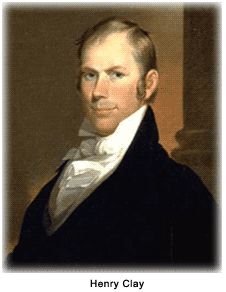 Clay argued that the West, which opposed the tariff, should support it since urban factory workers would be consumers of western foods. In Clay’s view, the South (which also opposed high tariffs) should support them because of the ready market for cotton in northern mills. This last argument was the weak link. The South was never really on board with the American System and had access to plenty of markets for its cotton exports.
Clay first used the term “American System” in 1824, although he had been working for its specifics for many years previously.
Portions of the American System were enacted by Congress. The Second Bank of the United States was rechartered in 1816 for 20 years. High tariffs were maintained from the days of Hamilton until 1832. However, the national system of internal improvements was never adequately funded; the failure to do so was due in part to sectional jealousies and constitutional scruples about such expenditures.
Despite his uneven success in gaining passage of all aspects of the American System, Henry Clay was proud of the plan. In a speech in Cincinnati in 1830, he declared:
Clay argued that the West, which opposed the tariff, should support it since urban factory workers would be consumers of western foods. In Clay’s view, the South (which also opposed high tariffs) should support them because of the ready market for cotton in northern mills. This last argument was the weak link. The South was never really on board with the American System and had access to plenty of markets for its cotton exports.
Clay first used the term “American System” in 1824, although he had been working for its specifics for many years previously.
Portions of the American System were enacted by Congress. The Second Bank of the United States was rechartered in 1816 for 20 years. High tariffs were maintained from the days of Hamilton until 1832. However, the national system of internal improvements was never adequately funded; the failure to do so was due in part to sectional jealousies and constitutional scruples about such expenditures.
Despite his uneven success in gaining passage of all aspects of the American System, Henry Clay was proud of the plan. In a speech in Cincinnati in 1830, he declared:
That system has had a wonderful success. It has more than realized all the hopes of its founders. It has completely falsified all the predictions of its opponents. It has increased the wealth, and power, and population of the nation. It has diminished the price of articles of consumption and has placed them within the reach of a far greater number of our people than could have found means to command them if they had been manufactured abroad instead of at home.