
What's Peshtigo? A small speck of a lumber town about 250 miles north of Chicago, near the western shores of the Bay of Green Bay.
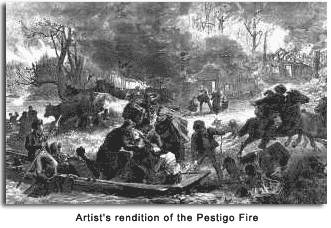 Conditions were ripe in the area in the fall of 1871, owing to an unusually dry summer. Small prairie fires were common and either burned themselves out or were quickly quenched. Loggers tried to to hold their slash burning to small areas. Some farmers needed to burn small piles of brush that had accumulated from clearing land for additonal crop-growing acreage. And a railroad was being constructed at that time, between Michigan's Upper Peninsula and Milwaukee, Wisconsin. This necessarily left debris to the sides of the track.
The Peshtigo paradigm
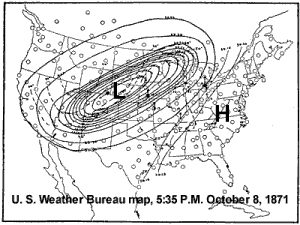
A cold front moved across a broad expanse of north central America that day, which brought swirling winds that allowed small fires to combine into larger ones. Circumstances, such as this wind, the topography of the area, and the abundant fuel, all came together to create a perfect setting for a catastrophic event. As the temperature rose, so did the wind's intensity. A firestorm, in essence "nature's nuclear explosion," burst into being.
The firestorm, whipped by what is today acknowledged to have been a low-grade tornado, was described as "a wall of flame, a mile high, five miles wide, traveling 90 to 100 miles an hour, hotter than a crematorium, turning sand into glass." It destroyed 12 pioneer towns and about 1.5 million acres, or nearly 2,000 square miles, of prime timber, and killed an estimated 2,200 people.
Traveling in a northeasterly direction, the fire leapt the Peshtigo River and burned a swath through the countryside before reaching the waters of Green Bay, where it finally died out.
An obscure disaster
Why does the largest and deadliest fire in the history of the United States go largely unnoticed?
Conditions were ripe in the area in the fall of 1871, owing to an unusually dry summer. Small prairie fires were common and either burned themselves out or were quickly quenched. Loggers tried to to hold their slash burning to small areas. Some farmers needed to burn small piles of brush that had accumulated from clearing land for additonal crop-growing acreage. And a railroad was being constructed at that time, between Michigan's Upper Peninsula and Milwaukee, Wisconsin. This necessarily left debris to the sides of the track.
The Peshtigo paradigm
A cold front moved across a broad expanse of north central America that day, which brought swirling winds that allowed small fires to combine into larger ones. Circumstances, such as this wind, the topography of the area, and the abundant fuel, all came together to create a perfect setting for a catastrophic event. As the temperature rose, so did the wind's intensity. A firestorm, in essence "nature's nuclear explosion," burst into being.
The firestorm, whipped by what is today acknowledged to have been a low-grade tornado, was described as "a wall of flame, a mile high, five miles wide, traveling 90 to 100 miles an hour, hotter than a crematorium, turning sand into glass." It destroyed 12 pioneer towns and about 1.5 million acres, or nearly 2,000 square miles, of prime timber, and killed an estimated 2,200 people.
Traveling in a northeasterly direction, the fire leapt the Peshtigo River and burned a swath through the countryside before reaching the waters of Green Bay, where it finally died out.
An obscure disaster
Why does the largest and deadliest fire in the history of the United States go largely unnoticed?
 Because on this very date, October 8, 1871, Mrs. O'Leary's cow supposedly kicked over the lantern. Yes, The Great Chicago Fire, which consumed 2,000 acres and claimed 300 lives, also occurred on this date — as did fires in Manistee, Saugatuck, and Holland, Michigan — and stole the spotlight from the Peshtigo fire, in part because communications to the rest of the world were better from those places.
Comet or coincidence? Fragment or figment?
Some scientists theorize that fragments of the expiring Biela's Comet survived entry into the earth's atmosphere and simultaneously set off fires around Lake Michigan. While it is tantalizing to try to connect the seemingly unconnectible events that occurred on that fateful day and night, there is no scientific evidence that ties these events together.
Because on this very date, October 8, 1871, Mrs. O'Leary's cow supposedly kicked over the lantern. Yes, The Great Chicago Fire, which consumed 2,000 acres and claimed 300 lives, also occurred on this date — as did fires in Manistee, Saugatuck, and Holland, Michigan — and stole the spotlight from the Peshtigo fire, in part because communications to the rest of the world were better from those places.
Comet or coincidence? Fragment or figment?
Some scientists theorize that fragments of the expiring Biela's Comet survived entry into the earth's atmosphere and simultaneously set off fires around Lake Michigan. While it is tantalizing to try to connect the seemingly unconnectible events that occurred on that fateful day and night, there is no scientific evidence that ties these events together.