
The personification of terror in the early 2000s can easily be identified with the name of one man: Osama bin Laden. He fought violently for the preservation of all Muslim nations by defying Western influences with all means necessary, which include various acts of terrorism.
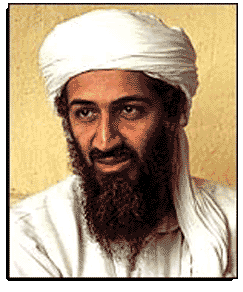 In 1988, bin Laden began to assemble a terrorist networking organization called al Qaeda, and declared jihad (holy war) against anyone who stepped in the way of his version of justice. On September 11, 2001, the world saw just how capable and determined his loyal followers had become.
Early life, school, and marriage
Osama bin Laden was born in 1957 to a Syrian mother. As the 17th of 52 stepbrothers and sisters, bin Laden learned early on how to fend for himself.
His father, Mohammed Awad bin Laden, migrated from South Yemen to the seaport of Jeddah around 1930. Awad bin Laden began his new citizenship in Saudia Arabia as a poverty-stricken porter (load carrier).
However, after eventually building up a successful construction company, and providing low-cost bids for many of reigning King Saud's palaces, Awad bin Laden eventually became the minister of public works for the Kingdom — placing his family at the number-two position of wealth in the country. Osama and his siblings were all treated as equals by their devoted Moslem father.
At the age of 13, Osama lost his father in a plane crash. By the time Osama was 17, he had taken a Syrian woman to be his wife. While still living in the city of Jeddah with his family, Osama completed his primary, secondary and even university education. In 1979, he eventually earned a degree in civil engineering from the University of Jeddah.
First Afghanistan conflict
The 1978 Soviet Union invasion of Afghanistan motivated bin Laden to support the defending mujahideen (freedom fighters). He initially visited Pakistan to meet with high officials, refugees, and citizens, to recruit freedom fighters.
After getting an eyeful of what the Soviets were up to, bin Laden returned to the Saudi kingdom to consult many of his brothers, friends and other relatives.
In 1982, bin Laden decided to enter Afghanistan with a hefty bankroll to support the mujahideen. While in Afghanistan, he established close ties with mujahideen leader, Sheikh Abdullah Azzam.
Afghanistan training camps
By 1984, bin Laden had initiated a staging area for strengthening his presence in Afghanistan. At the doorstep to the Afghan war, in Peshawar, Pakistan, bin Laden's staging area (also known as the Guest House) functioned as the first station for newly minted mujahedeen, before going to the front.
In 1986, bin Laden arranged to establish his own presence inside Afghanistan, and by 1988, he had erected more than six intensive-training camps. Some were mobilized more than once. That year, Osama decided to direct his own battles with his own command — eventually breaking ties with Sheikh Abdullah Azzam. He formed his own army, al Qaeda, (meaning "the base" in Arabic).
President Ronald Reagan signed a covert release of funds, high-end armaments, and CIA specialists to aid bin Laden, Azzam and the mujahideen. That American assistance helped to force the Soviets out of Afghanistan by 1989.
Banned by Saudi Arabia
At the end of 1989, just as the Soviet Union was finishing its withdrawal from Afghanistan, bin Laden returned home in anticipation of a warm welcome. Instead, he was issued a travel ban. He was not allowed to leave Saudi Arabia, owing to numerous inflammatory speeches he had given prior to his return, that advocated uprisings.
bin Laden was actually planning a new jihad in South Yemen. Further, his speeches and lectures had predicted the eventual invasion of Yemen by Saddam Hussein's forces. The Saudi regime disapproved of his stance because of close ties with Iraq.
On August 2, 1990, Iraqi forces invaded Kuwait, and shortly thereafter, American and coalition forces began to arrive in Kuwait's defense. Operation Desert Storm was now underway, which changed bin Laden's tone completely. He now planned to take the initiative against the U.S.
By lobbying religious scholars and Muslim activists, bin Laden succeeded in extracting a fatwah (declaration) from one of the senior scholars, that military training and readiness was a religious duty. He immediately circulated that fatwah and convinced potential fighters that they should get their training in Afghanistan.
It has been estimated that 4,000 men traveled to the Afghanistan training camps in response to the fatwah. The Saudi regime was not happy with bin Laden's activities, so they confined his movements to Jeddah only. That did little to restrain him; bin Laden left his homeland for good, and eventually headed back to war-torn Afghanistan.
Back to Afghanistan
Before heading for Afghanistan, bin Laden arrived in Pakistan to meet with various "business associates" for supporting his new terror regime. He knew, however, that if he were to stay in Pakistan too long, authorities would nab him and deport him to the kingdom that he now despised.
Osama soon realized that by remaining in Pakistan, he was putting himself in extreme jeopardy. So, with his mission for terror still in his sights, he headed directly for his camps in Afghanistan.
During bin Laden's stay in Afghanistan, as well as his short time in Pakistan, the Saudis tried more than once to kidnap or assassinate him, in collaboration with Pakistani intelligence. Fortunately for bin Laden, his close ties with higher officials in both Pakistan and Saudi Arabia provided up-to-date intelligence, which would give him enough time to escape.
In 1991, after becoming tired of hiding, bin Laden decided to leave Afghanistan and head for the only alternative country available to him: Sudan.
In Sudan
Osama's choice of Sudan had little to do with holy war or terrorism. He was simply attracted there because of its new regime. He wanted to have safe refuge as well as help the government with its construction projects.
While in Sudan, he again escaped an assassination attempt by Saudi intelligence. By 1994, the Saudis publicly announced that bin Laden's citizenship had been withdrawn. In 1996, with political pressures against bin Laden rising in Sudan, he secretly planned a trip back to Jalalabad, Afghanistan.
Ties to the Taliban
Within a few months of his arrival in Afghanistan, bin Laden issued his first anti-American message, an announcement of jihad against the superpower. At that time, bin Laden's declaration of jihad was limited only to expelling American forces from the Arabian Peninsula.
At the end of 1996, the Taliban easily swept Jalalabad, and bin Laden fell under their control. He was optimistic that they would give him sanctuary, but was uncertain. He was surprised when a Taliban delegation arrived to meet him by order of Mullah Omer, the leader, with instructions to reassure him that he would have even better protection under the Taliban.
Osama became aware that the main driving force behind the Taliban were the Ulema (religious scholars). He quickly established solid links with them and lobbied them specifically about ridding American forces from the Arabian Peninsula. He was able to convince the Ulema and won a fatwah signed by some 40 scholars in Afghanistan — sanctioning the use of all means to expel American forces from the peninsula.
He attracted Kashmiris, Pakistanis, Indians, and Muslims from the Soviet Republics. He thought at that stage he could establish an international alliance against the U.S.
bin Laden's rage
In July 1998, bombings rocked the U.S. embassies in Kenya and Tanzania, and the media pointed their finger at none other than bin Laden. Hundreds of people had died, and many more were wounded as a result of the terrorist attacks.
In retaliation for the bombings, Americans chose an al Qaeda camp in Khost, Afghanistan, to bombard by air. Bin Laden was hundreds of miles away, and the fighters were on the northern front.
Following the American retaliation, bin Laden was placed under heavy protection and advised to stay in hiding by Taliban leader Abdullah Jan Wahedi. bin Laden and the Taliban were being forced to defend themselves against the United Front under the command of the anti-Taliban military commander and Mujahideen, Ahmad Shah Massoud.
Laden's followers protected the Kabul front and pushed Massoud's forces back.
September 11, 2001
bin Laden remained underground for nearly three years. On September 11, 2001, four American airliners were hijacked by members of bin Laden's militant Islamist group, al Qaeda. The result was horrific. Two planes were purposely piloted by terrorists into the twin towers of the World Trade Center in New York City; another smashed into the Pentagon in Washington, D.C., while the fourth plummeted to the ground, short of its target, in Pennsylvania. As a result of those terrorist suicide attacks, nearly 2,800 Americans lost their lives — including many New York firefighters and police.
As a result of those acts of violence, President George W. Bush declared his own form of jihad against all terrorists, with special references to Osama bin Laden. A few months later, the U.S. began to crush the Taliban in Afghanistan while attempting to flush out bin Laden.
While American forces were infiltrating Afghanistan, bin Laden was busily recording terrorist video tapes in undisclosed locations throughout Afghanistan. By using the tapes to take credit for the carnage on September 11, they were merely a means for bin Laden to unleash terror propaganda.
As of 2005, Osama bin Laden's whereabouts were unknown, but rumor placed him in the mountainous border region between Pakistan and Afghanistan. He was the most wanted terrorist in the world, and the FBI offered a $25 million reward for information leading to his capture.
In the early hours of the morning on May 2, 2011, a force of American SEALs conducted a raid on the house in Abbotabad, Pakistan, where Osama bin Laden had been hiding for months, perhaps years. In the course of the raid, bin Laden was killed by shots to the head and chest. After positive identification, his body was buried at sea.