Americans with Disabilities Act - (ADA)
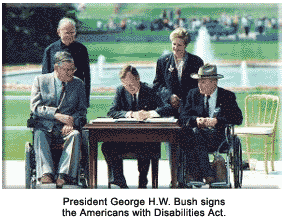
On January 23, 1990, the 101st Congress passed the "Americans with Disabilities Act of 1990" (ADA), which was then signed by President George Bush. It established comprehensive protection for people with a variety of disabilities in many aspects of public life.
The impetus for the ADA grew out of the Civil Rights Movement of the 1960's. Federal legislation to protect civil rights initially focused on the prevention of racial discrimination. Having seen the federal government involve itself in protecting racial minorities, advocates for the disabled began to agitate for protection for their constituency as well.
Their first success came when, in 1988, the Fair Housing Act was amended to add people with disabilities and families with children for the classes of persons covered. Then in 1973, the Rehabilitation Act prohibited discrimination against someone with a disability by anyone receiving federal assistance, but it did not cover discrimination by employers, public accommodations in the private sector, publicly funded programs or those providing federal financial assistance. Coverage for all disabilities did not take place until the passage of the ADA.
 Findings and purposes of the Congress
Findings
(1) Some 43,000,000 Americans have one or more physical or mental disabilities, and that number is increasing as the population as a whole grows older.
Findings and purposes of the Congress
Findings
(1) Some 43,000,000 Americans have one or more physical or mental disabilities, and that number is increasing as the population as a whole grows older.
(2) Historically, society has tended to isolate and segregate individuals with disabilities, and, despite some improvements, such forms of discrimination against individuals with disabilities continue to be a serious and pervasive social problem.
(3) Discrimination against individuals with disabilities persists in such critical areas as employment, housing, public accommodations, education, transportation, communication, recreation, institutionalization, health services, voting, and access to public services.
(4) Unlike individuals who have experienced discrimination on the basis of race, color, sex, national origin, religion, or age, individuals who have experienced discrimination on the basis of disability have often had no legal recourse to redress such discrimination.
(5) Individuals with disabilities continually encounter various forms of discrimination, including outright intentional exclusion, the discriminatory effects of architectural, transportation, and communication
barriers, overprotective rules and policies, failure to make modifications to existing facilities and practices, exclusionary qualification standards and criteria, segregation, and relegation to lesser services, programs, activities, benefits, jobs, or other opportunities.
(6) Census data, national polls, and other studies have documented that people with disabilities, as a group, occupy an inferior status in the society, and are severely disadvantaged socially, vocationally,
economically, and educationally.
(7) individuals with disabilities are a discrete and insular minority who have been faced with restrictions and limitations, subjected to a history of purposeful unequal treatment, and relegated to a position
of political powerlessness in the society, based on characteristics that are beyond the control of such individuals and resulting from stereotypic assumptions not truly indicative of the individual ability of such individuals to participate in, and contribute to, society.
(8) the nation's proper goals regarding individuals with disabilities are to assure equality of opportunity, full participation, independent living, and economic self-sufficiency for such individuals.
(9) the continuing existence of unfair and unnecessary discrimination and prejudice denies people with disabilities the
opportunity to compete on an equal basis and to pursue those opportunities for which the free society is justifiably famous, and costs the United States billions of dollars in unnecessary expenses resulting from dependency and nonproductivity.
Purposes
(1) To provide a clear and comprehensive national mandate for the elimination of discrimination against individuals with disabilities.
(2) To provide clear, strong, consistent, enforceable standards
addressing discrimination against individuals with disabilities.
(3) To ensure that the federal government plays a central role in
enforcing the standards established in this chapter on behalf of
individuals with disabilities.
(4) To invoke the sweep of congressional authority, including the
power to enforce the Fourteenth Amendment and to regulate commerce, in order to address the major areas of discrimination faced day to day by people with disabilities.
The Americans with Disabilities Act consists of five titles:
Title I - Employment - directed by the U.S. Equal Employment Opportunity Commission (EEOC); and the U.S. Department of Labor (DOL).
Title II - Public Services - (and public transportation) directed by the Federal Transit Administration (FTA); U.S. Department of Health and Human Services (HHS); U.S. Department of Education (ED); U.S. Department of Housing and Urban Development (HUD).
Title III - Public Accommodations - directed by U.S. Department of the Interior (DOI); U.S. Department of Agriculture (USDA).
Title IV - Telecommunications - directed by the Federal Communications Commission (FCC).
Title V - Miscellaneous Provisions -.
Examples of cases that determined the constitutionality of ADA provisions
Tennessee v. Lane, 541 U.S. 509 (2004), was a Supreme Court case regarding Congress's enforcement powers under section 5 of the Fourteenth Amendment.
The plaintiffs included disabled Tennesseans who were not able to access the upper levels in state courthouses. They sued in federal court, arguing that since Tennessee was denying them public services because of their disabilities, it was violating Title II of the Americans with Disabilities Act (ADA). Under Title II, no one can be denied access to public services due to his or her disability, and it allows those whose rights have been violated to sue states for money damages. Plaintiffs in this case were successful in their suit against Tennessee.
Board of Trustees of the University of Alabama v. Garrett, 531 U.S. 356 (2001), became a United States Supreme Court case that determined that the Congress's enforcement powers under the Fourteenth Amendment to the
Constitution did not extend to the abrogation of state sovereign immunity under the
Eleventh Amendment where the discrimination complained of was based on disability.
