
At the outbreak of the American Civil War, the navies of the world still relied primarily on wooden ships. The battle between two ironclad vessels, the Union's Monitor and the Confederacy's Virginia, on March 9, 1862, signaled the start of the era of armored navies.
On April 20, 1861, Union forces at the Norfolk Naval Yard scuttled a federal frigate, the Merrimac, in order to keep it out of enemy hands. The ship, whose name was sometimes spelled "Merrimack," was later raised by Confederate forces and rechristened the CSS Virginia. The vessel underwent major renovations, including removal of the superstructure above the waterline and the construction of a slanted top (prompting some observers to compare the ship to a floating barn roof). Eight inches of iron sheeting was applied to the exterior. Ten 12-pound cannons were installed as well as a massive battering ram on the bow. The craft was extremely long and cumbersome to maneuver, requiring almost a mile to turn around. Her commander was Captain Franklin Buchanan.
The Union forces were aware of the Confederate ship and looked for counter measures. A design by John Ericsson was approved and the name "Monitor" adopted. Built on Long Island at Greenpoint, she had a displacement of almost a thousand tons and a length of 172 feet. It was a strange-looking vessel, presenting only a flat deck topped by a 9-foot by 20-foot revolving turret which housed two guns. The majority of the crew was stationed below the waterline.
The initial performance of the Monitor was not impressive. After an unsuccessful harbor trial on February 27, 1862, she put out to sea on March 3 under the command John L. Worden, but was forced to return due to rudder problems. On March 6, she set out again from New York City, this time towed by a tug.
 Hampton Roads is the a channel through which the waters of three rivers, the James, Nansemond and Elizabeth, flow into Chesapeake Bay. On the northern side is Newport News and on the south are Norfolk and Portsmouth. On March 8, the Virginia ventured into these waters off Newport News, Virginia, and attacked a number of federal wooden vessels, destroying two and running another, the Minnesota, aground. The victory was not without cost to the Virginia, as the cast iron ram attached to the prow broke off when it rammed the Cumberland and two of its guns lost their muzzles. Following its triumph, the ironclad returned to port. If not halted, the Virginia would have destroyed the Union blockade in a matter of a few weeks.
That night, however, the Monitor reached Hampton Roads. On the following day, the Monitor, made its appearance. Never before had two ironclad vessels engaged in naval battle. The first two be built were France's Gloire and Britain's Warrior, built in 1859 and 1860, respectively, but they had never met in combat.
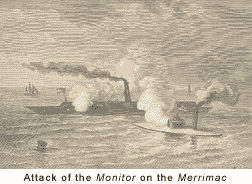
The ships engaged one another off Hampton Roads in a four-hour battle. The two ships passed each other repeatedly, firing at close range. Due to the poor training of both crews, much of the fire was to no effect. However, the Virginia’s gunners managed to hit the Monitor’s turret, largely disabling the vessel and wounding the captain. The Monitor was faster and more maneuverable, but was limited to one shot every seven or eight minutes.
After a couple of hours, the Monitor entered shallower waters into which the larger Virginia could not follow, in order to replenish the supply of ammunition in its turret. The Virginia took the opportunity to do further damage to the Minnesota, which was still aground. The Virginia itself then went aground at the same time that the Monitor was returning to the fray.
After some difficulty, the Virginia freed itself and headed for deeper water with the Monitor in pursuit. The Virginia attempted to ram the Monitor, but the missing iron prow diminished its effect and its smaller and nimbler opponent escaped with just a glancing blow. The Monitor again headed to shallow waters and the Virginia returned to the navy yard at Norfolk, bringing the battle to a close.
Both sides claimed victory. The North cited the withdrawal of the Virginia as evidence of their claim, while the South pointed to the disabling of the Monitor as evidence of victory. Many in the South believed that they had discovered a means of breaking the Northern blockade.
The engagement between these two ironclad ships was a watershed in naval warfare; the days of the wooden navies were numbered. These particular vessels did not engage each other again. The Virginia was scuttled by her crew when the Confederates abandoned Norfolk on May 11, 1862, and the Monitor sank in a gale off Cape Hatteras on December 31, 1862. However, the U.S. Navy recognized the value of the design and ordered 35 more ships of that class in 1862 and another 24 in 1863, although many of them were never completed.
Hampton Roads is the a channel through which the waters of three rivers, the James, Nansemond and Elizabeth, flow into Chesapeake Bay. On the northern side is Newport News and on the south are Norfolk and Portsmouth. On March 8, the Virginia ventured into these waters off Newport News, Virginia, and attacked a number of federal wooden vessels, destroying two and running another, the Minnesota, aground. The victory was not without cost to the Virginia, as the cast iron ram attached to the prow broke off when it rammed the Cumberland and two of its guns lost their muzzles. Following its triumph, the ironclad returned to port. If not halted, the Virginia would have destroyed the Union blockade in a matter of a few weeks.
That night, however, the Monitor reached Hampton Roads. On the following day, the Monitor, made its appearance. Never before had two ironclad vessels engaged in naval battle. The first two be built were France's Gloire and Britain's Warrior, built in 1859 and 1860, respectively, but they had never met in combat.
The ships engaged one another off Hampton Roads in a four-hour battle. The two ships passed each other repeatedly, firing at close range. Due to the poor training of both crews, much of the fire was to no effect. However, the Virginia’s gunners managed to hit the Monitor’s turret, largely disabling the vessel and wounding the captain. The Monitor was faster and more maneuverable, but was limited to one shot every seven or eight minutes.
After a couple of hours, the Monitor entered shallower waters into which the larger Virginia could not follow, in order to replenish the supply of ammunition in its turret. The Virginia took the opportunity to do further damage to the Minnesota, which was still aground. The Virginia itself then went aground at the same time that the Monitor was returning to the fray.
After some difficulty, the Virginia freed itself and headed for deeper water with the Monitor in pursuit. The Virginia attempted to ram the Monitor, but the missing iron prow diminished its effect and its smaller and nimbler opponent escaped with just a glancing blow. The Monitor again headed to shallow waters and the Virginia returned to the navy yard at Norfolk, bringing the battle to a close.
Both sides claimed victory. The North cited the withdrawal of the Virginia as evidence of their claim, while the South pointed to the disabling of the Monitor as evidence of victory. Many in the South believed that they had discovered a means of breaking the Northern blockade.
The engagement between these two ironclad ships was a watershed in naval warfare; the days of the wooden navies were numbered. These particular vessels did not engage each other again. The Virginia was scuttled by her crew when the Confederates abandoned Norfolk on May 11, 1862, and the Monitor sank in a gale off Cape Hatteras on December 31, 1862. However, the U.S. Navy recognized the value of the design and ordered 35 more ships of that class in 1862 and another 24 in 1863, although many of them were never completed.