
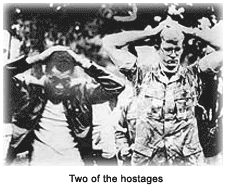
On November 4, 1979, an angry mob of some 300 to 500 "students" who called themselves "Imam's Disciples," laid siege to the American Embassy in Teheran, Iran, to capture and hold hostage 66 U.S. citizens and diplomats. Although women and African-Americans were released a short time later, 51 hostages remained imprisoned for 444 days with another individual released because of illness midway through the ordeal.
 Background
In 1953, the CIA staged "Operation Ajax," which unseated a duly elected prime minister, Mohammed Mossadegh, and reinstated Mohammed Reza Pahlavi as Iran's traditional and ancestral shah (monarch). The agreement stipulated that, in exchange for military and economic aid to Iran, there would a continuous supply of oil to the U.S.
Pahlavi, however, made some bad decisions. In the early 1960s, he promised his people increased personal freedoms and other social reforms. That didn't happen.
The shah's wealth grew, and he succumbed to the temptations of a luxurious western lifestyle, which angered the Iranian people, especially the religious right wing. The clergy began to preach long and loud against the shah and his queen, which stirred the masses to revolt. The shah was forced to abdicate the throne again and leave the country in January 1979.
The new ruler, Ayatollah Khomeini (pronounced Ko-MAY-nee), railed against the American government, denouncing it as the "Great Satan" and "Enemy of Islam."
When the shah was diagnosed with lymphoma, he requested to be treated by U.S. doctors. His request was granted. That was the proverbial "straw that broke the camel's back," and so enraged Iranians that a rabble stormed the American Embassy in Teheran.
Negotiations and other failures
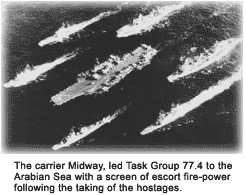
President Jimmy Carter immediately imposed economic sanctions and applied diplomatic pressure to expedite negotiations for the release of the hostages. First, Carter cancelled oil imports from Iran, then he expelled a number of Iranians from the U.S., followed by freezing about $8 billion of Iranian assets in the U.S.
At first, the Iranian government denied responsibility for the incident, but its failure to take action against the hostage-takers belied the denial. The Carter administration could do little other at that point than be patient and persistent.
 In February 1980, Iran issued a list of demands for the hostages' release. They included the Shah's return to Iran, a demand for an apology for American involvement in Iran, including the coup in 1953, and a promise to steer clear of Iranian affairs in the future. From the president's perspective, those demands could not be met.
In late April, Carter decided upon an ultra-secret mission to rescue the hostages. The operation, dubbed "Eagle Claw," seemed hastily thrown together by some, doomed to failure by others. Teheran was surrounded by 700 miles of desert on all sides; the city itself was crammed with four million people, and the embassy was huge and well guarded. It was to have been a two-night process requiring a minimum of six helicopters and a handful of C-130 cargo aircraft. To be on the safe side, eight copters were prepared for the mission.
Once inside Iranian borders and advancing under cloak of night to a predetermined staging area 50 miles outside Teheran in the Great Salt Desert, one "helo" had to turn back with operating problems. Another helo and then another succumbed to a swirling dust storm, known in that area as a "haboob." The mission was aborted.
Upon attempting their retreat, a miscommunication gave one helo the okay to lift off. The storm slammed the helo into a C-130, causing a gigantic fireball, killing three in the chopper and five in the airplane.
The aftermath, as Iranians eventually found and mockingly paraded the wreckage on worldwide television, was total humiliation for the United States, and spurred an onslaught of investigations and congressional hearings. Cyrus Vance, the secretary of state who had objected to the plan, resigned in protest. Back to square one.
"October Surprise"
Upon the death of the shah in July (which neutralized one demand) and the Iraqi invasion of Iran in September (necessitating weapons acquisition), Iran became more amenable to reopening negotiations for the hostages' release.
In the late stages of the presidential race with Ronald Reagan, Carter, given those new parameters, might have been able to bargain with the Iranians, which might have clinched the election for him. The 11th-hour heroics were dubbed an "October Surprise"* by the Reagan camp — something they did not want to see happen.
Allegations surfaced that William Casey, director of the Reagan campaign, and some CIA operatives, secretly met with Iranian officials in Europe to arrange for the hostages' release, but not until after the election. If true, some observers aver, dealing with a hostile foreign government to achieve a domestic administration's defeat would have been grounds for charges of treason.
Reagan won the election, partly because of the failure of the Carter administration to bring the hostages home. Within minutes of Reagan's inauguration, the hostages were released. Under Reagan, the Iran-Contra Affair completes this story.