
F. Scott Fitzgerald was an Irish-American Jazz Age novelist and short-story writer. Many regard him as one of the greatest American writers of the 20th century.
Early days
Born on September 24, 1896, Francis Scott Key Fitzgerald was born in St. Paul, Minnesota. He was the namesake and second cousin three times removed of the National Anthem`s author. His parents were Edward and Mary. As a child, Francis attended Saint Paul Academy.
Francis went on to Princeton University in 1913. He started to neglect his studies for his literary apprenticeship. He ended up on academic probation and was evidentaly unlikely to graduate, when he joined the army in 1917. He was convinced that he would die in the war, so he rapidly wrote a novel, The Romantic Egotist. Fitzgerald received a rejection letter from Charles Scribner’s & Son, praising the novel’s originality and asking that it be resubmitted when revised.
In June 1918, Fitzgerald was assigned to Camp Sheridan, near Montgomery, Alabama. There he met and fell in love with a celebrated belle, 18-year-old Zelda Sayre, the youngest daughter of an Alabama supreme court judge. Fitzgerald submitted a revised version of his novel, but it was rejected by Scribner`s a second time.
World War I ended just before he was to be sent overseas. Following his discharge in 1919, Fitzgerald went to New York City to find his fortune in order to marry. However, Zelda was unwilling to wait, so she broke off the engagement.
Fitzgerald quit his job in July 1919, then left New York to return to St. Paul and rewrite his novel as This Side of Paradise. It was finally accepted by editor Maxwell Perkins of Scribner`s in September.
Sudden fame
Fitzgerald would interrupt his work on novels to write money-making popular fiction throughout his life. The Saturday Evening Post became his best story market. “This Side of Paradise” was published in March 1920; its release made Fitzgerald famous overnight. A week later, he married Zelda Sayre in New York.
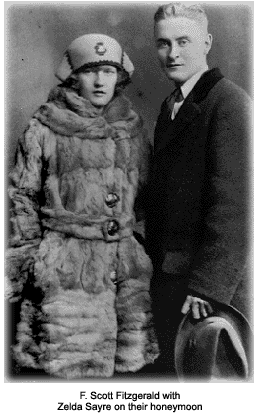 The couple lived in New York City, where he wrote his second novel, The Beautiful and the Dammed. Zelda became pregnant, so they relocated to St. Paul, where she gave birth to their only child, Frances Scott (Scottie) Fitzgerald; she was born in October 1921.
A rupture
The Fitzgeralds traveled to France in the Spring of 1924, where he wrote the Great Gatsby. The marriage was damaged when Zelda became involved with a French naval aviator. The Fitzgeralds remained in France until the end of 1926, alternating between Paris and the Riviera. During their time there, Zelda’s behavior became increasingly erratic. In 1930, she suffered the first of several mental breakdowns. She would spend the remainder of her life in and out of sanitoriums.
By 1931, The Great Depression was fully underway, and Fitzgerald wrote nostalgically about that lost time that went before in Echoes of the Jazz Age:
The couple lived in New York City, where he wrote his second novel, The Beautiful and the Dammed. Zelda became pregnant, so they relocated to St. Paul, where she gave birth to their only child, Frances Scott (Scottie) Fitzgerald; she was born in October 1921.
A rupture
The Fitzgeralds traveled to France in the Spring of 1924, where he wrote the Great Gatsby. The marriage was damaged when Zelda became involved with a French naval aviator. The Fitzgeralds remained in France until the end of 1926, alternating between Paris and the Riviera. During their time there, Zelda’s behavior became increasingly erratic. In 1930, she suffered the first of several mental breakdowns. She would spend the remainder of her life in and out of sanitoriums.
By 1931, The Great Depression was fully underway, and Fitzgerald wrote nostalgically about that lost time that went before in Echoes of the Jazz Age:
Now once more the belt is tight and we summon the proper expression of horror as we look back at our wasted youth. Sometimes, though, there is a ghostly rumble among the drums, an asthmatic whisper in the trombones that swings me back into the early twenties when we drank wood alcohol and every day in every way grew better and better, and there was a first abortive shortening of the skirts, and girls all looked alike in sweater dresses, and people you didn`t want to know said "Yes, we have no bananas," and it seemed only a question of a few years before the older people would step aside and let the world be run by those who saw things as they were — and it all seems rosy and romantic to us who were young then, because we will never feel quite so intensely about our surroundings any more.In 1934, Tender is the Night was published; critics regarded it as one of Fitzgerald`s best works. In 1937, he traveled to Hollywood, California, to become a screenwriter for MGM Studios. He was under contract with the studio until the end of 1938. While there, Fitzgerald fell in love with movie columnist Sheilah Graham, and moved into his lover`s apartment. The end game After his contract was up, Fitzgerald once again became a freelance writer, and started working on his last novel, The Love of the Last Tycoon. He wrote half of it. Fitzgerald had been an alcoholic since he was in college, and became notorious for heavy drinking during the 1920s. The abuse left him in poor health by the late 1930s. On December 21, 1940, F. Scott Fitzgerald collapsed and died of a heart attack in Sheilah Graham`s apartment. He was 44 years old. Zelda died in a fire at the Highland mental institution in Asheville, North Carolina, in 1948. The remains of F. Scott and Zelda Fitzgerald were originally buried in the Rockville (Maryland) Union Cemetery. With the permission and assistance of their child, Frances "Scottie" Fitzgerald Lanahan Smith, the Women`s Club of Rockville had their bodies moved to the family plot in Saint Mary`s Cemetery, in the same city. “The Love of the Last Tycoon” was finished by his friend, Edmund Wilson, and published in 1941 under the title, The Last Tycoon. In 1959, the movie Beloved Infidel, starring Gregory Peck and Deborah Kerr, portrayed Fitzgerald during his final years as a Hollywood scenarist.