
The Trilateral Commission* is the brain child of David Rockefeller (heavily influenced by the book entitled Between Two Ages written by an Establishment scholar, Professor Zbigniew Brzezinski of Columbia University), who sought to bring together a large group of private citizens from North America (U.S. and Canada, originally), Japan, and those countries aligned with the European Union, to address and solve issues of global importance.
It was created in 1973 amid world-wide tensions, including the final months of the Vietnam War, to acknowledge the decline in the United States’s role as the primary world policy maker and to create a broader-based body of individuals whose input would be valued and incorporated into a shared form of leadership.
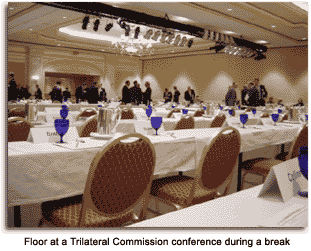 The approximately 400 members on the commission come from all walks of life, including academia, business, labor unions, and the media, as well as the public service sector, excluding current national cabinet ministers or secretaries. The method for rotating members off the panel and invitations offered to new members vary from group to group.
They meet once a year to pore over reports, called the Triangle Papers, assigned to a team of authors from each of the three geographical areas (hence, “trilateral”). Recent reports have such titles as The New Challenges to International, National, and Human Security Policy, The "Democracy Deficit" in the Global Economy: Enhancing the Legitimacy and Accountability of Global Institutions, and Globalization and Trilateral Labor Markets: Evidence and Implications.
Those reports are published, are available to the general public, and cost about $10 plus shipping and handling.
The annual meeting places rotate among the regions with the 2003 meeting held in Seoul, the 2004 meeting in Warsaw, and the 2005 meeting in Washington, D.C. The 2006 meeting is to be held in Tokyo.
The geographical boundaries have been increased to include Mexico in the North American Group. The Japan Group has added the better part of eastern and southeastern Asia, as well as Australia and New Zealand, and the name has been changed to Pacific Asian Group.
The approximately 400 members on the commission come from all walks of life, including academia, business, labor unions, and the media, as well as the public service sector, excluding current national cabinet ministers or secretaries. The method for rotating members off the panel and invitations offered to new members vary from group to group.
They meet once a year to pore over reports, called the Triangle Papers, assigned to a team of authors from each of the three geographical areas (hence, “trilateral”). Recent reports have such titles as The New Challenges to International, National, and Human Security Policy, The "Democracy Deficit" in the Global Economy: Enhancing the Legitimacy and Accountability of Global Institutions, and Globalization and Trilateral Labor Markets: Evidence and Implications.
Those reports are published, are available to the general public, and cost about $10 plus shipping and handling.
The annual meeting places rotate among the regions with the 2003 meeting held in Seoul, the 2004 meeting in Warsaw, and the 2005 meeting in Washington, D.C. The 2006 meeting is to be held in Tokyo.
The geographical boundaries have been increased to include Mexico in the North American Group. The Japan Group has added the better part of eastern and southeastern Asia, as well as Australia and New Zealand, and the name has been changed to Pacific Asian Group.